P91 Online UPS – Scalable Runtime Rack/Tower UPS (1000–3000VA, 120V)
1000–3000 VA | 120V | Online Double-Conversion UPS
Runtime-flexible online UPS engineered for distributed IT, AV, retail, and multi-site infrastructure requiring continuous power conditioning and scalable runtime.
1000–3000 VA · 120VAC · Online Double-Conversion UPS · Scalable Runtime
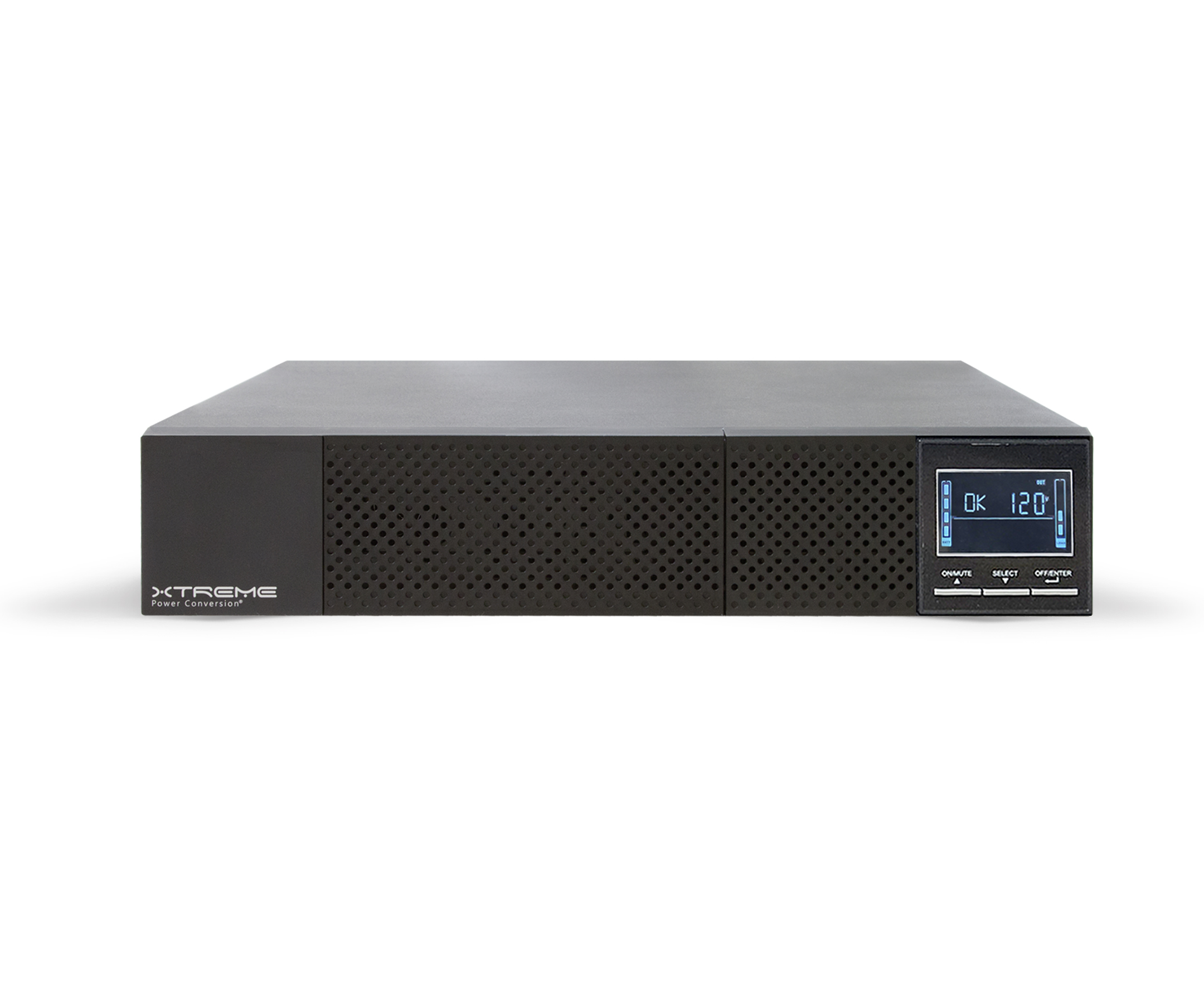
P91 online UPS with scalable runtime
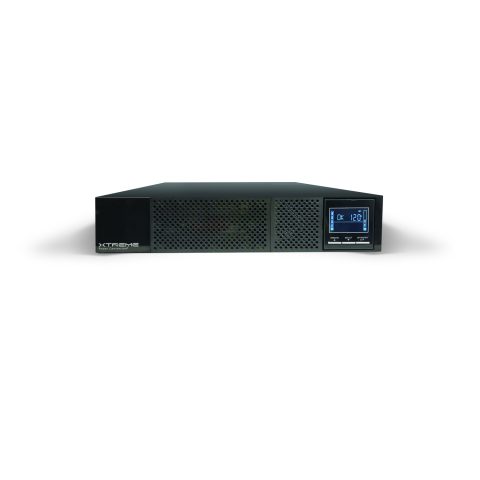
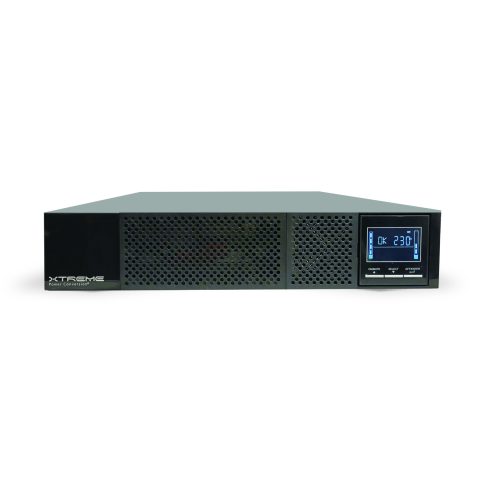
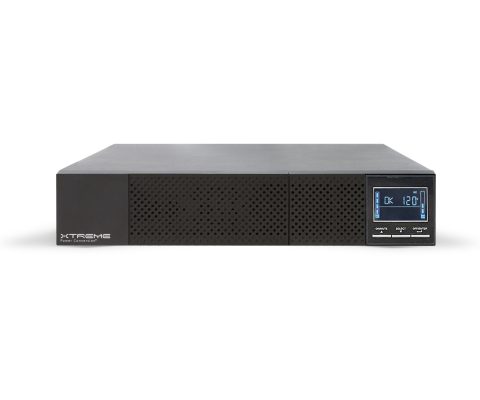
The P91 is a 120 V online double-conversion UPS built around a flexible VRLA battery architecture: internal batteries provide standard ride-through, while external battery packs extend runtime to match the application. Online topology continuously conditions incoming power with zero transfer time, and near-unity power factor (2U units) delivers maximum usable watts — all in a compact 2U rack/tower form factor (plus a 1U model). It is TAA compliant (made in Taiwan; UL / cUL listed) for federal, education, and public-sector procurement. For a lithium alternative, see the P91 Li.
Scalable-runtime online UPS architecture
Unlike fixed-runtime platforms, the P91 is built around a flexible battery architecture. Internal batteries provide standard ride-through, while external battery packs extend runtime based on application requirements — so runtime is engineered per deployment rather than constrained by internal capacity. Online double-conversion topology continuously conditions incoming power, protecting equipment from voltage disturbances, frequency variation, and electrical noise, and maintains zero transfer time during outages.
What the P91 delivers
Zero transfer time and continuous conditioning – pure sine output at ≤2% THD (linear) / ≤4% THD (non-linear) on 2U units.
Add up to seven matching packs (BP36 / BP48 / BP72) to take a rack from a few minutes of ride-through to over two hours — enough to outlast most outages or bridge to a generator — then recharge to 95% in under 3 hours.
2U units deliver near-unity output power factor — up to 1450 W from a 1500 VA frame, more usable watts than the 1350 W typical of competing online units.
An adjustable charger (up to 8 A) quickly recharges internal batteries and up to seven external packs; recharge to 95% in under 3 hours.
An optional XBDM bypass lets you service or swap the UPS without dropping the rack; after a full discharge, auto-restart brings the load back the moment utility returns — no truck roll to power-cycle.
Up to 98% ECO-mode efficiency, with optional Web/SNMP, Modbus, and relay/dry-contact monitoring cards.
The standard online UPS with scalable runtime
The P91 operates as the standard online UPS platform within distributed power architecture, providing conditioned power and scalable runtime at the rack or edge level. It is typically deployed in network closets, IDF/MDF environments, and multi-site infrastructure where runtime requirements vary but platform standardization is required.
Choose the P91 for online protection with VRLA runtime scaled per deployment and the lowest upfront cost; step up to lithium (P91 Li or J90) for reduced maintenance and longer lifecycle, or down to the line-interactive P80 / S71 where full-time conditioning isn’t required.
P91 (VRLA) or lithium?
The P91 is a VRLA-based platform optimized for runtime scalability and lower initial cost — ideal when extended-runtime requirements and budget outweigh lifecycle optimization. Lithium platforms such as the P91 Li and J90 prioritize lifecycle performance, reduced maintenance, and higher density. Both deliver full-time online conditioning; the choice comes down to runtime strategy and total cost of ownership.
P91-1500 vs the field at 1.5 kVA
The differences are clearest at a single capacity. Here is the P91-1500 against the 1.5 kVA online platforms it most often replaces, drawn from the per-model comparisons. The 1, 2, and 3 kVA matchups follow the same pattern — full breakdowns are in the comparison hub.
| Feature (1.5 kVA) | Xtreme P91-1500 | APC SRT1500XLA | Eaton 9PX1500RT | Vertiv GXT5-1500 |
|---|---|---|---|---|
| Topology | Online double-conversion | Online double-conversion | Online double-conversion | Online double-conversion |
| Real power | 1450 W | 1350 W | 1350 W | 1350 W |
| UPS depth | 16.1 in | 20.0 in | 17.7 in | 18.6 in |
| Warranty (electronics / battery) | 3 yr / 3 yr | 3 yr / 2 yr | 3-year | 3 yr / 3 yr |
| TAA compliant | Yes | No | No | Optional SKU |
The P91-1500 leads on usable watts (1450 W vs 1350 W), shallower depth (16.1 in — the smallest here), full 3-year battery warranty, and standard TAA compliance. Tripp Lite and WattBox matchups are in the hub. All P91 comparisons →
Five models, 1000–3000 VA
| Model | Capacity | Form factor | Receptacles | Dimensions (W×D×H) | Weight | Internal battery |
|---|---|---|---|---|---|---|
| P91c-1000 | 1000 VA / 800 W | 1U | (3) NEMA 5-15R | 17.2 × 17.8 × 1.7 in | 28 lbs | (4) 6V 290W |
| P91-1000 | 1000 VA / 1000 W | 2U | (8) NEMA 5-15R | 17.2 × 15.1 × 3.5 in | 25.5 lbs | (2) 12V 9Ah |
| P91-1500 | 1500 VA / 1450 W | 2U | (8) NEMA 5-15R | 17.2 × 15.1 × 3.5 in | 34.2 lbs | (3) 12V 9Ah |
| P91-2000 | 2000 VA / 1930 W | 2U | (8) NEMA 5-15/20R | 17.2 × 19.0 × 3.5 in | 43 lbs | (4) 12V 9Ah |
| P91-3000 | 3000 VA / 2880 W | 2U | (1) L5-30R + (6) 5-15/20R | 17.2 × 23.8 × 3.5 in | 60.6 lbs | (6) 12V 9Ah |
2U units offer near-unity power factor and selectable output (100/110/115/120/127 VAC). Rack depth is measured front bracket to unit panel; add 1 in for the front bezel. The P91c-1000 is a 1U model with internal batteries only.
Four things that separate the P91 at 1.5 kVA
External battery packs are not one of them. APC, Eaton and Vertiv all offer them in this class, so runtime expansion is table stakes rather than a differentiator. What actually separates the P91 is narrower and more useful.
- TAA compliant, every modelAPC and Eaton are not TAA compliant in this class. Vertiv requires a separate SKU. On a federal, state, education or healthcare contract that is binary: you are eligible to bid or you are not.
- 100 W more usable power1450 W at 1500 VA against 1350 W from all three competitors. A 0.97 power factor rather than 0.90, so more of the nameplate reaches the load.
- Shorter chassis15.1″ deep on the 1000 and 1500 VA models against 20.0″ for the APC, 18.6″ for the Vertiv and 17.7″ for the Eaton. That decides whether it fits a shallow or wall-mount rack.
- Three-year battery warrantyMatched by Vertiv, but APC covers the battery for two. On a distributed estate the battery is the part that gets replaced.
Scalable runtime with external battery packs
Internal batteries provide short ride-through; matching external packs scale runtime substantially. Each model shows runtime in minutes at 100% and 50% load, from internal-only out to seven packs.
| Load | Internal | +1 | +2 | +3 | +4 | +5 | +6 | +7 |
|---|---|---|---|---|---|---|---|---|
| P91c-1000 · 1000 VA · 1U · internal only | ||||||||
| 100% load | 8 | — | — | — | — | — | — | — |
| 50% load | 20 | — | — | — | — | — | — | — |
| P91-1000 · 1000 VA · internal only | ||||||||
| 100% load | 3 | — | — | — | — | — | — | — |
| 50% load | 10 | — | — | — | — | — | — | — |
| P91-1500 (BP36) · 1500 VA · BP36 packs | ||||||||
| 100% load | 3 | 17 | 33 | 51 | 72 | 93 | 112 | 128 |
| 50% load | 10 | 42 | 84 | 120 | 157 | 199 | 244 | 289 |
| P91-1500 (BP36E) · 1500 VA · BP36E packs (max 4) | ||||||||
| 100% load | 3 | 33 | 72 | 112 | 146 | — | — | — |
| 50% load | 10 | 84 | 157 | 244 | 339 | — | — | — |
| P91-2000 (BP48) · 2000 VA · BP48 packs | ||||||||
| 100% load | 3 | 17 | 33 | 51 | 72 | 93 | 112 | 128 |
| 50% load | 10 | 42 | 84 | 121 | 157 | 200 | 244 | 290 |
| P91-3000 (BP72) · 3000 VA · BP72 packs | ||||||||
| 100% load | 3 | 17 | 33 | 52 | 73 | 94 | 112 | 129 |
| 50% load | 10 | 42 | 84 | 121 | 158 | 201 | 246 | 292 |
Estimated minutes; values vary with battery age, temperature, and load profile. A maximum of seven packs is supported on the P91-1500 / 2000 / 3000 (the high-capacity BP36E pack up to four). The P91c-1000 and P91-1000 use internal batteries only. Size it with the UPS selector →
Built for distributed infrastructure
The P91 is deployed where continuous conditioning and runtime flexibility are required — network closets and IT infrastructure, AV systems, retail and restaurant environments, education facilities, and multi-site commercial installations.
Conditioned power and scalable runtime for switching and routing.
Standardized online protection for IDF/MDF and structured cabling.
Clean, zero-transfer power for AV and media racks.
Reliable ride-through for POS and back-office systems.
Conditioned power for classroom and campus IT.
One platform with runtime engineered per location.
Capacity guidance: 1000 VA for small network and AV systems; 1500 VA for distributed IT; 2000 VA for network racks and AV infrastructure; 3000 VA for higher-density distributed systems. Runtime is defined by battery configuration and load.
P91 specifications
| Specification | Detail |
|---|---|
| Topology | Online double-conversion |
| Capacity | 1000 / 1000 / 1500 / 2000 / 3000 VA (800–2880 W) |
| Output power factor | Near-unity (up to 1.0 on 2U units) |
| Input | 55–150 VAC (load dependent), 50/60 Hz auto-sensing |
| Output voltage | 120 VAC nominal; 100 / 110 / 115 / 127 VAC selectable (2U) |
| Output waveform | Pure sine wave; 2U ≤2% / ≤4% THD, 1U ≤3% / ≤5% THD (linear / non-linear) |
| Output frequency | 50/60 Hz (±0.1 Hz on 2U, ±0.3 Hz on 1U) |
| Efficiency | Up to 98% (ECO mode) / 94% (online mode) |
| Battery | Sealed, maintenance-free VRLA (lead-acid); internal + external pack expansion |
| External battery packs | BP36 / BP36E / BP48 / BP72; up to 7 packs (1500 / 2000 / 3000) |
| Recharge | <3 h to 95% (2U, 2 A); <9 h to 90% (1U) |
| Charger current | Up to 8 A adjustable (2U); 1 A (1U) |
| Form factor | 2U rack / tower (P91c-1000 is 1U) |
| Operating temperature | 32–104°F (0–40°C) |
| Altitude | Up to 6,500 ft |
| Communications | RS-232 (2U), USB, EPO; intelligent slot (Web/SNMP, relay/dry contact, Modbus) |
| Approvals | UL, cUL, RoHS, FCC Class A/B; TAA compliant |
| Load protection policy | $50,000 connected-equipment protection (USA and Canada) |
| Warranty | 3-year electronics & battery (USA & Canada); optional 5-year |
| Included | ViewPower software, front brackets, tower pedestals, user manual |
| Options | Bypass distribution (XBDM), power distribution (XPDU), matching battery packs, 4-post rail kit, 2-post shelf kit, wall-mount bracket (2U) |
Specifications from the P91 1-3kVA datasheet (Rev 4/6/20). Capacities are based on the highest selectable voltage; some models derate at lower voltages. For 230 V online models, reference the P91g.
Pair with an XPD-IT for isolated online power
Online double-conversion rebuilds the output waveform, which addresses nine of the ten common power problems. The tenth is common mode noise, measured between ground and either neutral or line, and no amount of conversion reaches it — that takes galvanic separation.
Where the load is sensitive enough to see ground-referenced interference in its output rather than in its power — analytical instruments, medical imaging, AV racks with a ground loop — add an XPD-IT isolation PDU downstream of the P91. The TX91 builds the same transformer into the UPS, but starts at 3.8 kVA; below that a pair covers it.
Matched pairings at 120 V
| UPS | Real power | Isolation PDU | Capacity |
|---|---|---|---|
| P91-1500 | 1450 W | XPD-IT15LV | 1.5 kW |
| P91-1.5kLi | 1350 W | XPD-IT15LV | 1.5 kW |
| P91-2000 | 1930 W | XPD-IT20LV | 2.0 kW |
| P91-2kLi | 1800 W | XPD-IT20LV | 2.0 kW |
| P91-3000 | 2880 W | (2) XPD-IT15LV | 3.0 kW combined |
Size the transformer to the load, not to the UPS nameplate. If the instrument draws 900 W, an XPD-IT15LV is right whichever P91 sits above it. Wire the PDU downstream of the UPS and plug the equipment directly into it — isolation is established at the transformer output and a power strip after it undoes most of the benefit.
Above 2 kW, two transformers. No single LV isolation PDU exceeds 2.0 kW, so a P91-3000 at 2880 W is covered by a pair of XPD-IT15LV units with the load split between them. Read the caution below first. Where the whole load has to sit behind one transformer, specify a TX91 instead. Full sizing and wiring detail is on the UPS with isolation transformer page.
Two transformers means two ground references. Each one establishes its own derived neutral-to-ground bond, so equipment on one that is signal-connected to equipment on the other has a potential difference between them — a new ground loop, which is the condition isolation was installed to remove. Split only where the two load groups have no audio, video, network or serial cabling running between them.
Power distribution and monitoring
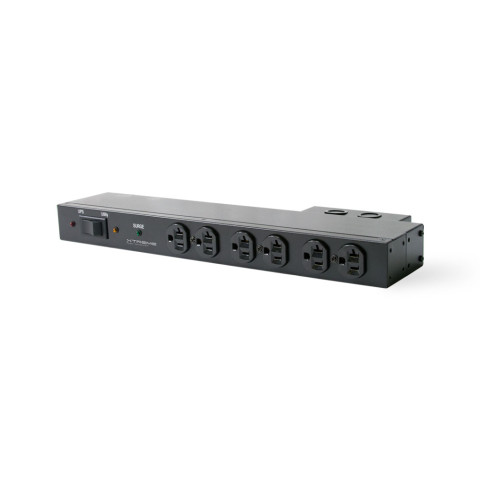
The P91 is commonly deployed alongside intelligent power distribution such as the Xtreme Power SPDU, enabling outlet-level monitoring, remote reboot, and standardized rack power architecture across distributed environments. An optional XPDU power-distribution unit and XBDM bypass module support maintenance and scaling without dropping the load.
P91 online UPS — frequently asked questions
How many power problems does the P91 protect against?
Nine of the ten. Online double-conversion rebuilds the output waveform from DC, so it corrects voltage, noise, frequency, transients and harmonic distortion, and there is no transfer time because the load never leaves the inverter. The tenth, common mode noise, requires galvanic separation and is addressed by adding an isolation transformer downstream or by specifying a TX91.
What is the difference between the P91 and the P80?
Topology. The P80 is line interactive, which corrects voltage using transformer taps and covers five of the ten power problems. The P91 is online double-conversion, which rebuilds the waveform continuously and covers nine, with zero transfer time. Choose the P91 when the load cannot tolerate a transfer, when the site runs from a generator, or when noise and harmonics are the complaint rather than voltage level.
Can the P91 run from a generator?
Yes, and it is a common reason to specify one. Engine generators vary output frequency as load changes, and a line-interactive or standby UPS will often reject that as out of tolerance and run the load from battery until it is exhausted. The P91 regenerates its output frequency, so it accepts generator power and rides through the variation.
How do I extend the runtime?
With matching external battery packs. That is the platform’s defining feature: runtime scales after installation without replacing the UPS. Sizing depends on the load and the target runtime, so send us the watts and the duration and we will confirm the pack count.
Should I choose the P91 or the lithium P91 Li?
The VRLA P91 has a lower purchase price. The P91 Li adds LiFePO4 chemistry with far longer battery service life, faster recharge, tolerance of elevated ambient temperature, and a longer warranty. Across a distributed deployment where battery replacement means a site visit, the lithium version usually costs less over the life of the install even though it costs more to buy.
How do I size a P91?
On watts, not VA. Add up the nameplate wattage of everything you intend to protect and leave headroom. The P91 runs an unusually high real power figure for its VA rating, 1450 W at 1500 VA, so you get more usable capacity per VA than from platforms rated at 1350 W in the same class.
Is the P91 TAA compliant?
Yes. That is a meaningful difference in this class: among the competing 1.5 kVA online platforms, TAA eligibility is typically absent or a separate SKU, which means a buyer on a federal, state, education or healthcare contract often cannot use the model they wanted.
What accessories are available?
External battery packs for runtime, an XBDM bypass distribution module for maintenance without dropping the load, an XPDU power distribution unit, the SPDU smart PDU for outlet-level monitoring and remote reboot, rail and shelf kits, tower pedestals, a 2U wall-mount bracket, and an XPD-IT isolation PDU where the load needs galvanic separation.
Documents and related links
Plan your P91 deployment
Talk to an Xtreme Power specialist about capacity and runtime sizing, external battery-pack configuration, XBDM bypass and distribution, TAA procurement, and standardizing one online platform across multiple sites.