
UPS for IDF and MDF Closets
A switch going down in an IDF closet takes an entire floor offline: every IP phone, access point, camera, and workstation on that circuit. A PoE switch that loses power mid-session doesn’t just drop connections; it drops every powered device on every port. The right UPS, sized and placed correctly for the closet, prevents both.
Find the right UPS for your IDF or MDF closet
| Environment | Typical load | Recommended UPS | Typical runtime | Why |
|---|---|---|---|---|
| Wall-mounted devices, no cabinet | 1-2 switches, WAP | J60 Series · 350VA, 600VA LithiumView product → | 5-15 min | Ultra-compact fanless UPS mounts directly to wall or backboard alongside equipment. No cabinet required. Fanless: silent in any environment. |
| Shallow wall-mounted cabinet | Small switch, gateway | J60C Series · 600VA LithiumView product → | 5-15 min | Short-depth 1U form factor fits shallow enclosures where standard rack UPS cannot. The J60C was designed specifically for this installation constraint. |
| Standard IDF rack | Switch stack, firewall, WAPs | J90 Series · 1-3kVA LithiumView product → | 5-15 min | 1U online UPS with switchable outlets and remote reboot. High-temperature operation. Extended battery packs on the 2 and 3 kVA models extend runtime to hours. Best choice where reliability and remote management matter most. |
| Large IDF or small MDF | Multiple switches, servers | M90S Series Modular StandardView product → | 10-30 min | Scalable modular protection: add power and battery modules as load grows, with N+1 capability. Starts smaller than a core-room build; 120/240V single-phase. |
| MDF or core network room | Core switches, servers, high load | M90S Series Modular StandardView product → | 15-60 min | Scalable modular architecture for building-level protection. N+1 redundancy capability. Right choice where the MDF serves a full campus or building infrastructure. |
UPS for every IDF and MDF configuration
IDF and MDF closets present the same core challenge in different form factors: limited space, often elevated ambient temperatures, and limited on-site access for maintenance. These platforms cover the full range of configurations.
One case removes the closet entirely. Where a property has moved to passive optical LAN, unpowered optical splitters replace the floor switch and the protection problem moves out to an optical network terminal in each zone box or riser. Sizing a UPS for an ONT →
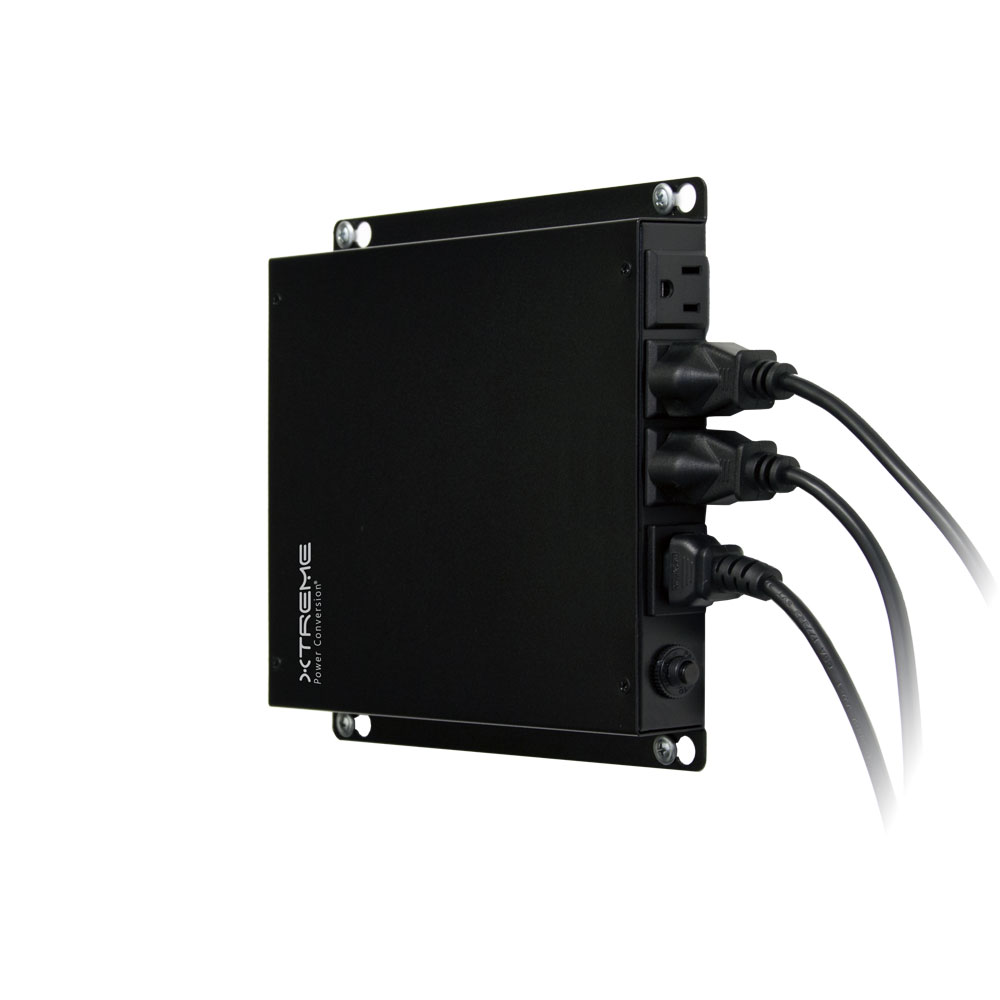
The J60 is designed for IDF installations where there’s no cabinet: a switch mounted on a backboard, a WAP controller on a wall. Wall, DIN rail, or flat mount. Fanless and silent. LiFePO₄ battery eliminates replacement in locations where access is inconvenient or maintenance calls are expensive.
View J60 →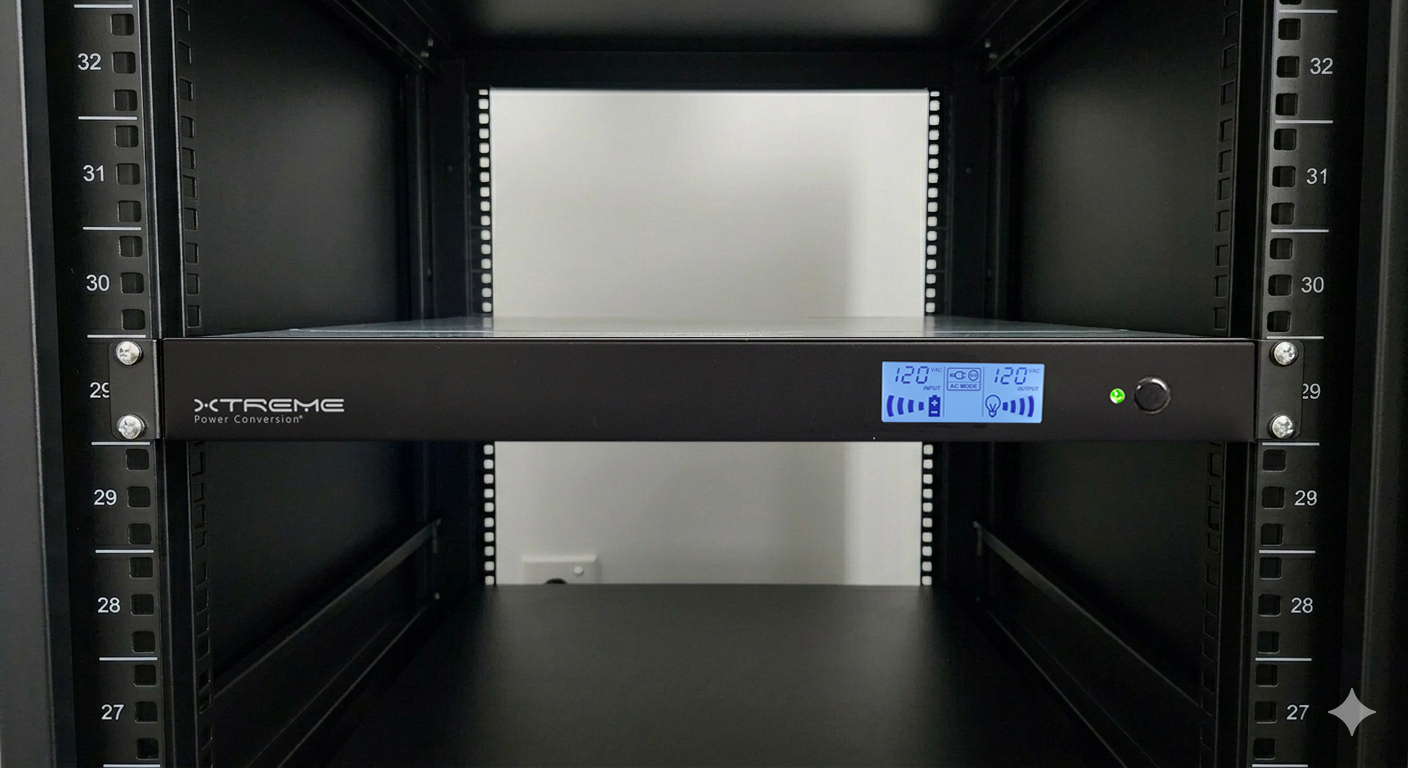
Short-depth 1U form factor for shallow wall-mount cabinets and structured wiring enclosures. The most common IDF installation constraint, that a standard rack UPS is too deep, is exactly what the J60C solves. Same LiFePO₄ chemistry as the J60. Rack or wall mount.
View J60C →
Continuous online power conditioning for network switches, firewalls, and communications gear. Switchable outlets enable remote reboot of individual devices without dispatching a technician. High-temperature operation suits non-conditioned IDF locations. Extended battery packs on the 2 kVA and 3 kVA models stretch runtime from minutes to hours. 1U rack or wall mount. 120V.
View J90 →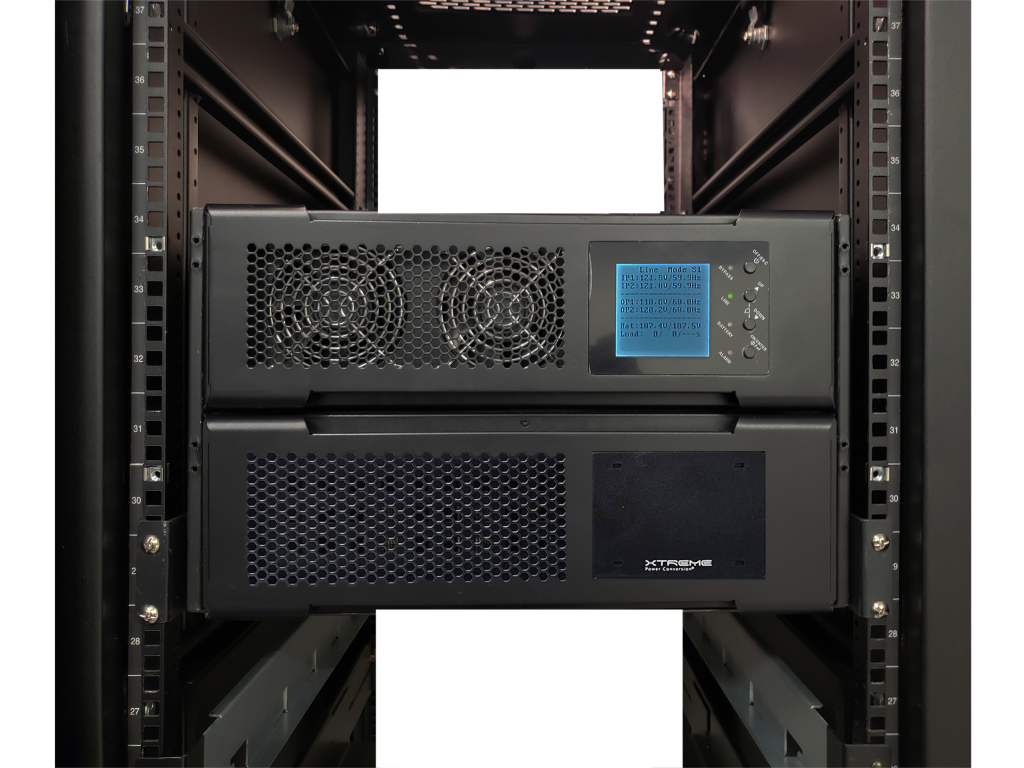
For MDF and core network rooms serving a full building or campus. Hot-swappable power and battery modules with N+1 redundancy. Single-phase 120/240V, lead-acid. Scales from 6 to 48 kW across the M90S-2S / 4S / 6S / 12S family.
View M90S →Protecting wall-mounted racks and shallow cabinets
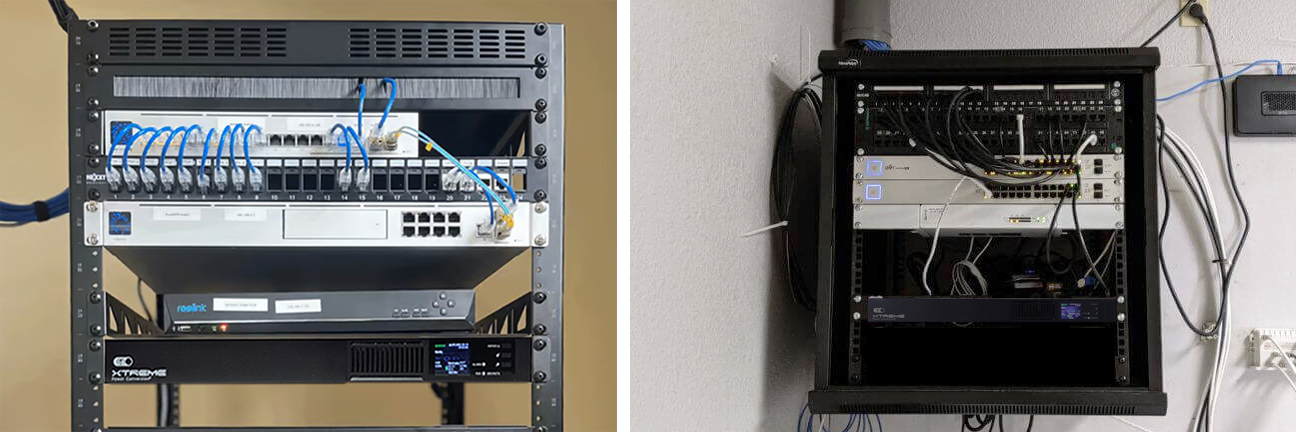
Many IDF closets use wall-mounted two-post racks or shallow cabinets rather than full-depth four-post racks. Standard rack UPS systems are typically 16-20 inches deep, too deep for most shallow enclosures. The J60C is built for exactly this constraint.
Lithium or lead-acid for the closet
IDF and MDF closets are often non-conditioned and distributed. A campus with 20 locations means 20 battery-replacement events every few years. That favors the LiFePO₄ batteries in the J60, J60C, and J90: up to 15-year service life, reliable 50°C operation, and no recurring truck rolls for battery swaps. The lead-acid M90S stays the budget-driven option for larger modular loads.
Full comparison across lifecycle, temperature, and cost: Lithium UPS vs lead-acid UPS →
Smart PDU: outlet-level control for distributed closets
For IDF and MDF deployments where remote management is a priority, pairing a UPS with a Smart PDU provides both battery backup and outlet-level control. The UPS protects against outages; the Smart PDU lets you reboot individual devices, monitor load per outlet, and manage distributed equipment without an on-site visit.

Plan your IDF and MDF power strategy
UPS sizing, model selection, runtime planning, and deployment strategy for network closets across enterprise, education, healthcare, and distributed infrastructure.