

Li90 Integrated 3-Phase Lithium UPS (10–30 kVA)
10–30 kVA | 208/120V Three-Phase | Online Double Conversion
Integrated lithium UPS platform engineered to modernize electrical room infrastructure by eliminating external batteries, reducing maintenance, and improving long-term performance predictability.
10–30 kVA · 208/120V Three-Phase · Online Double-Conversion · LiFePO₄
Li90 — Integrated Three-Phase Lithium UPS
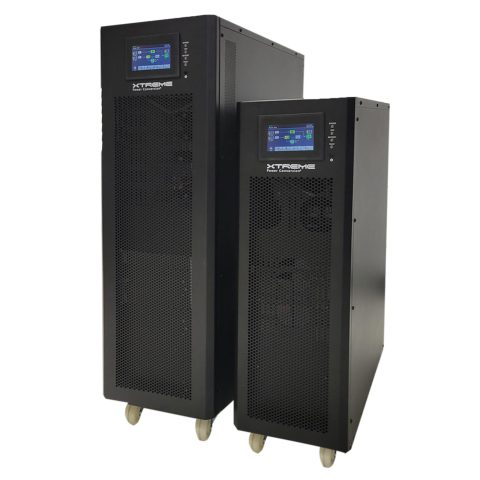
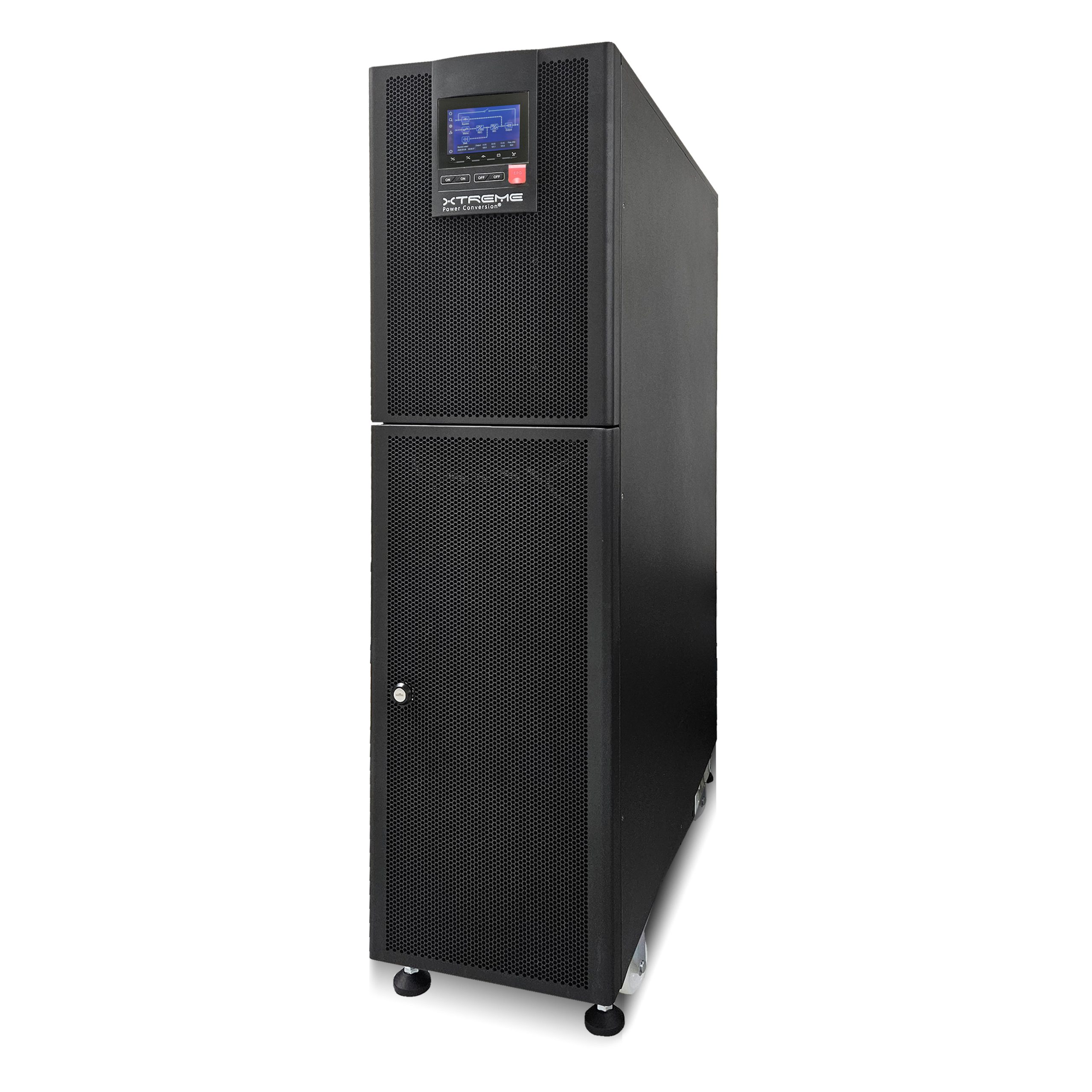
The Xtreme Power Li90 is an integrated lithium three-phase UPS engineered to modernize electrical-room infrastructure — eliminating external batteries, reducing maintenance, and improving long-term performance predictability. It replaces legacy architectures that rely on external battery cabinets with a compact, single-cabinet system optimized for lifecycle performance and simplified deployment.
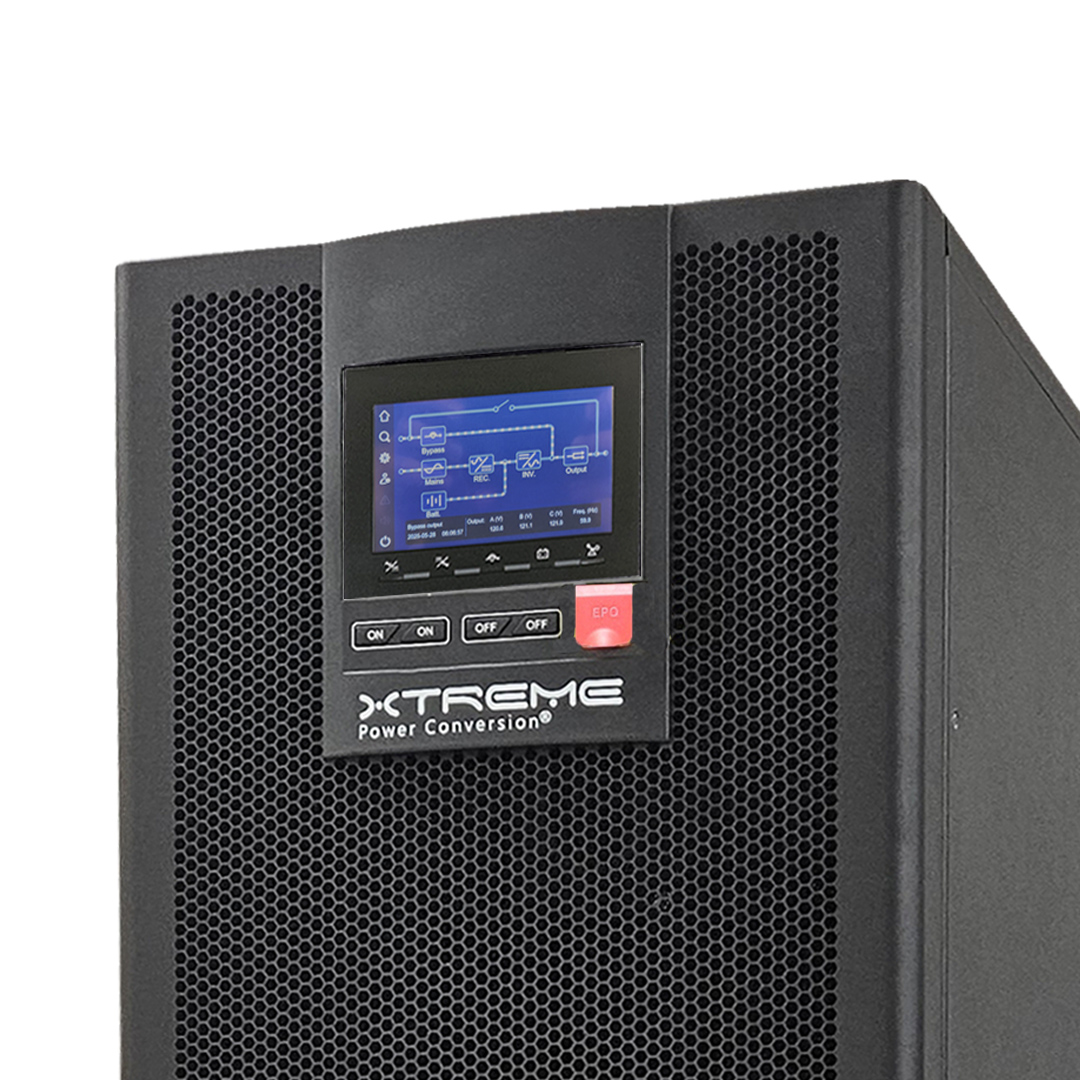
Lithium energy storage, built into the cabinet
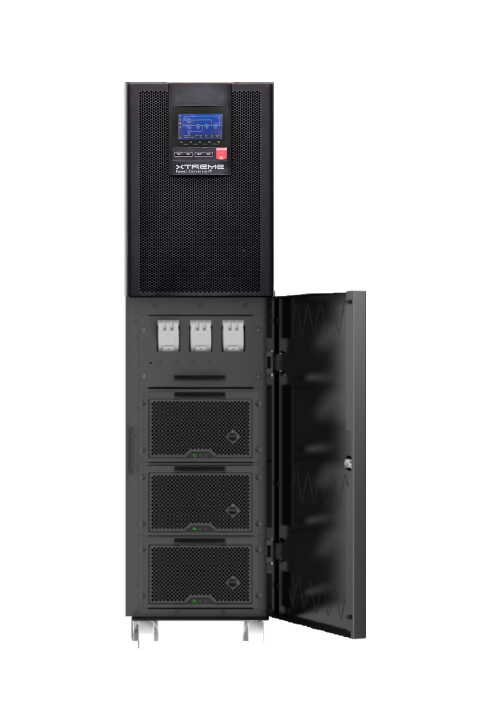
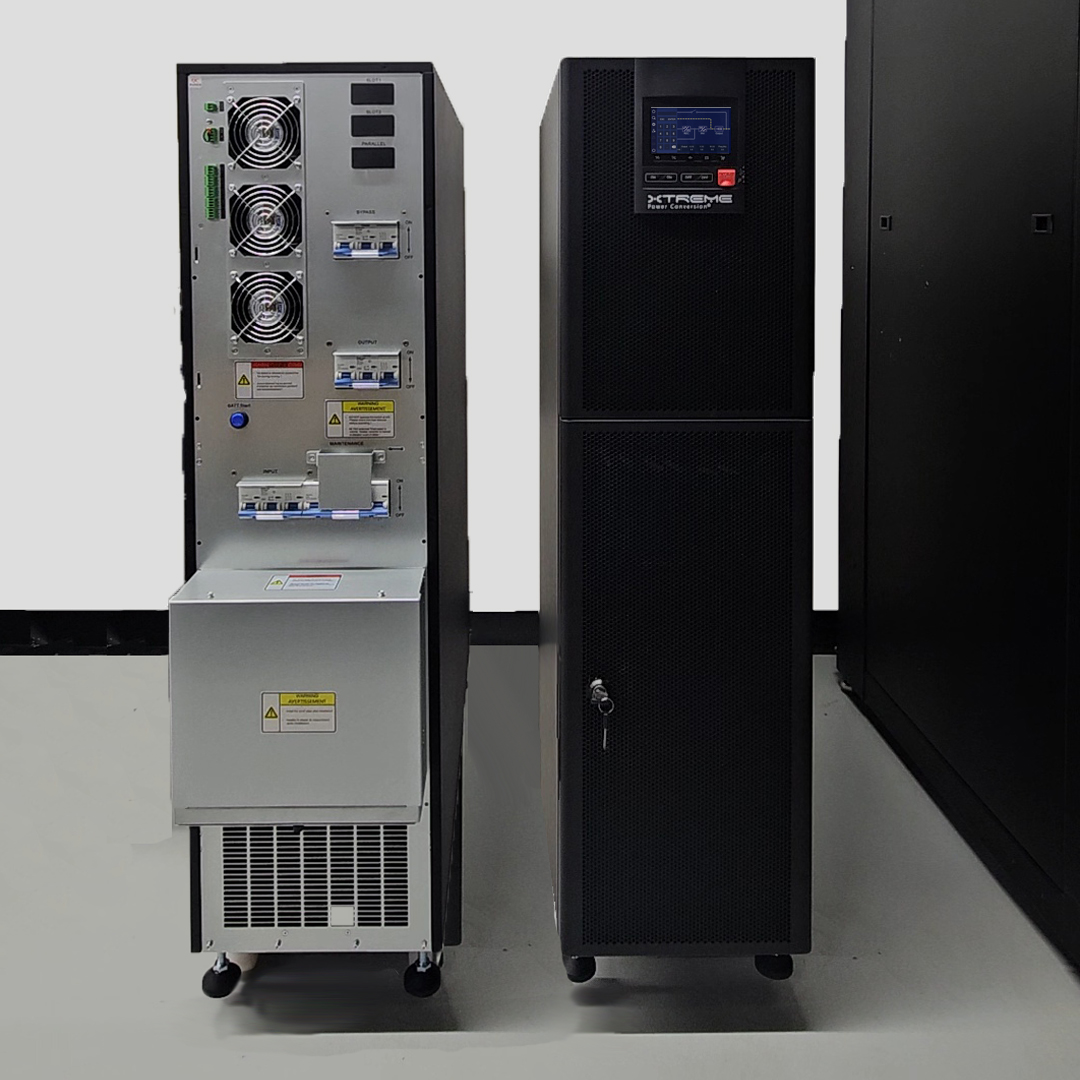
The Li90 integrates lithium batteries directly within the UPS cabinet. Traditional three-phase UPS rely on external VRLA battery cabinets — increasing footprint, installation complexity, and ongoing maintenance. The Li90 consolidates the UPS and energy storage into a single system, reducing installation complexity, improving service accessibility, and enabling higher density within electrical rooms. It aligns the UPS with long-term infrastructure planning by removing periodic battery replacement as a recurring event. Unity power factor (1.0) delivers full usable capacity — kVA = kW — across all three ratings, with online double-conversion protection and an integrated maintenance bypass for safe on-site service.
Engineered for demanding environments
Up to 15 years of service life and 3,000–5,000 discharge cycles — about three times the life of VRLA.
Battery modules replace fast, with no system downtime — service the battery while the load stays protected.
Just 12.6 inches wide — a single cabinet ideal for edge, automation, and retrofit installations where electrical-room space is tight.
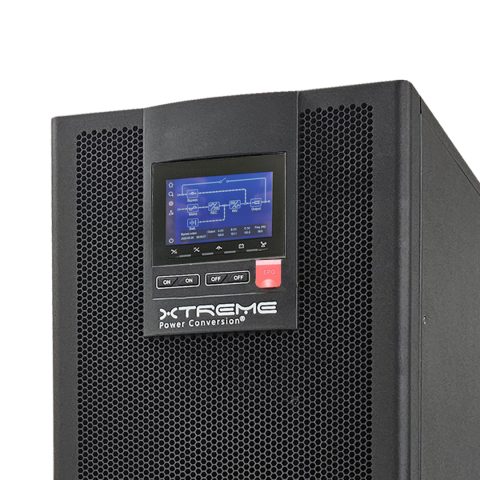
Full-color touchscreen LCD with single-line mimic diagram and event logging for clear local status and diagnostics.
110% for 60 minutes and 150% for 1 minute — built for inrush, surges, and motor/startup loads.
Safe, on-site service without shutting the system down. External maintenance bypass available as an option.
Self-cleaning fans help keep the cabinet clear in dusty environments and extend service life.
Coated boards add protection in industrial and high-humidity environments.
Single or dual input (rectifier & bypass). RS485, USB, EPO, 1 input + 5 output dry contacts, 2 card slots, optional SNMP.
Three ratings, one slim platform
| Battery modules | 1 module (1–3 selectable) |
| Enclosure weight | 207 lb |
| Audible noise | <63 dB |
| Battery modules | 2 modules (2–3 selectable) |
| Enclosure weight | 227 lb |
| Audible noise | <63 dB |
| Battery modules | 3 modules |
| Enclosure weight | 243 lb |
| Audible noise | <68 dB |
Shared across all models: 12.6″ W × 35.2″ D × 49.2″ H (add 3.9″ depth for terminal-block cover). LiFePO₄ module = 50 Ah / 57.6 V / 2,880 Wh, 80 lb each. Charge current 2–40 A selectable (20 A default). Full system weight = enclosure weight + 80 lb per installed module.
Internal-battery runtime by configuration
Approximate runtimes in minutes, by installed battery-module count (rows) and load in kW (columns). No external battery cabinet required.
| Battery modules ↓ / Load kW → | 2.5 | 5 | 7.5 | 10 | 12.5 | 15 | 17.5 | 20 | 22.5 | 25 | 27.5 | 30 |
|---|---|---|---|---|---|---|---|---|---|---|---|---|
| 1 module | 58 | 29 | 22 | 15 | — | — | — | — | — | — | — | — |
| 2 modules | 116 | 58 | 44 | 30 | 25 | 20 | 18 | 15 | — | — | — | — |
| 3 modules | 174 | 87 | 66 | 45 | 38 | 30 | 26 | 22 | 20 | 18 | 16 | 15 |
Runtimes in approximate minutes. Actual runtime varies with battery age, temperature, and load profile. UPS sizing tool →
Remove battery replacement from the operating model
The Li90 reduces long-term operational burden by eliminating the periodic battery-replacement cycles associated with VRLA systems. LiFePO₄ batteries provide a much longer service life — up to 15 years under ideal operating conditions — improving predictability, reducing service interventions, and aligning UPS infrastructure with long-term facility-planning cycles. By removing external battery systems and extending battery life, the Li90 minimizes both planned and unplanned maintenance events. Replacing a VRLA three-phase UPS? The Li90 eliminates external battery cabinets, the 3–5-year replacement cycle, and the floor space they consume.
A modernization alternative to legacy three-phase UPS
The Li90 is commonly evaluated against platforms such as the Eaton 93PM, APC Galaxy VS, and Vertiv Liebert EXS when modernizing facility UPS infrastructure. The key distinction is architectural: most competing platforms rely on external or modular battery systems, increasing footprint and lifecycle maintenance, while the Li90 integrates lithium batteries within a single cabinet for a more compact deployment with reduced maintenance exposure. It is frequently deployed in replacement scenarios — Eaton 9355 systems nearing end-of-life battery cycles, 93PM installations with rising service complexity, APC Galaxy VS systems using external battery cabinets, and Vertiv Liebert EXS platforms in space-constrained rooms.
View Li90 comparisons →
Where the Li90 fits in the Xtreme Power lineup
The Li90 is the facility-level UPS in a coordinated architecture, selected when a centralized topology is preferred but legacy battery-cabinet requirements are no longer acceptable. For scalable redundancy or capacity expansion, consider the modular M90U; for rack-level distributed protection, the J90; and within the three-phase portfolio, the E91 covers traditional VRLA-based systems.
Where the Li90 is deployed
The Li90 is deployed in facilities undergoing electrical-infrastructure modernization where space, maintenance, and lifecycle cost are primary considerations: electrical-room upgrades and battery-replacement-avoidance programs, data-center and edge / distributed environments, healthcare and telecom infrastructure, and industrial automation and manufacturing facilities.
| 10 kVA | Smaller distributed loads and industrial control environments |
| 20 kVA | Mixed-use infrastructure such as healthcare and telecommunications |
| 30 kVA | Centralized facility loads where higher-capacity consolidation is required |
Runtime should be evaluated based on outage duration, generator coordination, and overall continuity strategy. Use the UPS sizing tool →
Li90 specifications
| Specification | Detail |
|---|---|
| Topology | Online double-conversion |
| Capacity | 10 / 20 / 30 kVA — unity power factor (kVA = kW) |
| Voltage | 208/220V three-phase (3W+N+G); output 190/200/208/220V ±1% L-L, default 208V |
| Input range | 120–156V linear derating, 156–268V at full load; 40–70 Hz |
| Battery | Integrated LiFePO₄ modules — 50 Ah / 57.6 V / 2,880 Wh each (80 lb per module) |
| Battery quantity | Li90-10K: 1 (1–3 selectable) · 20K: 2 (2–3) · 30K: 3 |
| Charge current | 2–40 A selectable (20 A default) |
| Overload (online) | <105% continuous · <110% 60 min · <130% 10 min · <150% 1 min · <200% 200 ms |
| Efficiency | Up to 94.5% online / 99% ECO mode |
| Interface | 4.3-inch full-color touchscreen with single-line mimic and event logging |
| Bypass | Integrated maintenance bypass (external maintenance bypass optional) |
| Communications | RS485, USB, EPO, dry contacts (1 in / 5 out), 2 card slots, optional SNMP |
| Dimensions (W×D×H) | 12.6 × 35.2 × 49.2 in (add 3.9 in depth for terminal-block cover) |
| Enclosure weight | 207 / 227 / 243 lb (10 / 20 / 30K) + 80 lb per battery module |
| Operating temp | −5 °C to 50 °C (23–122 °F); derated above 40 °C (104 °F) |
| Audible noise | <63 dB (10/20K) · <68 dB (30K) |
| Humidity / altitude | 0–95% non-condensing; up to 6,500 ft |
| Certifications | UL 1778, UL 1973, UN 38.3 |
| Warranty | Startup + 2-year on-site UPS; 5-year battery (USA) — 5-yr term up to 40 °C ambient, 2-yr for 40–50 °C |
Certifications
Documentation
Modernize your UPS infrastructure
Xtreme Power Conversion supports facility engineers, electrical consultants, and infrastructure planners with improved density, reduced maintenance, and predictable lifecycle performance.
Related guides and comparisons
| MODEL NUMBER | Li90-10K | Li90-20K | Li90-30K | |
| CAPACITY | Power rating | 10kVA/10kW | 20kVA/20kW | 30kVA/30kW |
| INPUT | Voltage / Range | 208/220 (3W+N+G) / 120V-156V linear derating, 156V-268V at full load | ||
| Frequency | 40–70Hz | |||
| OUTPUT | Voltage / Frequency | 190/200/208/220±1% (L-L) ±1% (default is 208V) / 50/60±0.1 (battery mode) | ||
| Oveload Capacity – Online Mode | <105% Continuous, <110% 60 min, <130% 10 min, <150% 1 min, <200% 200 ms | |||
| Efficiency | up to 94.5% online mode or 99% ECO mode | |||
| INTERNAL BATTERY | ||||
| Battery type | Lithium Iron Phosphate (LFP) Module | |||
| Modular Battery Capacity | 50AH / 57.6V / 2880Wh | |||
| Battery Quantity | 1 Module (1-3 Selectable) | 2 Module (2-3 Selectable) | 3 Modules | |
| Charge Current | 2A – 40A Selectable (20A default) | |||
| PHYSICAL | Dimensions (W x D x H) | 12.6″W x 35.2″D x 49.2″H* | ||
| Enclosure Weight | 207 lbs | 227 lbs | 243 lbs | |
| Battery Weight | 80 lbs per module | |||
| ENVIRONMENT | Operating temperature | 23F-122F (-5C-50C) Derates above 104F (40C) | ||
| Audible noise | <63dB (10, 20kW), <68dB (30kW) | |||
| Relative humidity | 0 – 95% (non condensing) | |||
| Altitude | 6,500 ft above sea level | |||
| APPROVALS | UL1778, UL38.3, UL1973 | |||
| WARRANTY | 5-year battery warranty, 2-year on-site UPS warranty | |||
| COMMUNICATIONS INTERFACE | RS485, EPO, Dry contact (1 input,5 output)+2 Slots+SNMP (optional) | |||
| INCLUDED IN BOX | User manual, USB cable | |||
| AVAILABLE OPTIONS | External maintenance bypass | |||