

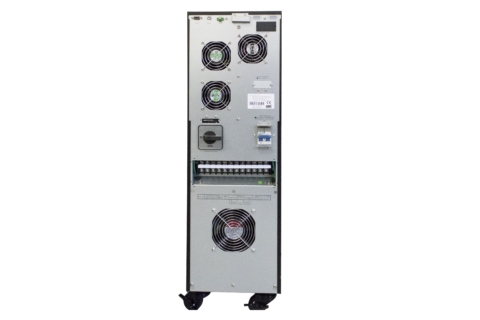


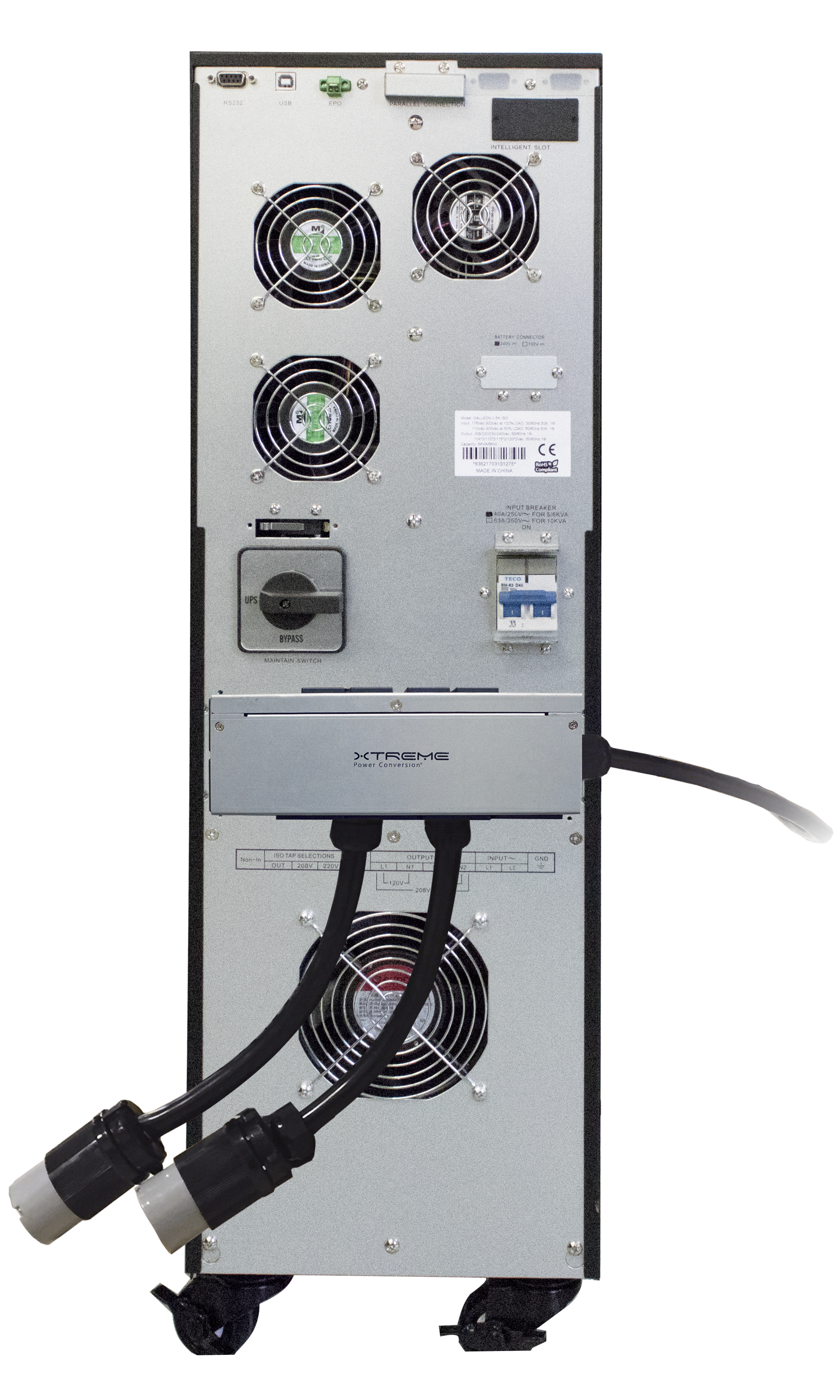
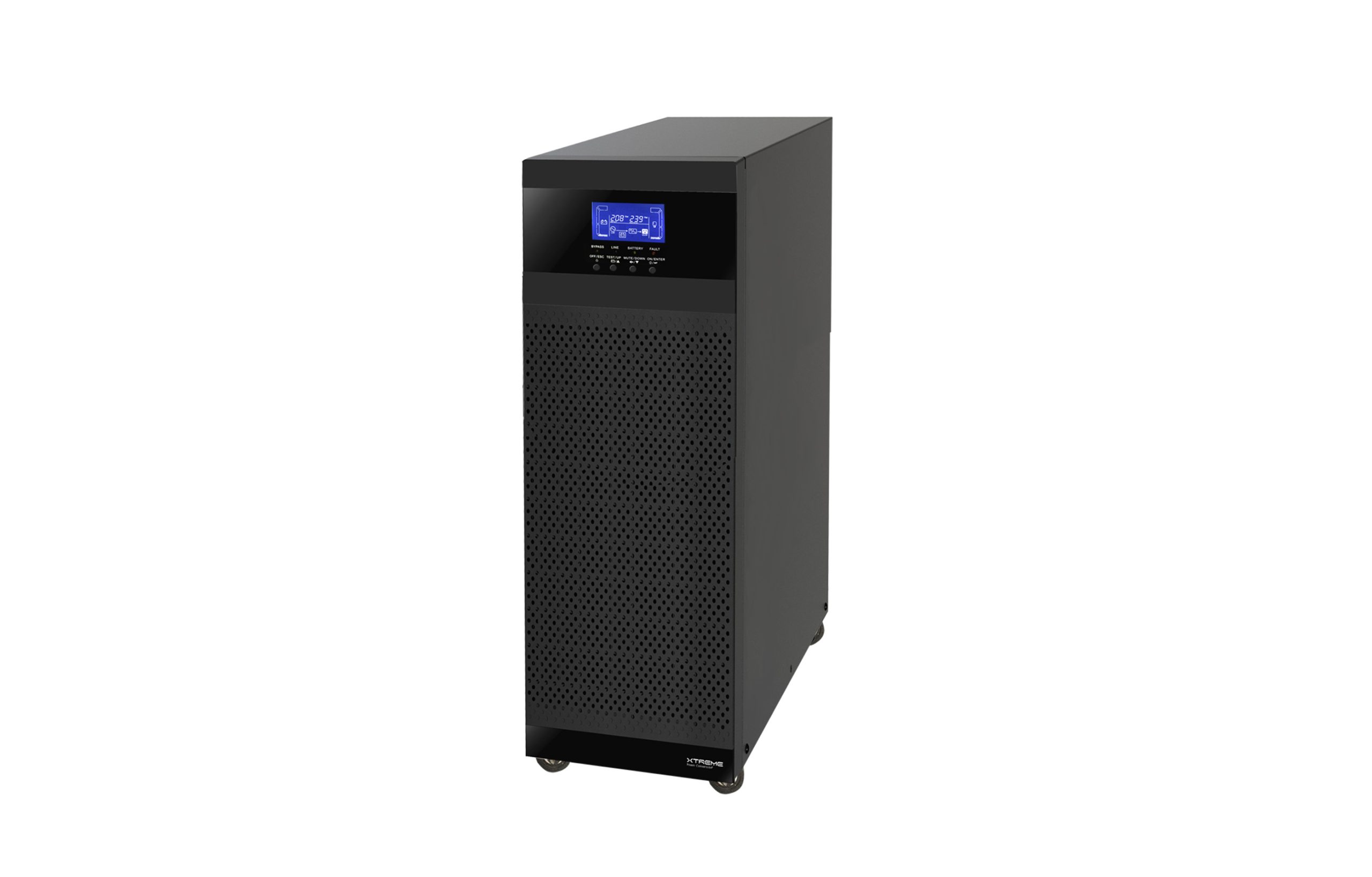
TXVR Isolated Power Conditioner
3.8kVA-10kVA
240/120VAC or 230/115VAC
Power conditioning for voltage critical processes in the most demanding conditions.
3.8–10 kVA · 240/120 VAC (or 230/115V) · Isolated Electronic Voltage Regulator · No Batteries · TAA
TXVR isolated electronic voltage regulator
The TXVR is an isolated electronic voltage regulator (3.8 to 10 kVA) for facilities that need clean, stable, noise-free power — without batteries. It holds output within ±1% even as utility input swings from −45% to +45%, while a built-in galvanic isolation transformer eliminates common-mode noise and the need for costly dedicated circuits. A static transfer switch, LCD monitoring, ANSI/IEEE C62.41 surge protection, dual output voltages, a 3-year warranty (USA and Canada), and TAA compliance round it out. When runtime needs change, the TXVR upgrades to a full UPS by adding firmware and external battery cabinets — a scalable path rather than a forklift replacement.
Precision power conditioning, no batteries required
The TXVR delivers isolated electronic voltage regulation, galvanic isolation, and surge suppression for facilities that need regulated, noise-free power rather than runtime. It is engineered for environments with severe voltage fluctuations, grounding issues, or electrical interference — where the problem is power quality, not outage backup. By regulating voltage electronically and conditioning power through an isolation transformer, the TXVR stabilizes operating conditions for sensitive loads without the cost, weight, and maintenance of a battery system.
±1% output across a −45% to +45% input swing
The defining capability of the TXVR is a very wide regulation window: it maintains output voltage within ±1% even when utility input varies by −45% to +45%. That covers the deep sags and surges that destabilize sensitive equipment in electrically challenging facilities — correcting them continuously, without drawing on a battery. The result is tight, repeatable output for precision loads in locations where the incoming utility cannot be relied upon to stay near nominal.
| Utility condition | TXVR response |
|---|---|
| Deep voltage sag (down to −45%) | Electronically corrected to within ±1% output |
| High voltage surge (up to +45%) | Electronically corrected to within ±1% output |
| Common-mode noise & grounding issues | Eliminated by the galvanic isolation transformer |
| Transients & surge events | Suppressed to ANSI/IEEE C62.41 Cat. A & B (6kV) with very low let-through |
Isolation without a battery to maintain
A built-in galvanic isolation transformer electrically separates the utility input from connected loads — and provides power conditioning during both normal and bypass operation. This mitigates the disturbances that degrade reliability in noisy or poorly grounded environments:
| Disturbance | How isolation addresses it |
|---|---|
| Common-mode electrical noise | Galvanic separation breaks the common-mode path between source and load |
| Ground reference instability | A stabilized ground reference supports sensitive equipment |
| Voltage transient propagation | Transients are attenuated rather than passed through to the load |
| Dedicated-circuit cost | Isolation removes the need to install expensive dedicated circuits |
Surge let-through is held under 10V normal mode (L-N) and under 0.5V common mode (N-G) at 6kV ANSI/IEEE C62.41 Cat. A.
What the TXVR delivers
Maintains output voltage within ±1% without batteries — clean, stable power conditioning rather than battery-backed runtime.
A wide input voltage window corrects deep sags and high surges from unstable utility conditions, keeping output tight where the incoming line cannot be trusted.
Eliminates common-mode noise and grounding issues and removes the need for expensive dedicated circuits, conditioning power during both normal and bypass operation.
Surge withstand to Category A & B (6kV / 200 & 500A, 100kHz ringwave) with ultra-low let-through — under 10V (L-N) and under 0.5V (N-G) at 6kV Cat A.
A static switch automatically transfers output to the isolated bypass source on overload or fault, and a manual maintenance bypass transfers the load to utility power for service.
Add firmware and external battery cabinets to convert the TXVR into a battery-backed UPS — a scalable path if runtime requirements emerge later.
The regulation tier of the isolation family
The TXVR is the no-battery member of the isolation family: it conditions and regulates power without providing backup. When runtime is required, the same chassis family steps up to the internal-battery TX91 and the external-battery, extended-runtime TX91L — and the TXVR itself can be field-upgraded into a UPS.
When you need regulation, not runtime
If the requirement is clean, regulated, noise-free power — rather than battery backup — the TXVR is the right tool. It avoids the cost, weight, replacement cycle, and footprint of a battery system while delivering isolation, wide-window regulation, and surge suppression. Where backup is required, the TX91 / TX91L add batteries to the same isolation approach, and the TXVR’s firmware-plus-battery upgrade path keeps that option open.
| Capability | TXVR (regulator) | Isolation UPS (TX91 / TX91L) |
|---|---|---|
| Voltage regulation | ±1% across −45% to +45% input | Regulated online output |
| Galvanic isolation | Integrated transformer | Integrated transformer |
| Battery / runtime | None — conditioning only | Internal (TX91) or external/extended (TX91L) |
| Best fit | Power quality where outage backup isn’t needed | Power quality and ride-through / continuity |
Upgradeable to a full UPS
Runtime requirements can change after a regulator is deployed. The TXVR is designed for that: by upgrading firmware and adding external battery cabinets, it becomes a battery-backed UPS — no forklift replacement, and a clean migration toward TX91L-style external-battery runtime.
Why not just use an isolation transformer PDU?
A fair question, since both isolate and neither has batteries. The difference is what happens to the voltage. An isolation transformer PDU is passive: it breaks the ground path and steps voltage by a fixed ratio, so whatever the utility does to the input arrives at the output shifted by that same ratio. If the feed sags 15%, the load sees a 15% sag.
The TXVR is active. It rebuilds the output through double conversion, so it holds ±1% regulation across a −45% to +45% input swing, corrects frequency, and cleans the waveform — and it isolates. That is nine of the ten common power problems from the conversion and the tenth, common mode noise, from the transformer. All ten, with no battery.
| Isolation PDU | TXVR | TX91 | |
|---|---|---|---|
| Galvanic isolation | Yes | Yes | Yes |
| Voltage regulation | None — fixed ratio | ±1% across −45% to +45% | ±1% |
| Frequency correction | No | Yes | Yes |
| Outage ride-through | No | No | Yes |
| Batteries to replace | None | None | Yes, on a service cycle |
That leaves a clean rule. If the load only needs the ground path broken, a transformer PDU is cheaper and lighter. If the power is also unstable, the TXVR regulates it without adding a battery to maintain. If the load cannot lose power at all, the TX91 is the same architecture with batteries in it — and the TXVR can be upgraded to one later with firmware and external battery cabinets.
Four models, 3.8–10 kVA, tower, no batteries
| Model | Capacity (kVA / kW) | Weight | Form factor | Topology |
|---|---|---|---|---|
| TXVR-3.8K | 3.8 / 3.8 | 142 lbs | Tower | Electronic voltage regulation (no batteries) |
| TXVR-5K | 5 / 5 | 145 lbs | Tower | Electronic voltage regulation (no batteries) |
| TXVR-6K | 6 / 6 | 148 lbs | Tower | Electronic voltage regulation (no batteries) |
| TXVR-10K | 10 / 10 | 187 lbs | Tower | Electronic voltage regulation (no batteries) |
All models provide unity output power factor, ±1% regulation, an integrated galvanic isolation transformer, and dual output voltages (240/120V or 230/115V) with an optional configurable PDU. The TXVR carries no batteries and provides no runtime — it is a power conditioner / voltage regulator, upgradeable to a UPS via firmware and external battery cabinets.
Where the TXVR is deployed
The TXVR is engineered for environments requiring precision voltage regulation and noise-free power — laboratory and scientific equipment, industrial and manufacturing automation, broadcast and media systems, research facilities and universities, retail and POS terminals, and any site with grounding issues, electrical noise, or input instability. It is the right choice where the priority is stable, isolated, regulated power rather than outage runtime.
TAA compliance without a battery lifecycle
The TXVR is TAA compliant alongside UL1778, cUL, FCC Class A, and RoHS — suited to U.S. federal, government, and other regulated installations requiring Trade Agreements Act compliance.
TXVR specifications

| Models | TXVR-3.8K / -5K / -6K / -10K (3.8 / 5 / 6 / 10 kVA = kW) — unity PF |
| Topology | Isolated electronic voltage regulation; integrated galvanic isolation transformer |
| Output stability | ±1% |
| Input voltage window | Corrects −45% to +45%; 208 / 220 / 230 / 240 VAC nominal; range 110–300 VAC; 46–54 Hz or 56–64 Hz |
| Output | 208 VAC, 240/120 VAC or 230/115 VAC; dual voltage; optional configurable PDU; 50 Hz ±0.1 Hz or 60 Hz ±0.1 Hz |
| Efficiency | Up to 97% ECO mode, 91% online mode |
| Overload | 110% for 10 min; 130% for 1 min; >130% for 1 s |
| Harmonic distortion | <2% at 100% linear load, regardless of input distortion |
| Battery / runtime | None — voltage regulation / conditioning only (no backup runtime) |
| Surge let-through | <10V normal mode (L-N), <0.5V common mode (N-G) at 6kV ANSI/IEEE C62.41 Cat. A |
| Surge withstand | ANSI/IEEE C62.41 Category A & B; 6kV / 200 & 500A, 100kHz ringwave |
| Transfer | Static switch to isolated bypass on overload or fault; manual maintenance bypass |
| Display | LCD status, alarm, and monitoring interface |
| Communications | RS-232, EPO, USB; intelligent slot for optional Web/SNMP and Relay/dry contact cards |
| Upgrade | Upgradeable to a full UPS via firmware + external battery cabinets |
| Dimensions / weight | 9.8 × 23.2 × 32.4 in (tower); 142 / 145 / 148 / 187 lbs (3.8 / 5 / 6 / 10 kVA) |
| Environment | 32–104°F (0–40°C); audible noise <50 dBA; altitude 5,200 ft |
| Approvals | UL-1778, cUL, FCC Class A, RoHS, TAA compliant |
| Warranty | 3 years (USA and Canada); 1 year outside the USA and Canada |
TXVR voltage regulator — frequently asked questions
What is the difference between a TXVR and an isolation transformer PDU?
A transformer PDU is passive: it breaks the ground path and steps voltage by a fixed ratio, so whatever the utility does to the input arrives at the output shifted by the same ratio. If the feed sags 15%, the load sees a 15% sag. The TXVR is active. It rebuilds the output through double conversion, holding plus or minus 1% regulation across a minus 45% to plus 45% input swing, correcting frequency and cleaning the waveform, and it isolates as well. Choose the PDU when you only need the ground path broken; choose the TXVR when the power is also unstable.
Why buy a UPS with no batteries?
Because power quality and power continuity are different requirements. Plenty of loads need clean, regulated, isolated power but sit behind a facility UPS or a generator, or can tolerate a brief outage. For those, batteries are a cost and a maintenance obligation with no benefit. The TXVR gives all ten of the common power problems addressed, with nothing to replace on a service cycle.
Can it be upgraded to a full UPS later?
Yes. Firmware plus external battery cabinets convert the TXVR into a battery-backed UPS, which makes it a reasonable starting point when runtime is not required today but might be. It is the same chassis family as the TX91L.
How much input voltage swing will it hold?
Plus or minus 1% output across a minus 45% to plus 45% input swing. That is a wide window, and it is the reason to specify a TXVR rather than a transformer on a feed that moves.
Does it address common mode noise?
Yes, through the isolation transformer. Common mode noise is measured between ground and either neutral or line, and it is the tenth of the ten common power problems, the only one online double-conversion alone does not reach. The TXVR covers nine from the conversion and the tenth from the transformer, with no battery in the path.
What should the load be plugged into?
The TXVR output, directly. Isolation is established at the transformer output and nowhere else, so a downstream PDU or power strip with its own ground path reintroduces exactly what the transformer was installed to break. Keep the TXVR close to the equipment as well, since everything past its output is unprotected cable again.
Is the TXVR TAA compliant?
Yes, which supports federal, state, education and healthcare procurement. Worth noting alongside the no-battery design: on a regulated program the TXVR is eligible to bid and carries no battery replacement cycle to budget for.
Where does it sit against the TX91 and TX91L?
Same isolation architecture, different runtime strategy. The TXVR has no batteries and conditions only. The TX91 carries internal batteries for ride-through and controlled shutdown. The TX91L carries no internal batteries either but is built around scalable external battery systems for extended runtime. All three cover 3.8 to 10 kVA.
Documents and related links
Plan your TXVR deployment
Talk to an Xtreme Power specialist about voltage-regulation requirements, isolation and surge needs, PDU and receptacle configuration, the UPS upgrade path, and TAA-compliant deployment for laboratory, industrial, broadcast, research, and POS environments.