
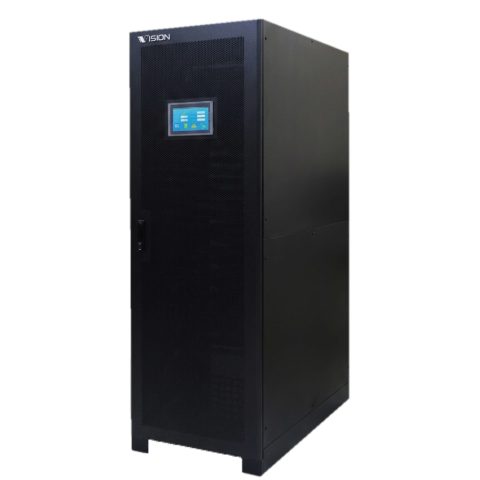

Vision REVO TP Series – LFP Battery Cabinets for X90 UPS (20.5–51.2 kWh)
20.5–51.2 kWh | ±204.8 or ±256 Vdc | LFP Battery Cabinet
Lithium iron phosphate battery cabinets for X90 UPS systems, tested to UL 9540A with no thermal runaway or propagation, supplied and supported by XPC as a single integrated system.
Battery Cabinet · LFP · X90 UPS · 40–700 kW
Vision REVO TP Series LFP Battery Cabinets
The Vision REVO TP Series is a lithium iron phosphate battery system that XPC integrates with the X90 UPS family. All four models use the same cabinet, 23.6 by 39.4 by 78.7 inches, and differ only in the battery modules inside: 20.5 kWh to 51.2 kWh of energy on a ±204.8 Vdc or ±256 Vdc bus, and up to eight cabinets parallel on one system for 410 kWh. Cabinets install and service from the front only and are UL 9540A tested with no thermal runaway or propagation. XPC supplies the cabinets, the firmware integration to the X90, start-up, and warranty support as a single system.


Built for the room the UPS actually lives in
Lithium iron phosphate trades some energy density for a far more forgiving thermal profile. UL 9540A testing produced no thermal runaway and no propagation, which is the result that matters to the authority having jurisdiction reviewing your installation.
TP80 through TP200 are the same enclosure at 23.6 x 39.4 x 78.7 in. Only the modules inside change, so energy scales without changing the floor plan and a capacity revision late in design does not move walls or re-cut a raised floor. Weight is the one physical difference, from 1,058 to 1,985 lbs.
Installation and maintenance are done entirely from the front, and all power and communication cabling enters through the top. Cabinets can sit against a wall, which recovers aisle depth in constrained rooms.
Each cabinet holds 8 or 10 modules at 50 Ah or 100 Ah, each with its own management unit reporting to the cabinet BMS. Automatic cell balancing holds capacity consistent across the string and extends usable life.
Every cabinet ships with a Cabinet Battery Management System. One Global Battery Management System is required per battery system and ships integrated into the front door of the first cabinet, aggregating every paralleled cabinet into a single reporting point with display, LAN, dry contacts, and EPO.
Supports ±204.8 Vdc and ±256 Vdc bus configurations and communicates with the X90 UPS through the GBMS. Up to eight cabinets parallel on one system, with active current distribution balancing load across them.
Integration with the X90 family
The TP Series is a third-party battery system, not an XPC-manufactured product. Pairing high energy density lithium cabinets from a specialist battery manufacturer with a UPS platform is standard practice across the industry, and it is how the large UPS vendors bring lithium to market. What differs between vendors is the depth of the integration and who stands behind the combined system. XPC supplies the TP Series as an integrated part of an X90 system: sized together, commissioned together, and supported under one warranty.
Battery firmware is field upgradable. XPC validates GBMS and CBMS firmware against X90 control firmware and documents the combinations we support, so a battery firmware revision does not arrive at a live site untested against the UPS.
The GBMS presents state of charge, cell and module data, and alarm conditions to the UPS. Charge current limits and the charge voltage window are set to the cabinet model rather than to a generic lead-acid profile.
The GBMS provides an EPO contact and three dry contacts that land in the X90 and the facility monitoring scheme, so a battery event is visible and actionable at the UPS and at the building.
When the TP Series is purchased with an XPC UPS and start-up, commissioning covers both. That is also the condition for the two year labor warranty on the battery system.
Cabinet count is set by DC load and target runtime, then checked against the discharge current ceiling of the model. A DC collector cabinet may be required depending on cabinet count and installation.
Service escalation runs through XPC for both the UPS and the battery system. Customers are not routed between a UPS vendor and a battery vendor to establish which one owns a fault.
Four capacities, one cabinet
The four models share one enclosure and differ in module count and module capacity. TP80 and TP160 hold eight modules, TP100 and TP200 hold ten, and the 50 Ah or 100 Ah module rating sets the energy. Select on energy and on the maximum UPS capacity a single cabinet supports, then parallel cabinets to reach the runtime the load requires. Up to eight cabinets can be paralleled on one system. Cabinets pair by nominal voltage: TP80 and TP160 run a ±204.8 Vdc bus, TP100 and TP200 run ±256 Vdc. Each cabinet is supplied as a bundle with its battery modules and CBMS. Battery modules ship on a separate pallet.
| Modules | 8 x 51.2 V / 50 Ah |
| Capacity | 50 Ah |
| Max UPS | 80 kW |
| Max discharge | 250 A |
| Weight | 1,058 lbs |
Entry
| Modules | 10 x 51.2 V / 50 Ah |
| Capacity | 50 Ah |
| Max UPS | 100 kW |
| Max discharge | 250 A |
| Weight | 1,213 lbs |
| Modules | 8 x 51.2 V / 100 Ah |
| Capacity | 100 Ah |
| Max UPS | 180 kW |
| Max discharge | 510 A |
| Weight | 1,676 lbs |
| Modules | 10 x 51.2 V / 100 Ah |
| Capacity | 100 Ah |
| Max UPS | 200 kW |
| Max discharge | 510 A |
| Weight | 1,985 lbs |
Highest energy
Runtime in minutes by DC load and cabinet configuration
Values are estimated minutes at the DC load shown, for a new battery at rated capacity. Actual runtime varies with battery age, ambient temperature, and site conditions. The table shows selected load points. Use the finder for any load in 10 kW steps from 40 kW to 700 kW. Runtimes are published up to four cabinets. For configurations above four cabinets, contact XPC engineering.
| Configuration | 40 kW |
50 kW |
60 kW |
80 kW |
100 kW |
120 kW |
150 kW |
200 kW |
250 kW |
300 kW |
350 kW |
400 kW |
500 kW |
600 kW |
700 kW |
|---|---|---|---|---|---|---|---|---|---|---|---|---|---|---|---|
| TP80 | 27.6 | 23.0 | 18.4 | 13.8 | – | – | – | – | – | – | – | – | – | – | – |
| 2 x TP80 | 55.2 | 46.0 | 36.8 | 27.6 | 22.1 | 18.4 | 14.7 | – | – | – | – | – | – | – | – |
| 3 x TP80 | 82.8 | 69.0 | 55.2 | 41.4 | 33.1 | 27.6 | 22.1 | 16.6 | – | – | – | – | – | – | – |
| TP100 | 34.5 | 28.8 | 23.0 | 17.3 | 13.8 | – | – | – | – | – | – | – | – | – | – |
| 2 x TP100 | 69.0 | 57.5 | 46.0 | 34.5 | 27.6 | 23.0 | 18.4 | 13.8 | – | – | – | – | – | – | – |
| 3 x TP100 | 104 | 86.3 | 69.0 | 51.8 | 41.4 | 34.5 | 27.6 | 20.7 | 16.6 | 13.8 | – | – | – | – | – |
| TP160 | 55.2 | 46.0 | 36.8 | 27.6 | 22.1 | 18.4 | 14.7 | – | – | – | – | – | – | – | – |
| 2 x TP160 | 110 | 92.0 | 73.6 | 55.2 | 44.2 | 36.8 | 29.4 | 22.1 | 17.7 | 14.7 | 12.9 | – | – | – | – |
| 3 x TP160 | 166 | 138 | 110 | 82.8 | 66.2 | 55.2 | 44.2 | 33.1 | 26.5 | 22.1 | 19.3 | 16.6 | 13.2 | – | – |
| TP200 | 69.0 | 57.5 | 46.0 | 34.5 | 27.6 | 23.0 | 18.4 | 13.8 | – | – | – | – | – | – | – |
| 2 x TP200 | 138 | 115 | 92.0 | 69.0 | 55.2 | 46.0 | 36.8 | 27.6 | 22.1 | 18.4 | 16.1 | 13.8 | – | – | – |
| 3 x TP200 | 207 | 172 | 138 | 104 | 82.8 | 69.0 | 55.2 | 41.4 | 33.1 | 27.6 | 24.2 | 20.7 | 16.5 | 13.8 | – |
| 4 x TP200 | 276 | 230 | 184 | 138 | 110 | 92.0 | 73.6 | 55.2 | 44.1 | 36.8 | 32.2 | 27.6 | 22.0 | 18.4 | 14.8 |
All values in estimated minutes. A dash means the configuration does not support that load. X90 UPS → · Request a sized configuration →
Vision REVO TP Series specifications
| Specification | TP80 | TP100 | TP160 | TP200 |
|---|---|---|---|---|
| Energy | 20.5 kWh | 25.62 kWh | 41.0 kWh | 51.2 kWh |
| Capacity | 50 Ah | 50 Ah | 100 Ah | 100 Ah |
| Nominal voltage | ±204.8 Vdc | ±256 Vdc | ±204.8 Vdc | ±256 Vdc |
| Module configuration | 8 x 51.2 V / 50 Ah | 10 x 51.2 V / 50 Ah | 8 x 51.2 V / 100 Ah | 10 x 51.2 V / 100 Ah |
| Recommended charge current | 10 A to 25 A | |||
| Maximum charge current | 25 A | 25 A | 50 A | 50 A |
| Charge voltage | ±217.6 to ±220.8 Vdc | ±272 to ±276 Vdc | ±217.6 to ±220.8 Vdc | ±272 to ±276 Vdc |
| Maximum discharge current at EODV | 250 A | 250 A | 510 A | 510 A |
| Maximum supported UPS capacity | 80 kW | 100 kW | 180 kW | 200 kW |
| Discharge end point voltage | ±179.2 Vdc | ±224 Vdc | ±179.2 Vdc | ±224 Vdc |
| Dimensions W x D x H | 23.6 x 39.4 x 78.7 in (599 x 1,000 x 1,999 mm) | |||
| Weight | 1,058 lbs | 1,213 lbs | 1,676 lbs | 1,985 lbs |
| Operating temperature | 32°F to 104°F (0°C to 40°C) | |||
| Cycle life | 2,500 cycles at 77°F, 0.5C / 2C, 100% DOD | |||
| Cabinet access | Front access only. No rear clearance required. Top cable entry. | |||
| Communications | Dry contact, CANBUS, MODBUS to X90 UPS | |||
| Cabinet BMS | Cabinet Battery Management System (CBMS) included with every cabinet | |||
| System BMS | One GBMS required per battery system, factory integrated into the first cabinet | |||
| Maximum cabinets paralleled | 8 | |||
| Shipping | Battery modules ship on a separate pallet from the cabinet | |||
| Warranty | 5 year parts. Start-up and 2 year labor warranty when purchased with an XPC UPS and start-up. | |||
| Compliance and safety | IEC 62619, UL 9540A, UL 1973, CE (EN 62477, EN 62040), CE-EMC (IEC 61000-6-2) |
IEC 62619, IEC 60068, UL 9540A, UL 1973, CE (EN 62477, EN 62040), CE-EMC (IEC 61000-6-2) |
||
Required accessory
Vision GBMS
One Global Battery Management System is required for each Vision battery system. It communicates with every paralleled battery cabinet, the UPS, and the user. The GBMS ships integrated into the front door of the first cabinet, so there is no separate enclosure to mount or wire on site.
| Vision GBMS | Specification |
|---|---|
| Function | Communicates with all parallel battery cabinets, the UPS, and the user |
| Interfaces | Display, LAN interface, 3 dry contacts, EPO contact |
| Mounting | Factory integrated into the front door of the first cabinet |
| Quantity required | One per battery system |
Compliance
IEC 60068 applies to the TP160 and TP200. UL 9540A testing was performed with no thermal runaway and no propagation observed.
Specify a REVO TP system
Send the UPS model, DC load, and target runtime. We return a cabinet count, floor space, collector cabinet requirement, and lead time.
More on three phase power and energy storage
| MODEL NUMBER | TP80 | TP100 | TP160 | TP200 | |
| CABINET | Energy | 20.5 kWh | 25.62 kWh | 41 kWh | 51.2 kWh |
| Capacity | 50 AH | 50 AH | 100 AH | 100 AH | |
| Nominal Voltage | ±204.8 Vdc | ±256 Vdc | ±204.8 Vdc | ±256 Vdc | |
| Battery Modules | 8 × 51.2V 50AH | 10 × 51.2V 50AH | 8 × 51.2V 100AH | 10 × 51.2V 100AH | |
| Cabinet BMS | CBMS included with every cabinet | ||||
| CHARGING | Charge Current, Recommended | 10 A to 25 A | |||
| Charge Current, Maximum | 25 A | 25 A | 50 A | 50 A | |
| Charge Voltage | ±217.6 to ±220.8 Vdc | ±272 to ±276 Vdc | ±217.6 to ±220.8 Vdc | ±272 to ±276 Vdc | |
| DISCHARGING | Max Discharge Current at EODV | 250 A | 250 A | 510 A | 510 A |
| Max Supported UPS Capacity | 80 kW | 100 kW | 180 kW | 200 kW | |
| Discharge End Point Voltage | ±179.2 Vdc | ±224 Vdc | ±179.2 Vdc | ±224 Vdc | |
| SYSTEM | Maximum Cabinets Paralleled | 8 | |||
| System BMS | One GBMS required per Vision Lithium Battery System | ||||
| Communication | Dry contact, CANBUS, MODBUS to X90 UPS | ||||
| MECHANICAL | Dimensions (W × D × H) | 23.6 × 39.4 × 78.7 in (599 × 1,000 × 1,999 mm) | |||
| Weight | 1,058 lbs | 1,213 lbs | 1,676 lbs | 1,985 lbs | |
| Access | Front access only, no rear clearance required. Top cable entry. | ||||
| ENVIRONMENTAL | Operating Temperature | 32°F to 104°F (0°C to 40°C) | |||
| Life Cycle | 2,500 cycles at 77°F, 0.5C / 2C, 100% DOD | ||||
| APPROVALS | Compliance Safety | IEC62619, UL9540A, UL1973, CE(EN62477, 62040), CE-EMC(IEC61000-6-2) | |||
| Warranty | 5 year parts. Start-up and 2 year labor warranty when purchased with an XPC UPS and start-up. | ||||