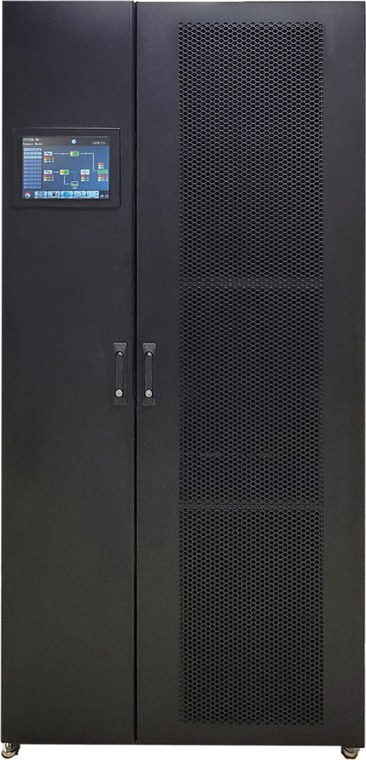
The X90 Series is Xtreme Power’s enterprise-class 480V modular UPS platform engineered for data centers, medical imaging environments, industrial infrastructure, and mission-critical facilities. Scalable from 50 kW to 700 kW, it supports centralized or distributed deployment and enables N, N+1, and parallel redundancy strategies.
All X90 Series systems are TAA compliant for federal, healthcare, and government applications, and the platform is widely deployed across regional edge infrastructure and distributed data environments. Learn more about UPS for Edge Data Centers.
X90-2S modular UPS supporting critical medical imaging infrastructure
Capacity range
50–700 kW
Voltage
480 V
Redundancy
N · N+1 · parallel
Compliance
TAA
Platform Configurations
Scalable 480V modular UPS power from 50 kW to 700 kW
The X90 platform scales by frame configuration — add power modules as load requirements grow, reducing initial infrastructure cost while maintaining high availability.
All four are floor-standing cabinets. For the same 480V capacity in a rack, see the Ai90 rack-integrated UPS, coming early 2027.
X90-1S
50 or 70 kW
The compact single-slot X90, sized for medical imaging suites, small data rooms and edge sites where floor space is limited. One 50 or 70 kW power module and up to 16 battery modules sit in a single cabinet with an integrated maintenance bypass, so 480V protection lands in the smallest footprint in the family. Redundancy at this capacity comes from a second system in parallel rather than a spare module in the frame.
A two-slot cabinet, widely deployed across medical imaging and broader healthcare environments. One or two 50 or 70 kW modules give 50, 70, 100 or 140 kW, so a site can start with one module and add the second as load grows. Fitted with two modules against a single-module load, the second is the N+1 spare.
A five-slot frame for enterprise data centers and industrial process loads. Five 70 kW modules reach 350 kW, or five 50 kW modules reach 250 kW, and modules are added in service as load grows. Sizing the frame one module above the load leaves the N+1 spare inside installed capacity.
The largest frame, built for centralized data halls and large infrastructure. Ten 70 kW modules reach 700 kW, or ten 50 kW modules reach 500 kW. Hot-swappable modules and concurrent maintainability allow capacity expansion and module service without dropping the critical load.
The X90-1S and X90-2S platforms are particularly well suited for medical imaging environments, where modular architecture delivers the stability and headroom these systems demand:
High inrush tolerance for imaging start-up loads
Clean and stable power delivery
Scalable capacity for equipment upgrades
Reliable operation in hospital environments
Data Centers & Critical Infrastructure
Modular UPS for scalable power protection
Modular UPS systems provide scalable power protection for data centers, healthcare facilities, and industrial environments. The X90 Series allows organizations to add power modules as load grows — keeping availability high while controlling upfront infrastructure cost.
Enterprise data centers
Medical imaging facilities
Regional edge data centers
Industrial infrastructure environments
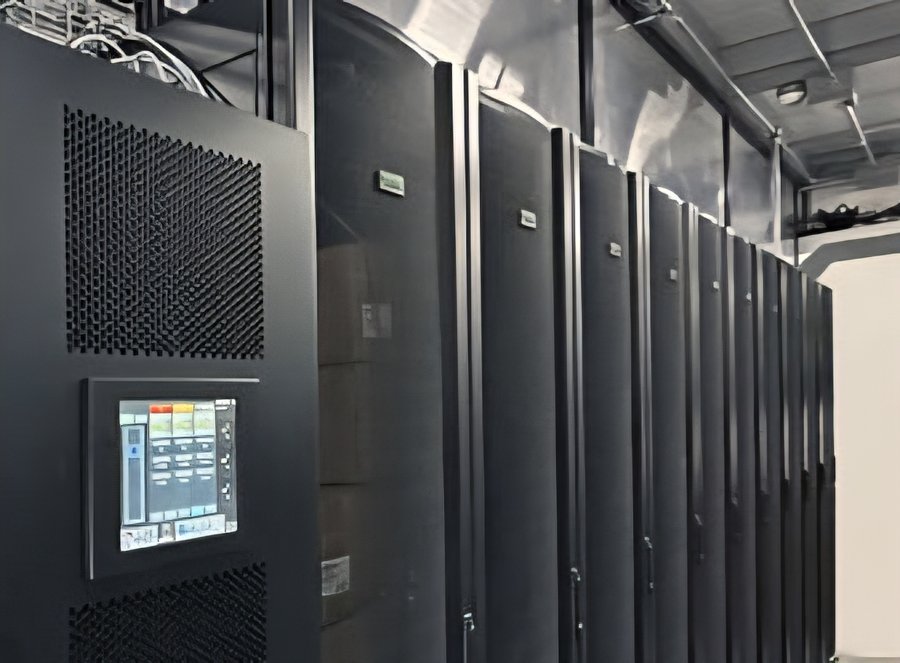
X90 frames deployed in a centralized data center power room
Federal & Government Ready
TAA-compliant three-phase UPS
All X90 Series configurations are TAA compliant, making them suitable for public-sector and government-adjacent deployments:
How do I choose between the X90-1S, 2S, 5S and 10S?
Start from the load and the growth horizon. The 1S is a single-slot cabinet at 50 or 70 kW. The 2S holds one or two modules for 50, 70, 100 or 140 kW. The 5S holds up to five modules, reaching 350 kW with 70 kW modules or 250 kW with 50 kW modules. The 10S holds up to ten, reaching 700 kW or 500 kW. Choose the frame whose ceiling leaves room for the redundant module and for expected growth.
What capacities are actually available?
Capacity comes in whole modules of 50 or 70 kW, so the steps are discrete rather than continuous. A 2S gives 50, 70, 100 or 140 kW. A 5S adds modules from there to 350 kW. Mixing module sizes within one frame is not a standard configuration.
How does N+1 redundancy work on the X90?
N+1 means installing one module more than the load requires, so a module fault or a module service does not interrupt the load. Because redundancy consumes a slot, it has to be planned into the frame size: a 140 kW load on a two-slot 2S leaves no spare slot, while the same load on a 5S leaves three.
What battery options does the X90 support?
VRLA cabinets for extended runtime at the lowest upfront cost, or Vision REVO TP lithium cabinets for a smaller footprint and longer service life. The X90-BC modular battery cabinet holds up to 36 hot-swappable battery modules, and a second cabinet extends that to 72.
Is the X90 TAA compliant?
Yes, every X90 configuration, which suits federal healthcare, Veterans Affairs hospitals, government laboratories, military installations and other public-sector deployments.
What makes the X90 suitable for medical imaging?
Imaging systems draw heavy inrush at start-up: MRI, CT, PET and linear accelerators all pull well above their steady-state rating for short periods. The X90’s overload envelope and modular headroom absorb those peaks, and capacity can be added when imaging equipment is upgraded rather than replacing the UPS.
Talk to Engineering
Speak with an Enterprise Power Specialist
Xtreme Power engineers help size, configure, and future-proof X90 deployments for healthcare, data center, and industrial environments.