


E91 Three-Phase UPS – Compact Facility UPS (10–20kVA, 208/120V)
10–20 kVA | 208/120V Three-Phase | Online Double-Conversion UPS
Compact centralized three-phase UPS engineered for localized facility infrastructure requiring reliable power protection, predictable maintenance, and efficient electrical room deployment.
10–20 kW · 208Y/120 VAC Three-Phase · Online Double-Conversion · Start-Up and On-Site Service Included · TAA
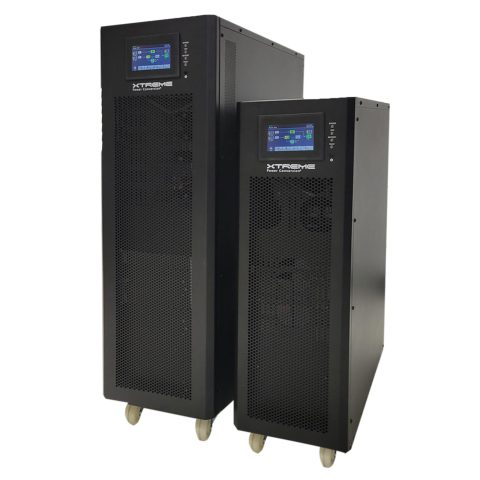
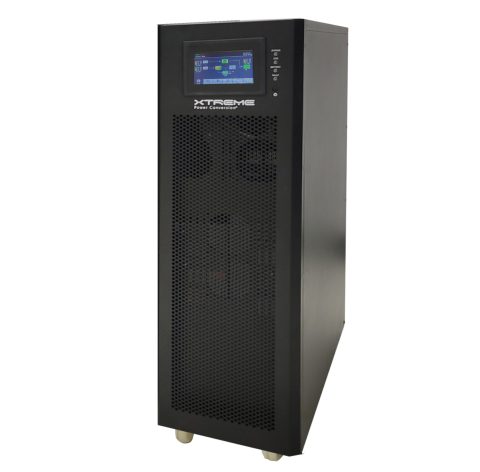
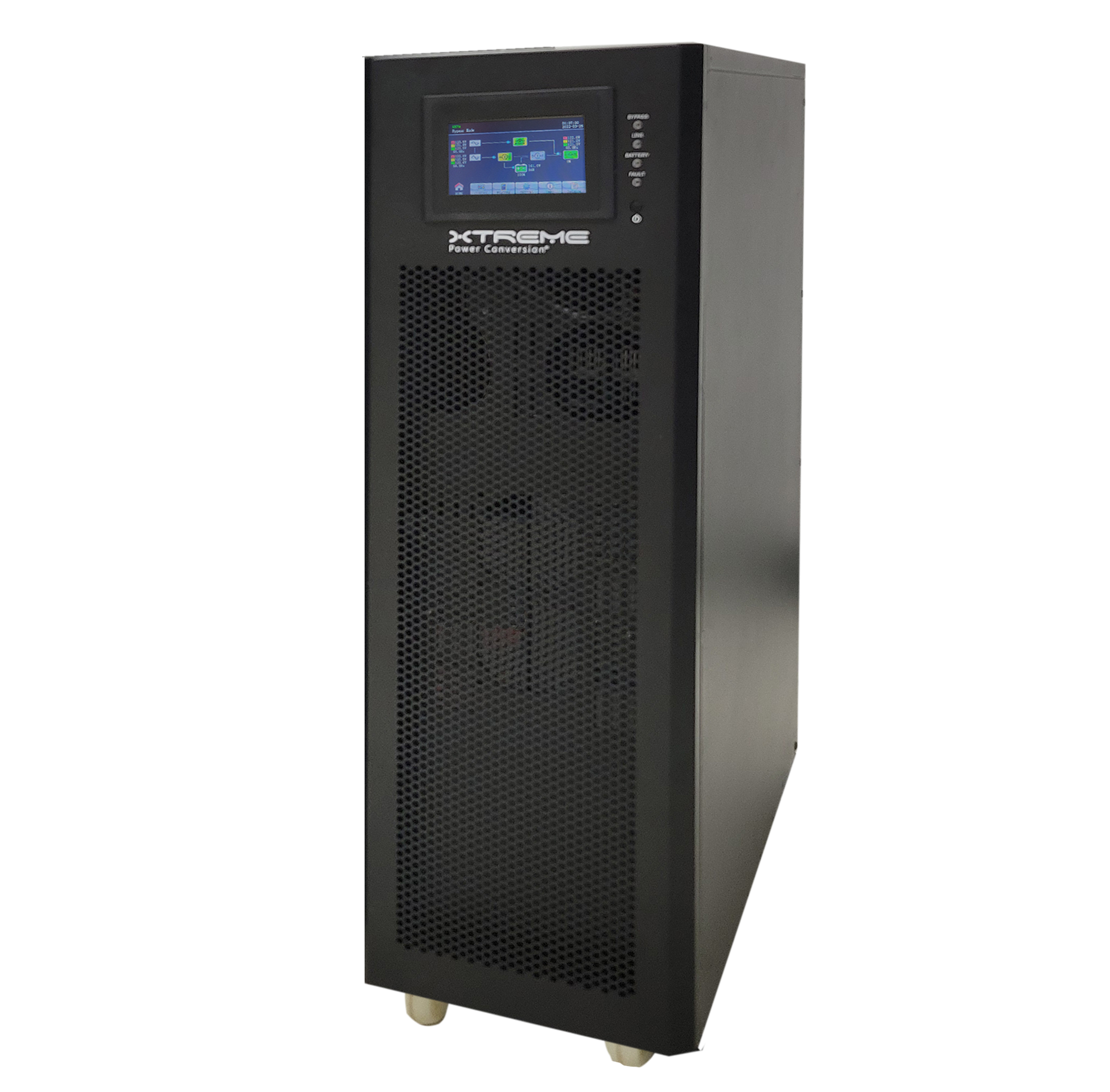
E91 compact three-phase facility UPS
The E91 is a compact centralized three-phase online double-conversion UPS (10 to 20 kW, 208Y/120V) that integrates UPS electronics and VRLA batteries in a single cabinet — built for healthcare, industrial automation, telecommunications, and edge/IT environments that need facility-level continuity without the complexity of modular or large-scale systems. Unity output power factor delivers up to 25% more real capacity for high-density loads, a 4.3-in touch LCD provides an interactive power one-line and alarms, and Energy Star 2.0 efficiency reaches up to 94% in double conversion and 98% in ECO mode. External battery cabinets extend runtime without transitioning to a modular architecture, and the platform is TAA compliant for regulated procurement. Factory start-up and 2 years of on-site service are included in the USA and Canada.*
*Factory start-up and 2 years on-site service: USA and Canada, within 100 miles of an XPC service center. Travel charges apply beyond 100 miles. Call (800) 582-4524 to confirm coverage for your site.

Centralized three-phase protection in a compact cabinet
The E91 is a compact centralized three-phase UPS for localized facility infrastructure. It provides reliable double-conversion power for edge facilities, small data centers, network closets, and industrial applications — integrating UPS and battery within one cabinet to simplify deployment and reduce installation complexity in space-constrained electrical rooms. The result is a balance between footprint efficiency, deployment simplicity, and established lifecycle service models, sized for facilities where capacity requirements are fixed.
Integrated UPS and battery, electrical-room optimized
The E91 integrates UPS electronics and VRLA batteries within a single cabinet, simplifying installation and reducing the complexity of a space-constrained electrical room. Optional external battery cabinets allow runtime to be expanded without transitioning to a modular UPS architecture — so a deployment can scale its runtime while keeping a fixed, predictable centralized capacity.
| Design goal | How the E91 delivers it |
|---|---|
| Footprint efficiency | UPS and internal VRLA batteries integrated in one compact cabinet |
| Deployment simplicity | Straightforward retrofit into existing electrical rooms; pre-installed input jumpers |
| Runtime flexibility | Optional EBP09 external battery cabinets extend runtime as needed |
| Predictable service | Established VRLA lifecycle with accessible design for routine maintenance |
What the E91 delivers
Unity PF (kVA = kW) provides more real capacity for high-density loads — supporting up to 25% more critical load than typical UPS platforms at the same kVA rating.
A color touch display provides vital information including an interactive power one-line, alarms, and UPS status for at-a-glance facility monitoring.
Energy Star 2.0 across 10 / 15 / 20 kW, with operation up to 94% in double-conversion mode and up to 98% in ECO mode.
Rides through momentary overloads (up to 110% for 1 hour, 130% for 1 minute) and can lock output at 50 or 60 Hz as a frequency converter.
Separate rectifier and bypass inputs (jumpers pre-installed) support dual- or single-feed electrical designs, with a manual maintenance bypass for service.
Optional EBP09-2 and EBP09-5 external battery cabinets extend runtime from minutes to hours without moving to a modular architecture.
Every E91 sold in the USA and Canada includes factory start-up and 2 years of on-site warranty service within 100 miles of an XPC service center. Sites beyond 100 miles are covered with a travel charge. Call (800) 582-4524 to confirm coverage for your site.
The compact facility tier of the Xtreme Power family
The E91 is the fixed-capacity VRLA option in the 208/120V three-phase range. Step up to the E91 30–40 kW for more centralized capacity in the same architecture, choose the Li90 for lithium, or the M90C-6S and M90U where growth or N+1 redundancy is required.
Compact VRLA vs modular and lithium
Modular UPS systems provide scalability and redundancy but add system complexity, cost, and footprint. Lithium platforms prioritize reduced maintenance, longer battery life, and higher energy density at a higher upfront cost. The E91 delivers a simpler centralized VRLA architecture for applications where capacity is fixed, lifecycle familiarity matters, and predictable service planning and cost structure are key considerations.
| Consideration | E91 (compact VRLA) | Modular (M90U) | Lithium (Li90) |
|---|---|---|---|
| Architecture | Centralized, fixed capacity | Scalable, redundant modules | Integrated lithium |
| Footprint | Compact single cabinet | Larger, scalable | Reduced footprint |
| Battery model | VRLA, periodic replacement | VRLA / modular | Lithium, long life, low maintenance |
| Best when | Capacity is fixed; simple, predictable service | Growth or redundancy is required | Low-maintenance modernization is the goal |
Comparing battery chemistries? See lithium UPS vs lead-acid UPS.
Three models, 10–20 kW
| Model | Capacity (kW) | Dimensions (W × D × H) | Weight | Internal battery | Charging |
|---|---|---|---|---|---|
| E91-10K | 10 | 9.9 × 26.3 × 32.3 in | 315 lbs | (40) × 12V 9AH | 2–12 A |
| E91-15K | 15 | 11.9 × 34 × 40.2 in | 504 lbs | (60) × 12V 9AH | 4 / 8 / 12 A |
| E91-20K | 20 | 11.9 × 34 × 40.2 in | 510 lbs | (60) × 12V 9AH | 4 / 8 / 12 A |
All models are unity power factor with online double-conversion topology, a 4.3-in touch LCD, and Energy Star 2.0 efficiency. The E91-10K uses the compact chassis; the E91-15K and -20K share the larger chassis. Optional EBP09-2 / EBP09-5 external battery cabinets (11.9 × 34 × 40.2 in) extend runtime, and optional E91-PDU1 / PDU2 distribution adds (4) L21-20R or L21-30R outlets.

Runtime by battery configuration and load
Estimated runtime in minutes at 25%, 50%, 75%, and 100% load — from internal batteries through one or two EBP09 external battery cabinets.
| Model | UPS internal batteries | UPS + EBP09-2 | UPS + EBP09-5 | UPS + (2) EBP09-5 | ||||||||||||
|---|---|---|---|---|---|---|---|---|---|---|---|---|---|---|---|---|
| Percentage load: | 25% | 50% | 75% | 100% | 25% | 50% | 75% | 100% | 25% | 50% | 75% | 100% | 25% | 50% | 75% | 100% |
| E91-10K | 69 | 28 | 16 | 11 | 152 | 69 | 41 | 28 | 298 | 130 | 86 | 58 | 550 | 247 | 152 | 113 |
| E91-15K | 69 | 28 | 16 | 11 | 125 | 54 | 32 | 22 | 215 | 98 | 59 | 41 | 400 | 167 | 109 | 78 |
| E91-20K | 47 | 19 | 11 | 7 | 93 | 37 | 22 | 15 | 152 | 69 | 41 | 28 | 272 | 122 | 78 | 52 |
Runtimes are shown in minutes and vary with battery age, cycles, and site conditions. Contact Xtreme Power at (800) 582-4524 or sales@xpcc.com for runtime sizing, or use the UPS sizing tool.
Where the E91 is deployed
The E91 is deployed across facilities requiring compact centralized UPS protection — healthcare imaging and clinical environments, industrial automation systems, commercial electrical infrastructure, telecommunications power rooms, and distributed IT or edge computing. Capacity typically aligns with facility scope: 10 kW for small electrical rooms, 15 kW for imaging and automation infrastructure, and 20 kW for broader commercial environments, with runtime extended via external battery cabinets.
TAA-compliant facility power
The E91 is TAA compliant, supporting regulated healthcare, government, and commercial deployments requiring Trade Agreements Act compliance — alongside UL, cUL, FCC, and Energy Star 2.0.
E91 specifications
| Models | E91-10K / -15K / -20K, 10 / 15 / 20 kW at unity power factor |
| Topology | Online double-conversion, three-phase; centralized compact cabinet |
| Input | 208Y/120 VAC or 220Y/127 VAC three-phase, 4W + G, +20 / −15%; 46–54 Hz or 56–64 Hz; separate rectifier & bypass inputs (dual or single, jumpers pre-installed) |
| Output | 208/120 VAC or 220/127 VAC; 50/60 Hz ±0.1%; unity power factor; frequency-converter capable |
| Efficiency | Up to 94% online (double conversion), up to 98% ECO mode; Energy Star 2.0 |
| Overload | Up to 110% for 1 hour; 130% for 1 minute; >130% for 1 second |
| Internal battery | Sealed maintenance-free lead acid (VRLA); (40) 12V 9AH (10 kW) or (60) 12V 9AH (15 / 20 kW); charging 2–12 A (10 kW), 4 / 8 / 12 A (15 / 20 kW) |
| External battery | EBP09-2 (40 × 12V 9AH, 310 lbs) / EBP09-5 (100 × 12V 9AH, 670 lbs); cabinet 11.9 × 34 × 40.2 in |
| Display | 4.3-in color touch LCD — interactive power one-line, status, and alarms |
| Dimensions / weight | 9.9 × 26.3 × 32.3 in / 315 lbs (10 kW); 11.9 × 34 × 40.2 in / 504–510 lbs (15 / 20 kW) |
| Optional PDU | E91-PDU1 (4 × L21-20R, 20A breakers) or E91-PDU2 (4 × L21-30R, 30A breakers) |
| Communications | RS-232, EPO, USB; intelligent slot for optional Web/SNMP and Relay/dry contact cards |
| Environment | 32–104°F (0–40°C); audible noise <60 dB (10 kW) / <65 dB (15 / 20 kW); altitude 5,200 ft (derates above 40°C and 5,200 ft) |
| Approvals | UL, cUL, FCC, Energy Star 2.0, TAA compliant |
| Warranty | 2 years electronics and battery (USA and Canada); 1 year outside the USA and Canada. Factory start-up and 2 years on-site service included within 100 miles of an XPC service center; travel charges apply beyond 100 miles. |
| Included | User manual, RS-232 cable, USB cable |
| Options | External maintenance bypass, output distribution PDU, external battery cabinets |
E91: common questions
What is the E91?
A compact three-phase online double-conversion UPS, 10 to 20 kW at 208Y/120 V, with internal VRLA batteries in a single cabinet. It suits electrical rooms in healthcare, industrial, telecom and edge sites where capacity is fixed.
What service is included?
In the USA and Canada, every E91 includes factory start-up and 2 years of on-site warranty service within 100 miles of an XPC service center. Sites beyond 100 miles are covered with a travel charge. Call (800) 582-4524 to confirm coverage for your site.
What is the warranty?
2 years on electronics and battery in the USA and Canada, and 1 year outside the USA and Canada.
What voltages does it support?
208Y/120 VAC or 220Y/127 VAC three-phase, 4W + G, +20/-15%, with separate rectifier and bypass inputs for dual- or single-feed designs. Input jumpers are pre-installed for single feed.
How is runtime extended?
With the EBP09-2 (40 batteries) or EBP09-5 (100 batteries) external cabinets. An E91-10K at full load runs 11 minutes on internal batteries and 113 minutes with two EBP09-5 cabinets.
Is the E91 UL listed and TAA compliant?
Yes. It carries UL, cUL and FCC approvals, meets Energy Star 2.0, and is TAA compliant.
When should I choose a modular UPS instead?
When the load will grow or N+1 redundancy is required. The E91 is fixed capacity. For modular growth at 208/120 V, see the M90C-6S or M90U; for more fixed capacity, the E91 30-40 kW.
Documents and related links
Plan your E91 deployment
Talk to an Xtreme Power specialist about service coverage for your site, capacity selection, runtime sizing with EBP09 external battery cabinets, PDU and distribution options, dual-feed electrical design, and compact centralized three-phase deployment for healthcare, industrial, telecom, and edge/IT environments.