P91 Li Lithium UPS (1000–3000VA, 120V) | Online Rack UPS
1000–3000 VA | 120V | Online Double-Conversion UPS
Lithium rack UPS designed for distributed IT, network, and AV infrastructure requiring reliable power protection, long battery life, and standardized deployment.
1000–3000 VA · 120VAC · Online Double-Conversion Lithium Rack UPS
P91 Li lithium online rack UPS
The P91 Li is a 2U online double-conversion UPS built on lithium iron phosphate (LiFePO₄) batteries for rack-based infrastructure that needs continuous conditioned power and predictable lifecycle performance. Online topology delivers zero transfer time and continuous conditioned power through the inverter, while LiFePO₄ chemistry adds long service life, reduced maintenance, faster recharge, and stable operation up to 50 °C. Rack, tower, or wall mountable and TAA-compliant, it is designed for standardized deployment across distributed IT, network, and AV sites — including a new short-depth 1000 VA model for shallow racks.

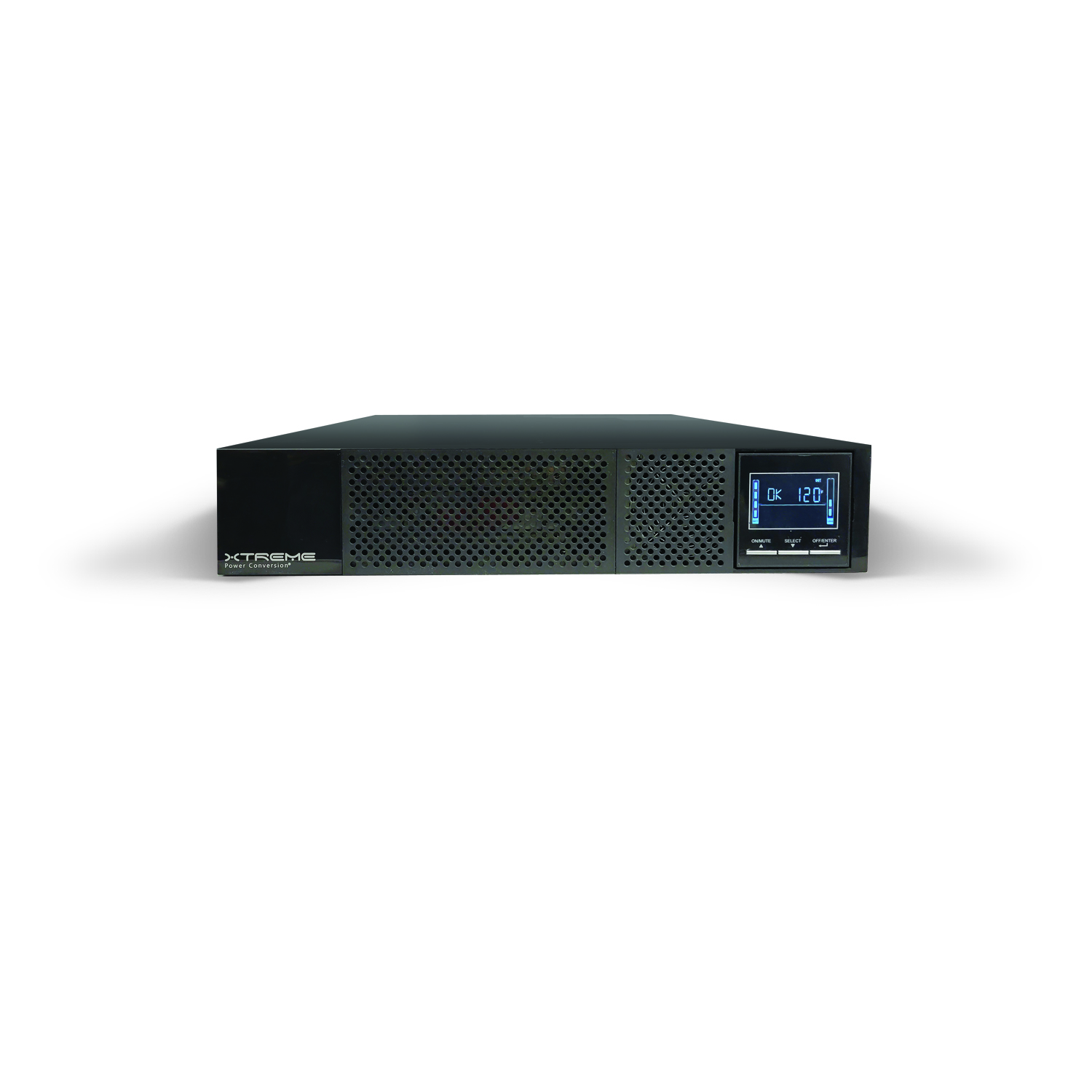
P91 Li 2U online double-conversion lithium UPS — front view with status LCD.
Rack-level power protection
The P91 Li is deployed in distributed infrastructure where localized UPS protection is required at the rack level. Online double-conversion topology provides zero transfer time and continuous conditioned power, regenerated by the inverter regardless of upstream disturbances. Lithium battery architecture supports longer service intervals, improved thermal performance, and reduced maintenance compared to VRLA UPS systems.
LiFePO₄ technology delivers up to 15 years of battery life, 3 to 4 times longer than lead-acid, eliminating routine replacement cycles, and recharges to 90% in about 1.5 hours.
What the P91 Li delivers
Zero transfer time and the cleanest output – pure sine wave at ≤2% THD (linear) / ≤4% THD (non-linear).
Up to 15-year battery life or 3,000–5,000 discharges, eliminating routine battery replacement.
Rated for high-temperature environments up to 50 °C (122 °F), with derating above 40 °C.
Hot-swappable internal lithium pack; the battery management system guards over-voltage, over-current, and over-temperature.
Six years on electronics and battery in the USA and Canada (2 years depot repair outside), plus a $50,000 connected-equipment load protection policy in the USA and Canada.
About 30% lighter than typical lead-acid; up to 98% ECO / 94% online efficiency; 1.5 h recharge to 90%.
The standard lithium rack platform
The P91 Li operates as the standard lithium rack UPS within the Xtreme Power architecture — deployed in network closets, IT racks, AV systems, and multi-site environments where a consistent platform is required. It sits between compact lithium platforms such as the J60C and high-density platforms such as the J90, balancing flexibility, runtime, and standard rack deployment.
P91 Li or J90?
The P91 Li is the standard 2U platform — built for internal-battery ride-through with flexible rack, tower, or wall installation. The J90 delivers the same online lithium protection in a 1U chassis (half the rack height) and adds individual outlet control, plus external battery pack support on its 2kVA and 3kVA models for runtime well beyond what internal batteries alone provide. Choose the J90 when rack space is at a premium, outlet-level switching is required, or runtime must extend past the P91 Li’s internal-only configuration; choose the P91 Li when a standard 2U platform with internal runtime is the better fit.
Four models, 1000–3000 VA
| Model | Capacity | Receptacles | Line cord | Dimensions (W×D×H) | Weight | Battery config |
|---|---|---|---|---|---|---|
| P91-1kLi (short-depth) | 1000 VA / 900 W | (8) NEMA 5-15R | 6 ft, 5-15P | 17.2 × 10.6 × 3.4 in | 17.2 lbs | 8S2P |
| P91-1.5kLi | 1500 VA / 1350 W | (8) NEMA 5-15R | 6 ft, 5-15P | 17.2 × 15.1 × 3.4 in | 25.6 lbs | 15S2P |
| P91-2kLi | 2000 VA / 1800 W | (8) NEMA 5-15/20R | 6 ft, 5-20P | 17.2 × 19.0 × 3.4 in | 33.5 lbs | 15S2P ×2 |
| P91-3kLi | 3000 VA / 2700 W | (1) L5-30R + (6) 5-15/20R | 6 ft, L5-30P | 17.2 × 23.8 × 3.4 in | 45.2 lbs | 24S1P ×3 |
All models are 2U (3.4 in) high and 17.2 in wide; depth grows with capacity (the 1000 VA model is short-depth at 10.6 in). Rack depth is measured front bracket to unit panel; add 1 in for the front bezel. Output voltage is selectable (100 / 110 / 115 / 120 / 127 VAC); derate capacity to 80% at 100 VAC.
Internal battery runtime by load
| Model | 100VA 90W |
150VA 135W |
200VA 180W |
300VA 270W |
400VA 360W |
600VA 540W |
800VA 720W |
1000VA 900W |
1200VA 1080W |
1400VA 1260W |
1500VA 1350W |
1600VA 1440W |
1800VA 1620W |
2000VA 1800W |
2333VA 2100W |
2666VA 2400W |
3000VA 2700W |
|---|---|---|---|---|---|---|---|---|---|---|---|---|---|---|---|---|---|
| P91-1kLi | 67 | 56 | 44 | 28 | 20 | 13 | 9 | 7 | — | — | — | — | — | — | — | — | — |
| P91-1.5kLi | — | 101 | 77 | 49 | 35 | 22 | 16 | 13 | 10 | 8 | 8 | — | — | — | — | — | — |
| P91-2kLi | — | — | 148 | 98 | 72 | 47 | 34 | 27 | 22 | 19 | 18 | 16 | 14 | 13 | — | — | — |
| P91-3kLi | — | — | — | 115 | 87 | 56 | 41 | 32 | 27 | 23 | 21 | 20 | 17 | 15 | 13 | 11 | 10 |
Approximate runtimes in minutes by absolute load — UPS load is shown in VA (top of each column) and watts (bottom, at 0.9 power factor). Each model is characterized from 10% to 100% of its rated load. Internal batteries only; actual runtime varies with battery age, temperature, and load profile. The P91 Li is designed for short-duration ride-through and controlled shutdown, not long-duration runtime — for extended runtime, the 1U J90 adds external battery packs on its 2k and 3k models. Size it with the UPS selector →
Built for distributed rack infrastructure
The P91 Li is deployed across network closets, AV systems, telecommunications infrastructure, and distributed IT — particularly IDF/MDF deployments and multi-site infrastructure where a consistent, maintainable UPS platform is required.
Conditioned power for switching, routing, and edge network equipment.
A consistent lithium platform for IDF/MDF and structured cabling rooms.
Clean, zero-transfer power for AV racks and control systems.
Reliable ride-through for telecom and communications nodes.
Standardized rack protection across distributed and edge sites.
Predictable lifecycle and maintenance for repeatable deployments.
Capacity guidance: 1000 VA (short-depth) for network switching and edge devices; 1500 VA for small server and telecom nodes; 2000 VA for distributed IT and AV systems; 3000 VA for higher-density rack deployments.
P91 Li specifications
| Specification | Detail |
|---|---|
| Topology | Online double-conversion |
| Capacity | 1000 / 1500 / 2000 / 3000 VA (900 / 1350 / 1800 / 2700 W) |
| Input | 55–150 VAC (load dependent), 50/60 Hz auto-sensing |
| Output voltage | 100 / 110 / 115 / 120 / 127 VAC selectable (derate to 80% at 100 VAC) |
| Output waveform | Pure sine wave; ≤2% THD (linear), ≤4% THD (non-linear) |
| Output frequency | 50/60 Hz ± 0.1 Hz |
| Efficiency | Up to 98% (ECO mode) / 94% (online mode) |
| Overload (online) | 110–130% for 5 min; >130–140% for 30 s; >140% for 1.5 s |
| Battery | LiFePO₄ — LFP256000 (1000 VA) / LFP26650 2600 mAh (1500–3000 VA); hot-swappable internal pack |
| Battery life | Up to 15 years / 3,000–5,000 discharges |
| Recharge | 1.5 h to 90% (1500–3000 VA) or 3 h (1000 VA); charger 2/4/6/8 A (4 A default) or 1.5 A (1000 VA), LCD-adjustable |
| Form factor | 2U; rack, tower, or wall mount (1000 VA is short-depth, 10.6 in) |
| Operating temperature | 32–122°F (0–50°C), derating above 104°F (40°C) |
| Altitude | Up to 6,500 ft |
| Communications | RS-232, USB, EPO; intelligent slot (Web/SNMP, relay/dry contact, Modbus) |
| Approvals | UL, cUL, RoHS, FCC Class A; battery packs UL1973, UN38.3; TAA compliant |
| Load protection policy | $50,000 connected-equipment protection (USA and Canada); registration required within 10 days of purchase |
| Warranty | 6-year electronics / 6-year battery (USA and Canada); 2 years depot repair outside the USA and Canada |
| Included | ViewPower software, front brackets, tower pedestals, user manual |
| Options | Switched metered-by-outlet PDU (SPDU), bypass distribution (XBDM), 4-post rail kit, 2-post shelf kit, wall-mount bracket |
A 2-year warranty applies where ambient temperature exceeds 40°C (104°F) and is below 50°C (122°F). Confirm configuration-specific details on the datasheet.
Pair with an XPD-IT for isolated online power
Online double-conversion rebuilds the output waveform, which addresses nine of the ten common power problems. The tenth is common mode noise, measured between ground and either neutral or line, and no amount of conversion reaches it. That takes galvanic separation.
Where the load is sensitive enough to see ground-referenced interference in its output rather than in its power — analytical instruments, medical imaging, an AV rack with a ground loop — add an XPD-IT isolation PDU downstream of the P91 Li. The TX91 builds the same transformer into the UPS but starts at 3.8 kVA; below that, a pair covers it.
Matched pairings at 120 V
| UPS | Real power | Isolation PDU | Capacity |
|---|---|---|---|
| P91-1kLi | 900 W | XPD-IT15LV | 1.5 kW |
| P91-1.5kLi | 1350 W | XPD-IT15LV | 1.5 kW |
| P91-2kLi | 1800 W | XPD-IT20LV | 2.0 kW |
| P91-3kLi | 2700 W | (2) XPD-IT15LV | 3.0 kW combined |
Size the transformer to the load, not to the UPS nameplate. If the instrument draws 900 W, an XPD-IT15LV is right whichever P91 Li sits above it. Wire the PDU downstream of the UPS, and plug the equipment directly into the PDU — isolation is established at the transformer output, so a power strip after it gives back most of the benefit.
Above 2 kW, two transformers. No single LV isolation PDU exceeds 2.0 kW, so a P91-3kLi is covered by a pair of XPD-IT15LV units with the load split between them. See the caution below before doing that. Full sizing and wiring detail is on the UPS with isolation transformer page.
Power distribution and monitoring
The P91 Li is typically deployed with rack-mounted power distribution and integrates with intelligent PDUs for monitoring and control. It pairs with Xtreme Power SPDUs to support standardized rack power architecture, remote monitoring, and outlet-level control across distributed deployments.

P91 Li paired with the XBDM bypass distribution module in a rack.
Lifecycle advantages over VRLA
Lithium UPS systems provide lifecycle advantages over VRLA, including longer service life, improved thermal performance, and reduced maintenance. LiFePO₄ battery systems are designed for long lifecycle performance, with up to 15-year battery life under ideal operating conditions.
P91 Li lithium online UPS — frequently asked questions
What is the difference between the P91 Li and the standard P91?
Battery chemistry, and everything that follows from it. The P91 uses sealed lead acid; the P91 Li uses LiFePO4. Lithium holds up at elevated ambient temperature, recharges faster, tolerates far more cycles, and carries a longer warranty. The purchase price is higher. Across a distributed estate where replacing a battery means sending someone to the site, the lithium version usually costs less over the life of the install.
How long do the batteries last?
Far longer than VRLA, which is the entire argument. Sealed lead acid in a UPS is typically replaced every three to four years, and sooner if the location runs warm. LiFePO4 is rated for many times the cycle count and tolerates heat that would halve VRLA life. On a distributed deployment the relevant number is not the price of a battery, it is the cost of the visit to change it.
Can I add external battery packs?
The P91 Li is built around internal batteries. If runtime beyond the internal pack is the requirement, the standard P91 is the platform designed for external battery expansion. Choose on which constraint matters more: battery service life or extended runtime.
Should I choose the P91 Li or the J90?
Rack space and runtime strategy. The P91 Li is the standard 2U platform built around internal-battery ride-through, with rack, tower or wall installation. The J90 delivers the same online lithium protection in 1U, adds individual outlet switching, and supports external battery packs on its 2 kVA and 3 kVA models. Choose the J90 when rack space is tight, outlet-level switching is needed, or runtime must go beyond internal batteries. Choose the P91 Li when a standard 2U platform with internal runtime is the better fit.
Can the P91 Li run from a generator?
Yes. Online double-conversion regenerates the output frequency, so it accepts generator power rather than rejecting it as out of tolerance the way a standby or line-interactive unit would. That is a common reason to specify online in the first place.
How do I size a P91 Li?
On watts, not VA. Add up nameplate wattage for everything you intend to protect and leave headroom. The range runs 900 W through 2700 W across four models, with the 1000 VA available in a short-depth chassis for shallow racks.
Does it need an isolation transformer?
Only if common mode noise is present. Online double-conversion already addresses nine of the ten common power problems. Add an XPD-IT isolation PDU when the load is sensitive enough to see ground-referenced interference in its measurements or its audio, which in practice means analytical instruments, imaging equipment, and AV racks with a ground loop. For general IT and network equipment it is not needed.
Is the P91 Li TAA compliant?
Yes. That matters on federal, state, education and healthcare contracts, where several competing lithium platforms are either not eligible or require a separate SKU.
Documents and related links
Plan with confidence
Xtreme Power supports UPS selection, lifecycle planning, and distributed infrastructure design for lithium rack UPS deployments across network, AV, telecom, and multi-site environments.