
UPS with an isolation transformer
The TX91 builds an isolation transformer into the UPS, but it starts at 3.8 kVA. Below that, isolation is a pair: a UPS for backup, and a transformer downstream of it for galvanic separation. Two pairings cover the range from a single POS lane up to a 2 kW laboratory instrument, and this page explains how to size and wire them.
- Pairings
- 2
- Range covered
- 200 W to 1.93 kW
- Ordered as
- Two line items
- Sizing help
- 800.582.4524
Isolation from 200 watts to 10 kilowatts
Xtreme Power covers galvanic isolation continuously across four capacity bands. Only the middle band is a single box. Everything under 3.8 kVA is a pair, and everything above 10 kVA is isolation distribution downstream of whatever UPS the site already has.
| Capacity | Platform | Form | Typical loads |
|---|---|---|---|
| Up to 200 W | JX-200 | Isolation only, or add a J60-350 for backup | POS lanes, kiosks, ATMs, signage, cameras |
| 1.35–1.93 kW | XPD-IT15LV / 20LV + P91 | Isolated online double-conversion, as a pair | Lab instruments, imaging, industrial control |
| 3.8–10 kW | TX91 / TX91L | Isolation built into the UPS, single unit | Analytical labs, mass spec, precision manufacturing |
| 6 and 10 kVA | XPD-IT60A, XPD-IT6KW, XPD-IT10KW | Isolation and voltage conversion downstream of any UPS | Mixed-voltage racks, IDF closets, broadcast |
The transformer goes after the UPS, not before it
This is the part people get backwards. Putting the transformer upstream cleans the power going into the UPS, which is not the problem you are solving, and leaves the protected equipment exposed to whatever the UPS output and the building ground reference are doing. Downstream is what breaks the common-mode path to the load.
Three rules that decide whether this works
Above 2 kW, use two transformers. No single LV isolation PDU exceeds 2.0 kW, so a 2700–2880 W UPS is covered by a pair of XPD-IT15LV units with the load split between them. But each transformer establishes its own derived neutral-to-ground reference, so equipment on one that is signal-connected to equipment on the other has a potential difference between them: a new ground loop, which is exactly what isolation was installed to remove. Split only where the two load groups have no audio, video, network or serial cabling running between them. Otherwise keep the load on one transformer, or step up to a TX91.
Size the transformer to the load, in watts. Not to the UPS nameplate. If the instrument draws 900 W, an XPD-IT15LV at 1.5 kW is right whether the UPS is a P91-1500 or a P91-2000. Sizing off the UPS rating is how a transformer ends up running near 100% continuously. VA ratings are little help here, since most modern loads sit close to unity power factor.
Connect the load directly to the transformer. Isolation is established at the transformer output and nowhere else. A power strip or PDU after it, with its own ground path, reintroduces exactly what the transformer was installed to break. This is the most common reason an isolated installation does not deliver what was paid for.
Put the transformer close to the load. Everything downstream of the secondary is unprotected cable. A long run picks up interference from whatever it is bundled with, and it adds voltage drop on a winding that is already working. Isolating at the far end of the room and then running fifty feet to the instrument gives back much of what you paid for. Mount the transformer in the same rack, under the same counter, or in the same cabinet as the equipment it protects.
Four things a transformer stops that filtering does not
A surge suppressor, a filter, and a double-conversion inverter all work on the waveform. An isolation transformer works on the connection: primary and secondary share no copper, so power crosses as magnetic flux and several classes of problem simply have no path to the load.
| Condition | Why isolation stops it |
|---|---|
| Common mode noise | Measured between ground and either neutral or line. Galvanic separation breaks the path between source and load, which is why this is the tenth of the ten common power problems and the only one double conversion alone does not address. |
| Ground potential differences | Equipment fed from different circuits sits at slightly different ground potentials, and current flows between them. That loop is the usual cause of hum in audio and banding in video. The transformer gives the load its own derived neutral-to-ground reference, so there is nothing to loop through. |
| Leakage current | Current that finds its way to ground through insulation and filter capacitors rather than the intended path. Separating the windings reduces what reaches the load side, which is why isolation is specified around patient-connected equipment and sensitive instrumentation. |
| DC offset on the supply | A transformer passes alternating flux and not direct current, so any DC riding on the incoming supply stops at the primary. DC offset can saturate downstream transformers and cause audible hum and heating in equipment that has its own. |
One thing an isolation transformer is not
It is not a medical isolated power system. Patient-care areas covered by NFPA 99 use isolated power panels with a line isolation monitor that continuously measures leakage and alarms on a fault. An isolation transformer on a UPS reduces leakage current reaching the load and is widely used for diagnostic and laboratory equipment, but it does not replace an isolated power panel where code calls for one. If the install is in a patient-care space, confirm the requirement with the facility’s electrical engineer before specifying.
Two configurations, two very different jobs
These are not two sizes of the same thing. One protects a single point-of-sale lane or kiosk at 200 W; the other protects a laboratory instrument at up to 1.93 kW with zero transfer time. Pick by the load, not by the price.
200 W · device level
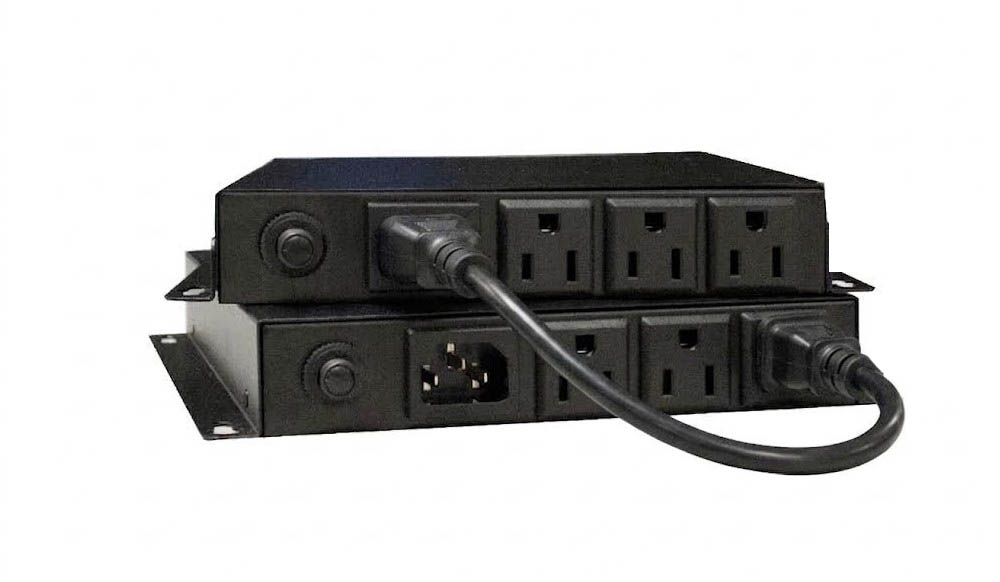
JX-200 with a J60-350
Isolated, battery-backed power for a single terminal, in two ultra-slim units built to the same footprint. The JX-200 can also be specified on its own where the load needs clean power but not backup.
Backup
350 VA / 200 W · 120 V · LiFePO₄
Ultra-slim lithium standby UPS rated to 50 °C, TAA compliant, wall or DIN-rail mount, 5-year warranty. Silent, fanless, and sized for locations that are not climate controlled.
Isolation
200 VA / 200 W · 120 V → 120 V · toroidal
Toroidal isolation transformer with neutral-to-ground bonding, surge diversion, and noise filtering. 1.25″ profile, (3) NEMA 5-15R, 5-year warranty.

Where it fits
- Point-of-sale and retail: checkout lanes, self-checkout, and back-office terminals. This is where the JX-200 sells most.
- Kiosks, ATMs, and digital signage players
- Security cameras, DVRs, and access control panels
- Embedded electronics in retail counters and millwork
Capacity note. The J60-350 is 350 VA / 200 W and the JX-200 is 200 VA / 200 W. Both are 200 W devices; the VA figures differ only because VA and watts diverge on low power factor loads. Size the protected load at 200 W.
1.35–1.93 kW · instrument level
XPD-IT isolation PDU with a P91
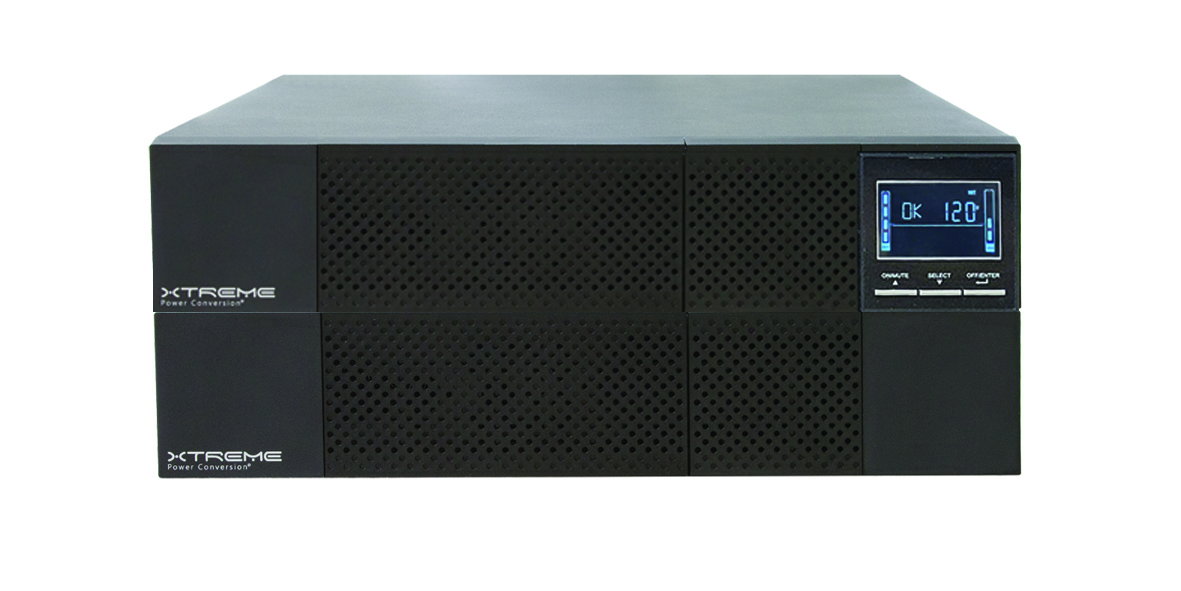
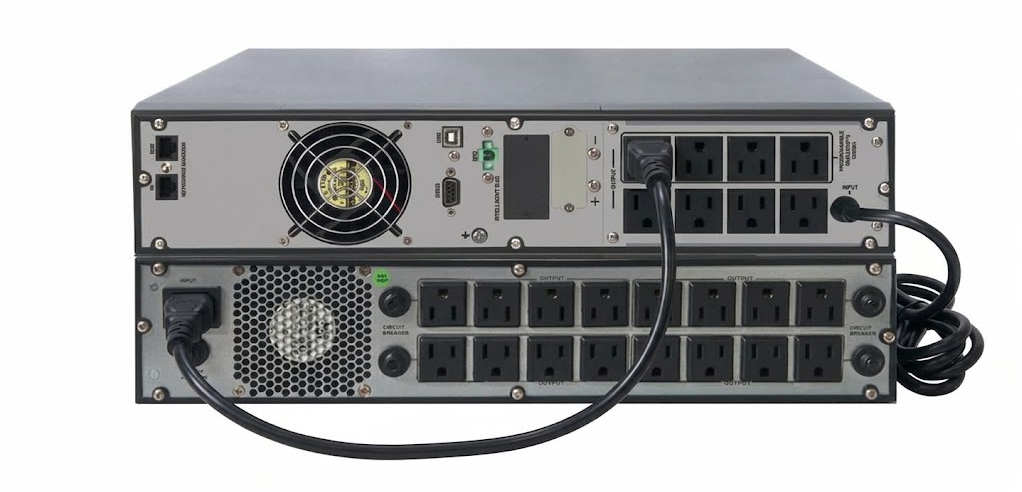
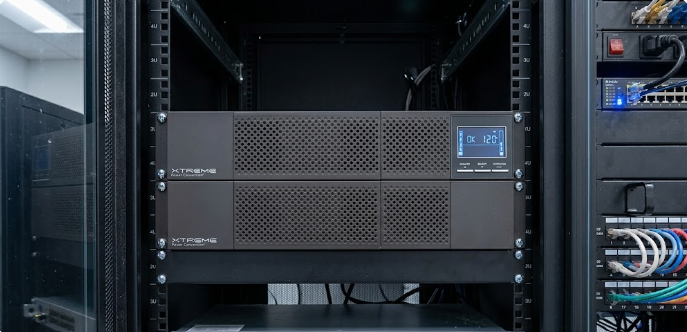
Isolated online double-conversion in two 2U units, 4U stacked. Zero transfer time from the P91, galvanic separation from the transformer, and sixteen isolated outlets for the instrument and its auxiliaries.
Backup and conditioning
1350–1930 W · 2U · online double-conversion
Rebuilds the output waveform continuously, so there is no transfer time and generator power is accepted rather than rejected. The Li versions add LiFePO₄ chemistry, 50 °C operation, hot-swappable batteries, and a 6-year warranty.
Isolation
1.5 / 2.0 kW · 120 V → 120 V · 2U
Heavy-duty galvanic isolation transformer in an all-metal 2U chassis with (16) outlets, per-bank breakers, and a detachable input cord. Rack, wall, or floor mount, 3-year warranty.
Matched pairings
| Transformer | Capacity | UPS | Real power |
|---|---|---|---|
| XPD-IT15LV | 1.5 kW | P91-1500 | 1450 W |
| XPD-IT15LV | 1.5 kW | P91-1.5kLi | 1350 W |
| XPD-IT20LV | 2.0 kW | P91-2000 | 1930 W |
| XPD-IT20LV | 2.0 kW | P91-2kLi | 1800 W |
Where it fits
- Residential and commercial AV: the largest market for these at 1.5 kVA and above. Ground loops between components on different circuits are the classic cause of hum in audio and banding in video, and that is common mode noise by another name. A transformer in the rack fixes it at the source rather than with ground-lift adapters.
- Analytical and laboratory instruments, including LC-MS, GC-MS, and HPLC systems
- Medical diagnostic and imaging equipment
- Industrial measurement, test, and control systems
- Broadcast and production racks on shared building power
Above 2 kW, isolation and voltage conversion arrive together
At this size the transformer usually has two jobs: it converts 208 V rack power down to 120 V, and it isolates. Most people specify one of these for the voltage change and get the isolation as a side effect. If isolation is the actual reason you are buying, that changes what you check.
If isolation is the goal, confirm it is an isolation transformer
An autotransformer will change voltage perfectly well, and it is lighter and cheaper. It shares a single winding between input and output, so it provides no galvanic separation and does nothing for common mode noise. Every XPD-IT model is a true isolation transformer with separate primary and secondary windings, which is why they weigh 137 to 209 lbs. If a competing quote is materially lighter or cheaper for the same kVA, check which one it is before comparing.
The two rules from the pairings above still apply at this size: put the transformer downstream of the UPS, and connect the sensitive equipment directly to its output rather than through another PDU.
| Model | Capacity | Voltage | Connections | Size & weight |
|---|---|---|---|---|
| XPD-IT60A | 6 kVA | 208 V → 120 V (or 240 V → 120 V) |
3 ft L6-30P input cord; (1) L6-30R and (12) 5-15/20R | 2U · 17.3 × 18.0 × 3.5 in · 137 lbs |
| XPD-IT6KW | 6 kVA | 208 V → 240/120 V (or 240 V → 240/120 V) |
Input and output terminal blocks; (2) L14-30R and (8) 5-15/20R | 3U · 17.3 × 32.8 × 4.7 in · 199 lbs |
| XPD-IT10KW | 10 kVA | 208 V → 240/120 V (or 240 V → 240/120 V) |
Input and output terminal blocks; (2) L14-30R and (8) 5-15/20R | 3U · 17.3 × 32.8 × 4.7 in · 209 lbs |
Choosing between the three
- XPD-IT60A if the loads are all 120 V and you want a plug-in install. It is the only one of the three with a cord rather than terminal blocks, and the only one at 2U. Note that 6 kVA system capacity is reduced by a 30 A input circuit.
- XPD-IT6KW if you need 240 V as well as 120 V at the same capacity. Terminal blocks mean an electrician, but you get a split output and 62 lbs more transformer.
- XPD-IT10KW for the same split output at 10 kVA.
Full detail on the plug-in model is on the 6 kVA isolation transformer PDU page, and the whole range including the LV models is on the isolation PDU page.
At 3.8 kVA and above, buy the TX91 instead
A pair is the answer below the TX91’s floor, not a cheaper substitute above it. Once the load justifies 3.8 kVA, the TX91 puts the same galvanic isolation inside the UPS: one chassis, one power cord, one warranty, one thing to service. The TX91L adds external battery systems where runtime has to reach hours rather than minutes.
And if you are not certain isolation is what you need at all, start with which power problems each UPS topology addresses. Common mode noise is the tenth of the ten and the only one double conversion alone does not cover. If it is not present at your site, isolation buys weight, depth, and cost for no measurable benefit.
Isolated UPS pairings: frequently asked questions
Why not just buy a TX91?
Capacity. The TX91 starts at 3.8 kVA, so below that there is no single-box isolated online UPS in the Xtreme Power range. A pair fills that gap. There is a second reason too: with a pair you can size runtime and isolation independently, replace either half without replacing the other, and add isolation to a P91 that is already installed. A TX91 cannot be unbundled.
Does the isolation transformer go before or after the UPS?
After. The transformer belongs downstream, between the UPS output and the load. Putting it upstream cleans the power going into the UPS, which is not the problem you are solving, and leaves the load exposed to whatever the UPS output and the building ground are doing. Downstream is what breaks the common-mode path to the protected equipment.
Is an autotransformer the same thing as an isolation transformer?
No, and the difference is the whole point. An autotransformer uses a single shared winding, so it will change voltage but the input and output stay electrically connected. It provides no galvanic separation and does nothing for common mode noise. An isolation transformer has separate primary and secondary windings with no electrical path between them, which is what breaks the common-mode path and establishes a clean ground reference. Autotransformers are lighter and cheaper for the same kVA, so if a quote looks unusually good on either count, confirm which one you are being offered.
How do I size the transformer?
To the load in watts, not to the UPS nameplate. If the instrument draws 900 W, an XPD-IT15LV at 1.5 kW is correct whether the UPS is a P91-1500 or a P91-2000. Sizing off the UPS rating is how you end up with a transformer running near 100% continuously. VA ratings are not much help here; most modern loads are close to unity power factor, so watts is the number that matters.
Can I plug the load into a power strip after the transformer?
It defeats most of the point. Isolation is established at the transformer output and nowhere else. A downstream strip or PDU with its own ground path reintroduces exactly what the transformer was installed to break. Connect the sensitive equipment directly to the transformer receptacles. This is the single most common reason an isolated installation fails to deliver what was paid for.
The JX-200 is 200 VA and the J60-350 is 350 VA. Do they actually match?
Yes, on the number that matters. The J60-350 is 350 VA / 200 W and the JX-200 is 200 VA / 200 W. Both are 200 W devices. The VA figures differ because VA and watts diverge on low power factor loads, which is largely a legacy of older equipment. Size the protected load at 200 W and the pair is matched. The JX-200 is also built to the J60-350 footprint, so they stack or mount together.
How far from the equipment can the transformer be?
As close as you can practically get it. Everything downstream of the transformer secondary is unprotected cable: it picks up interference from whatever it is bundled with, and it adds voltage drop. Isolating at a panel and then running a long branch to the equipment gives back a good part of what the transformer bought you. Same rack, same cabinet, or same counter as the load is the target.
Do these help with hum and buzz in an AV system?
Often, yes, and this is the largest single application for the 1.5 kVA and larger models. Hum in audio and banding in video usually trace to a ground loop between components fed from different circuits, which is common mode noise described in different words. A galvanic isolation transformer breaks the loop at the source. It is a proper fix rather than lifting a ground pin, which defeats a safety ground and does not address the underlying condition.
What problem does isolation actually solve?
Common mode noise, measured between ground and either neutral or line. It is the tenth of the ten common power problems and the only one that online double-conversion alone does not address. Galvanic separation breaks the common-mode path between source and load, limits harmonic coupling from equipment sharing the supply, and gives the load a stable ground reference. If your site has shared neutrals, ground loops, or instrumentation with a low noise floor, that is the condition to look for.
Does an isolation transformer reduce leakage current?
Yes, on the load side. Leakage current is what escapes to ground through insulation and filter capacitors rather than following the intended path, and separating the primary and secondary windings reduces how much of it reaches connected equipment. That is a large part of why isolation is specified around diagnostic imaging and laboratory instrumentation. One caution: this is not the same as a medical isolated power system. Patient-care areas covered by NFPA 99 use isolated power panels with a line isolation monitor, and an isolation transformer on a UPS does not replace one where code requires it.
Does isolation block DC on the incoming supply?
Yes. A transformer couples through alternating magnetic flux, so direct current does not cross from primary to secondary. DC offset on a supply, which can come from certain half-wave loads or from failing equipment upstream, will saturate transformers downstream of it and produce audible hum and extra heating in anything that has one. The isolation transformer stops it at the primary.
Do I need isolation, or would an online UPS be enough?
An online double-conversion UPS on its own addresses nine of the ten common power problems, which is enough for most equipment. Add isolation when the load is sensitive enough to see ground-referenced interference in its output rather than in its power: analytical instruments, mass spectrometers, electron microscopes, medical imaging. For general IT and network equipment it is usually not needed, and specifying it anyway buys weight, depth, and cost for no measurable benefit.
Are these sold as a single part number?
No. Each bundle is two line items, which is deliberate: it lets you match the transformer to the actual load rather than to a fixed pairing, and lets either half be replaced or upgraded on its own schedule. Quote both together and we will confirm the sizing before you order.
Confirm the sizing before you order
Send us the load in watts and the environment, and an application engineer will confirm the transformer size, the UPS model, and the connection order. Both pairings quote as two line items.