
UPS for PoE switches
A PoE switch carries data and power on the same cable, so it isn’t powering only itself — it’s the power supply for every device on every port. When utility power drops, the switch and all of its connected cameras, access points, phones, and door readers go dark at the same instant. The right UPS, sized for both the switch electronics and the PoE load it delivers, keeps that whole tree online through outages and disturbances. This guide covers how to size a UPS to a PoE power budget and which Xtreme Power platforms fit each load — for the closet form factor itself, see the IDF & MDF guide.

Network infrastructure runs on PoE — a single switch outage takes every powered device with it.
One switch, every powered device
A standard network switch only has to keep itself alive. A PoE switch is different — it’s the power source for everything plugged into it, so a single power interruption doesn’t drop one device, it drops the whole tree at once.
| When the PoE switch loses power | What goes down with it |
|---|---|
| IP security cameras | Surveillance goes dark — no live view and no recording across the coverage area |
| Wireless access points | Wi-Fi drops for every user in range of those APs |
| VoIP phones | Voice service is lost, including emergency calling |
| Access control & door readers | Badge readers and electronic locks can fall back to a default state |
| Building automation & IoT | Sensors, controllers, and automation nodes stop reporting |
A UPS keeps the switch and its powered devices running through outages and gives connected systems time to shut down gracefully during extended events.
Size the UPS to the PoE power budget
Sizing a UPS for a PoE switch has one extra step compared with an ordinary switch: the UPS has to carry the switch electronics plus the PoE power the switch delivers to its connected devices. Start from the PoE standard and port count, then add the switch’s own consumption.
| PoE standard | Per-port power | Typical powered devices |
|---|---|---|
| PoE — 802.3af | Up to 15.4 W | Basic cameras, VoIP phones, single-radio access points |
| PoE+ — 802.3at | Up to 30 W | PTZ cameras, dual-radio APs, video phones |
| PoE++ — 802.3bt Type 3 | Up to 60 W | Multi-radio APs, advanced cameras, thin clients |
| PoE++ — 802.3bt Type 4 | Up to 90 W | High-power APs, displays, powered building devices |
Worked example. A 24-port PoE+ switch, fully loaded, can deliver up to 24 × 30 W = 720 W of PoE, plus roughly 40–60 W for the switch electronics — about 780 W. Most switches cap total PoE at a fixed power budget that is often well below ports × maximum, so the switch’s rated PoE budget is the number to size from. For 780 W of real load, a UPS in the 1–1.5 kVA class provides capacity with margin for runtime.
Two practical rules: size to the switch’s published total PoE power budget rather than ports × maximum — the switch itself limits delivered PoE; and leave headroom so the UPS isn’t running at full load, which shortens both runtime and battery life. Use the UPS sizing tool to confirm runtime for your exact load.
UPS platforms by PoE load
These platforms cover PoE deployments from a single edge switch to a fully loaded rack stack, organized by capacity and PoE load. For the closet form factor — wall-mount, shallow cabinet, rack, or MDF room — see UPS for IDF & MDF closets.

350 / 600 VA · 120V or 230V · LFP · up to 15-yr battery
Ultra-compact protection for a small PoE switch feeding a handful of cameras or access points, plus edge networking gear.
- Sized for the smallest PoE budgets — a single af/at switch
- Fanless, silent LFP operation
- Long-life battery for distributed, low-access sites
- 120V or 230V models

600 VA · 120V or 208/230V · LFP · up to 15-yr battery · short-depth 1U
Backs a small PoE switch or a centralized power feed for a cluster of access points — switch electronics plus a modest af/at PoE budget. J60Ci covers 208/230V PoE environments; the short-depth 1U chassis also suits tight enclosures.
- Sized for a small PoE switch or a centralized access-point feed
- J60Ci covers 208/230V PoE environments
- Fanless, silent LFP operation
- Up to 15-year LFP battery life

1–3 kVA · 120V · LFP · up to 15-yr battery · 1U
Online double-conversion for a fully loaded PoE+ switch or a small switch stack — roughly a 1–1.5 kVA PoE budget — with clean power and switchable outlets for remote reboot.
- Online topology for continuous, conditioned power
- Covers a loaded PoE+ switch or a small stack
- Switchable outlets for remote device reboot
- Extended battery packs on the 2 and 3 kVA models scale runtime to hours
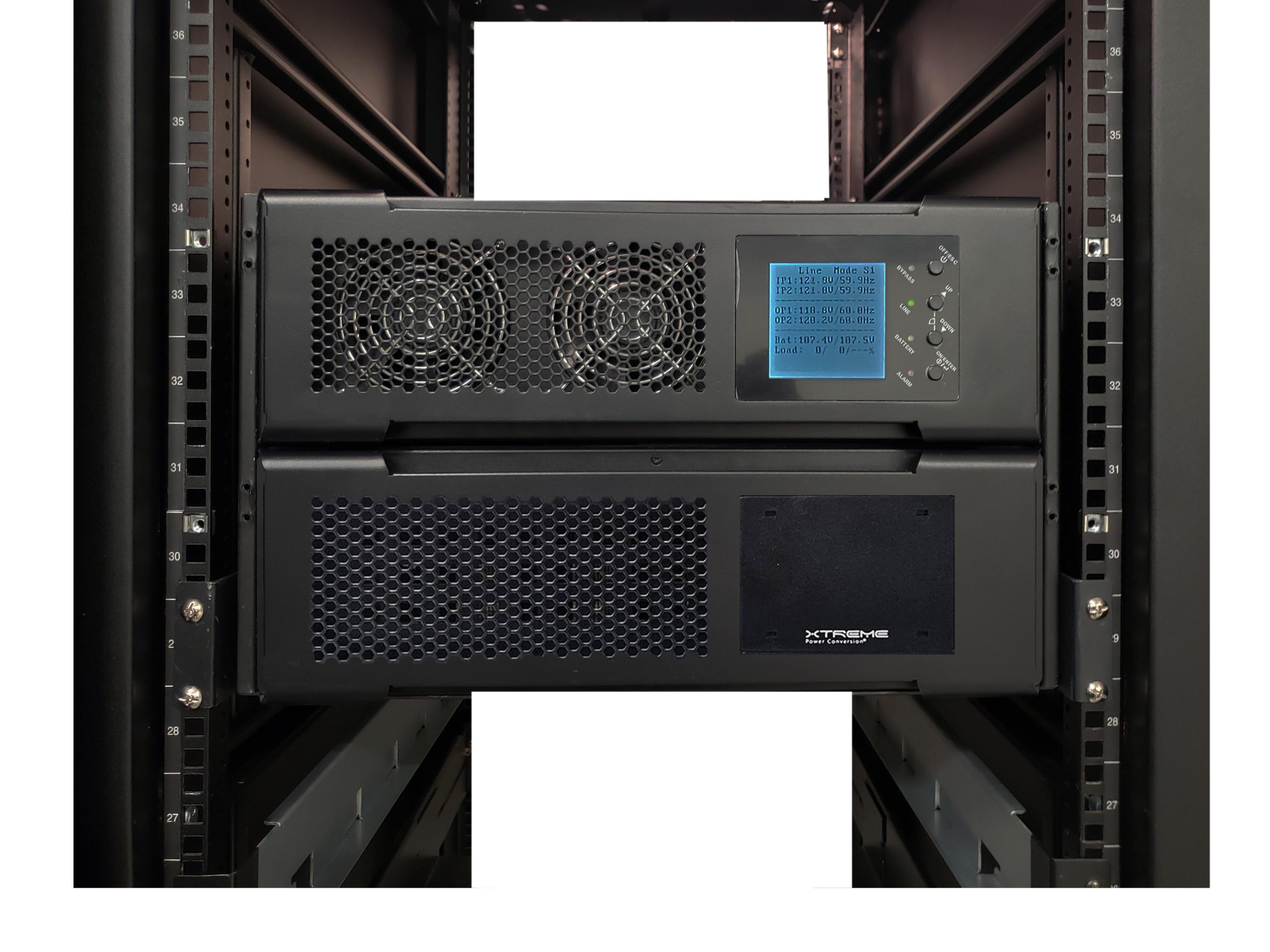
6–48 kW · 120/240V split-phase · modular · N+1
Scalable modular protection for large, multi-switch PoE deployments — add power and battery modules as the combined PoE budget climbs into the kW range.
- Scales from 6 to 48 kW across the M90S-2S / 4S / 6S / 12S family
- Hot-swappable power and battery modules
- N+1 redundancy for high availability
- Lead-acid battery; single-phase 120/240V
Match the platform to the PoE load
| Model | Capacity | Voltage | Battery | Typical PoE fit |
|---|---|---|---|---|
| J60 | 350 / 600 VA | 120V or 230V | LFP | A single edge PoE switch feeding a few cameras or APs |
| J60C / J60Ci | 600 VA | 120V or 208/230V | LFP | A small PoE switch, or centralized power for a cluster of access points |
| J90 | 1–3 kVA | 120V | LFP | A fully loaded PoE+ switch or a small switch stack (1–1.5 kVA) |
| J90i | 1–3 kVA | 208/230V | LFP | 208/230V PoE architectures and enterprise switching |
| M90S | 6–48 kW | 120/240V | Lead-acid | Large multi-switch PoE stacks with a combined budget in the kW range |
Where PoE UPS protection matters
A single PoE switch can power dozens of endpoints, so one UPS often protects many systems at once:
Lithium for distributed network closets
PoE switches often live in non-conditioned closets spread across many sites, where lead-acid batteries age faster and need recurring replacement. LiFePO₄ platforms (J60, J90, J90i) run reliably at elevated temperatures and last far longer, cutting maintenance trips across distributed infrastructure. At higher capacities, the scalable modular M90S uses lead-acid where added headroom and N+1 redundancy are the priority. For the full lifecycle, temperature, and cost breakdown, see the dedicated comparison: Lithium UPS vs lead-acid UPS →
PoE UPS questions
Do PoE switches need a UPS? Yes. A PoE switch powers its connected devices, so if the switch loses power, every camera, access point, and phone on it loses power and network connectivity at the same time.
What size UPS do I need for a PoE switch? Size for the switch electronics plus the total PoE power it delivers. Start from the switch’s rated PoE power budget (not ports × maximum), add the switch’s own draw, and leave headroom for runtime.
Can one UPS power multiple PoE switches? Yes. In a rack, one UPS commonly protects several switches plus routers and firewalls — as long as the combined load, including all PoE delivered, stays within the UPS rating.
How long will a UPS run a PoE switch? Runtime depends on UPS capacity and total PoE load; higher PoE loads draw the battery down faster. Extended battery packs (on platforms such as the J90) stretch runtime from minutes to hours.
PoE from an ONT in a passive optical LAN
In a passive optical LAN there may be no distribution switch to size for at all. The floor closet is replaced by unpowered optical splitters, and the optical network terminal at the edge sources PoE directly to the access points, phones, cameras, and readers behind it. The sizing arithmetic on this page applies unchanged; only the source device is different.
The trap is the same one, and sharper. A current enterprise ONT draws roughly 8 W on its own but up to 72 W when it is powering attached devices, because up to 60 W is handed out across its four ports. Size to the PoE-inclusive figure, not the ONT nameplate.
Where it goes & related guides
Size a UPS for your PoE deployment
Send us your switch models, port counts, and PoE standard, and our engineers will size the right UPS for the switch plus the cameras, access points, and phones it powers — with the runtime your site needs.