
UPS for network infrastructure
Different network equipment has different failure modes — and different UPS requirements. A PoE switch that loses power drops every powered device on every port simultaneously. A firewall that reboots mid-session drops every active connection. A VoIP gateway that goes down silences every phone in the building. This guide covers UPS specification by equipment type.
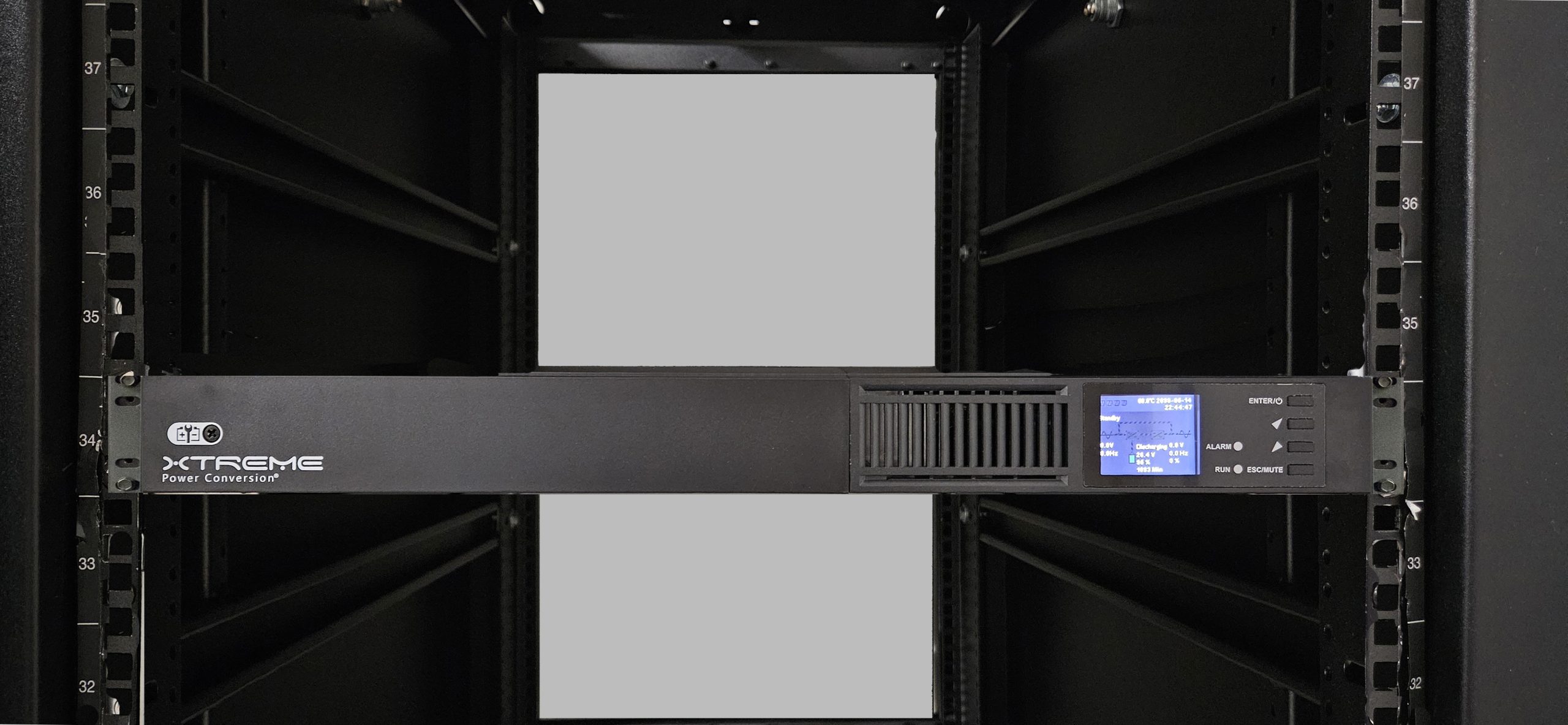
A J90 online lithium UPS protecting network switches and infrastructure in a standard IDF rack.
UPS requirements by network equipment type
Each equipment type in a network stack has distinct power sensitivity, failure consequences, and UPS requirements. Understanding these differences leads to better specification decisions than treating the rack as a single load.
A PoE switch doesn’t just carry data — it powers every device connected to it. IP phones, wireless access points, IP cameras, access-control readers, and digital displays all draw power through the Ethernet cable. When the switch loses power, every one of those devices goes dark at once. A single PoE switch outage can simultaneously disable communications, wireless access, surveillance, and physical security for an entire floor.
- Online double-conversion — zero transfer time to prevent device reset
- Capacity sized to switch load plus all PoE device draws
- Switchable outlets for remote reboot if the switch hangs
- High-temperature operation if the closet is non-conditioned
- SNMP monitoring for visibility into battery status
Online double-conversion, switchable outlets, remote reboot, 50°C operation, LiFePO₄ battery.
View J90 →Firewalls maintain stateful connection tables — a record of every active session. Even a brief interruption clears that state: user sessions drop, VPN tunnels disconnect, cloud applications lose connectivity. Reconnection may be automatic, or it may require manual intervention per session. For always-on services, a firewall reboot is a business-continuity event, not just a network inconvenience.
- Online double-conversion — zero transfer time, no session disruption
- Clean sine-wave output — some firewalls are waveform-sensitive
- Sufficient runtime for controlled failover or shutdown
- High reliability — firewalls are always-on infrastructure
- Monitoring integration for proactive management
Online double-conversion, clean sine-wave output, lithium service life for unmaintained closets.
View J90 →View P91Li → Compare →VoIP phones are usually powered by PoE from the switch, so protecting the switch protects the phones. The gateway or call server is the separate concern. In a power event, voice is often the most critical capability to keep — emergency calls, customer service, and internal coordination all depend on it. VoIP infrastructure typically needs longer runtime than data-only equipment: enough to ride through a longer outage, not just a momentary blip.
- Extended runtime — 20–30 minutes minimum for voice continuity
- Online double-conversion for zero transfer time
- Combined capacity for gateway plus PoE switch load
- Monitoring with alerts for low-battery conditions
- Reliable battery — VoIP is often the last system that should go dark
The J90 2kVA and 3kVA models deliver extended runtime at typical VoIP gateway loads — and accept EBP48 extended battery packs for multi-hour backup. P91Li suits higher combined loads or where rack/tower flexibility is needed.
View J90 →View P91Li →Access points draw PoE from the switch, so protecting the PoE switch protects the APs. The separate consideration is the wireless controller or management system — a dedicated appliance, a server, or a cloud platform. A controller that loses power can require manual intervention to restore AP association, which can take minutes per AP across a large campus. In bigger deployments, protecting the controller independently is worth planning for.
- PoE switch protection is primary — APs are powered through the switch
- Controller protection is secondary for on-premise managed deployments
- Compact form factor — controllers often in shallow or wall-mount enclosures
- Online protection for the controller to prevent association-table loss
The short-depth J60C fits the shallow enclosures controllers often live in; the J90 protects the PoE switch rack.
View J60C → Compare →View J90 →Remote network gear — a router and switch at a branch, a cellular gateway at an edge site, infrastructure in a retail location — shares one trait that changes the UPS math: a technician visit is expensive. Battery replacement isn’t just the battery; it’s the truck roll, the scheduling delay, and the downtime window. Across 20 or 50 sites, a 3–5 year lead-acid replacement cycle becomes a significant ongoing program. Lithium eliminates it.
- LiFePO₄ battery — eliminates battery-replacement truck rolls
- Remote reboot — switchable outlets or Smart PDU
- High-temperature tolerance — remote sites are often non-conditioned
- Compact form factor — wall-mount or shallow rack common
- SNMP monitoring — visibility without site visits
LiFePO₄ eliminates battery replacement; remote reboot avoids truck rolls for hung devices.
View J60C →View J90 →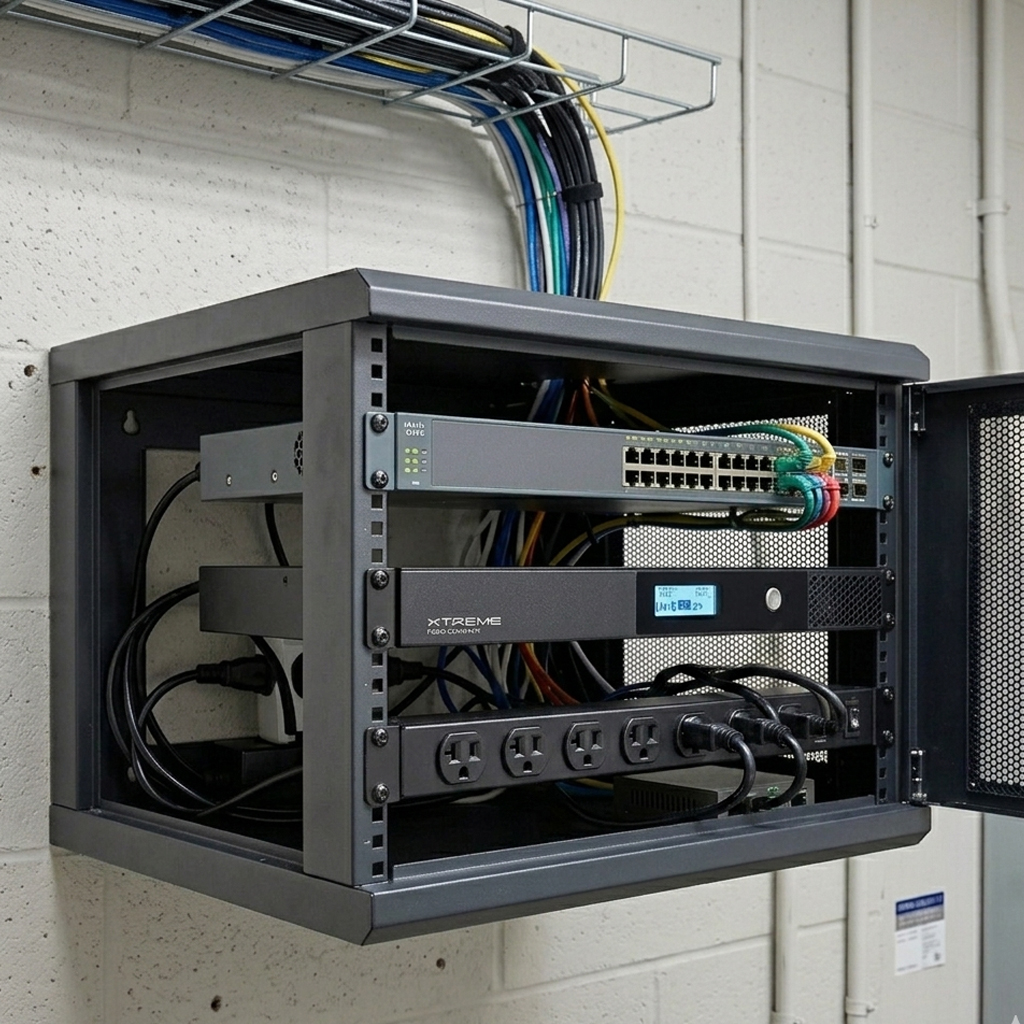
An Xtreme Power UPS in a wall-mount IDF rack alongside a PoE switch and PDU.
Equipment type to UPS — quick reference
| Equipment type | Recommended UPS | Key reason | Runtime target |
|---|---|---|---|
| PoE switch | J90 | Online, switchable outlets, remote reboot, 50°C; 2/3kVA for extended runtime | 10–20 min · longer with 2/3kVA |
| Core / distribution switch | J90 or P91Li | Online double-conversion, zero transfer time | 10–30 min |
| Firewall / security appliance | J90 or P91Li | Online, clean sine wave, zero transfer time | 15–30 min |
| VoIP gateway / call server | J90 2/3kVA or P91Li | Extended runtime at VoIP loads in 1U; EBP48 packs for longer | 20–30 min |
| Wireless controller | J60C | Compact; fits shallow enclosures where controllers live | 10–15 min |
| Wall-mounted switch / router | J60 | Mounts to wall or backboard, no cabinet needed | 5–15 min |
| Remote / edge site | J60C or J90 | LiFePO₄ eliminates battery-replacement truck rolls | 10–20 min |
Xtreme Power UPS platforms for network infrastructure

1kVA · 1.5kVA · 2kVA · 3kVA · 120V · to 50°C
The primary platform for standard IDF racks. Online double-conversion for switches, firewalls, and core equipment; switchable outlets enable remote reboot without a site visit; high-temperature operation for non-conditioned closets; LiFePO₄ eliminates replacement across distributed locations. The 2kVA and 3kVA models add extended runtime at equivalent load, and EBP48 extended battery packs scale runtime to many hours for generator transfer or VoIP continuity. 208/230V deployments use the J90i (same online platform).
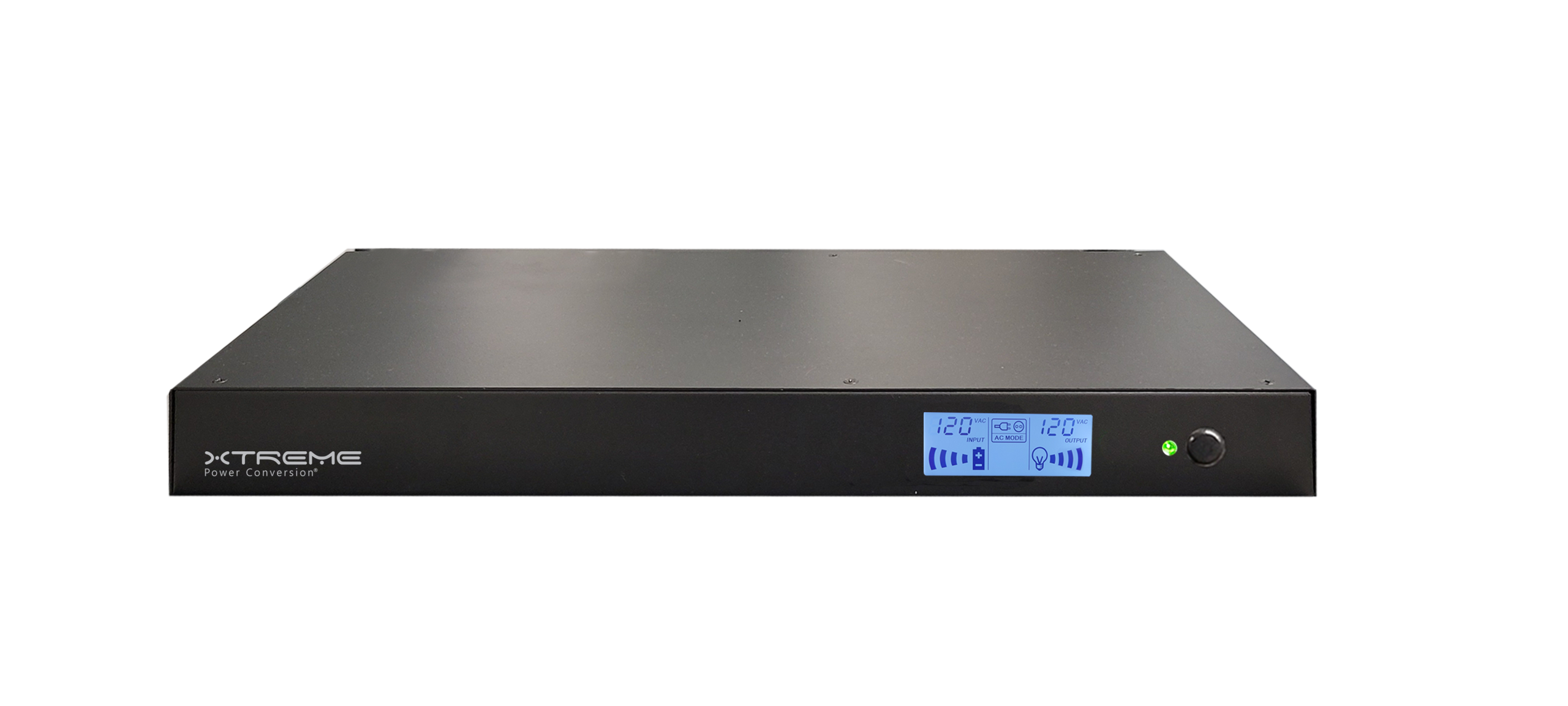
600VA · J60C 120V / J60Ci 208–230V · to 50°C
The solution for shallow cabinets and wall-mount enclosures where a standard-depth rack UPS won’t fit. Short-depth 1U form factor for structured-wiring cabinets, wall-mount enclosures, and shallow IDF installs. Same LiFePO₄ chemistry — no battery replacement across distributed sites. Rack or wall mount. Choose the J60C for 120V or the J60Ci for 208/230V.
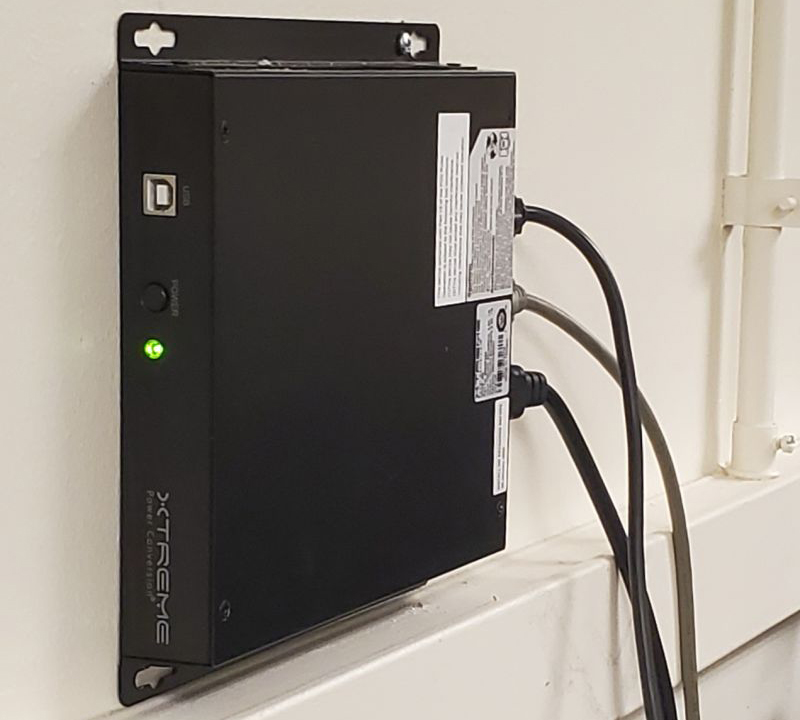
350VA · 600VA · 120V or 230V · to 50°C
For wall-mounted network devices with no cabinet — the only platform that mounts directly to a backboard. Wall, DIN-rail, or flat mount for equipment on open backboards and panels. Fanless — no noise, no moving parts. LiFePO₄ battery for the life of the installation.
Key factors in network UPS specification
Firewalls, core switches, and VoIP systems benefit from online double-conversion — zero transfer time and continuous conditioning. Standby UPS (J60, J60C/J60Ci) suits less-sensitive loads where a brief transfer is acceptable.
Telecom rooms, wiring closets, and IDF locations frequently lack dedicated HVAC. Lead-acid degrades rapidly above 25°C; all Xtreme Power lithium network UPS platforms operate to 50°C — the right choice for non-conditioned spaces.
The J90’s switchable outlets enable remote reboot of an individual device — a frozen switch or hung firewall — without dispatching a technician. For distributed deployments, this often justifies the platform on its own.
Many IDF cabinets and wall-mount enclosures are 12–16 inches deep — too shallow for a standard 1U rack UPS. The J60C/J60Ci short-depth design solves this directly. Verify cabinet depth before specifying any rackmount UPS.
Most network UPS deployments need 10–20 minutes — enough for a brief utility event, generator transfer, or controlled shutdown; VoIP typically warrants 20–30. The J90 2kVA/3kVA models provide extended runtime in a 1U footprint, and EBP48 extended battery packs scale runtime to many hours — often removing the need for a larger tower UPS.
Lead-acid replacement every 3–5 years across 20 or 50 sites is a significant operational program. LiFePO₄ batteries rated for up to 15 years in ideal conditions eliminate most of it — and the truck rolls that go with it.
Looking for installation-specific guidance by closet type — wall-mounted backboards, shallow cabinets, standard IDF racks, MDF rooms? This guide covers selection by equipment type; the IDF/MDF guide covers it by installation environment.
UPS for IDF & MDF closets →Network infrastructure UPS — frequently asked questions
What size UPS do I need for network infrastructure?
Do all network devices need the same UPS?
Why use a lithium UPS in network closets?
Should a network UPS be online or line-interactive?
How much runtime does network equipment need?
Talk to an Xtreme Power engineer about your network infrastructure
UPS sizing, runtime planning, model selection, and deployment strategy for network switches, firewalls, VoIP, and distributed edge infrastructure.
Related guides & solutions
Guides & environments
Technology & tools
Comparisons