
Home Automation and CEDIA UPS Solutions
A smart home that reboots during a power event isn’t smart — it’s a liability. AV processors, lighting control systems, home networks, and automation controllers all lose state when power fails. For CEDIA integrators, choosing the right UPS is part of delivering a system that works reliably and doesn’t generate service calls.
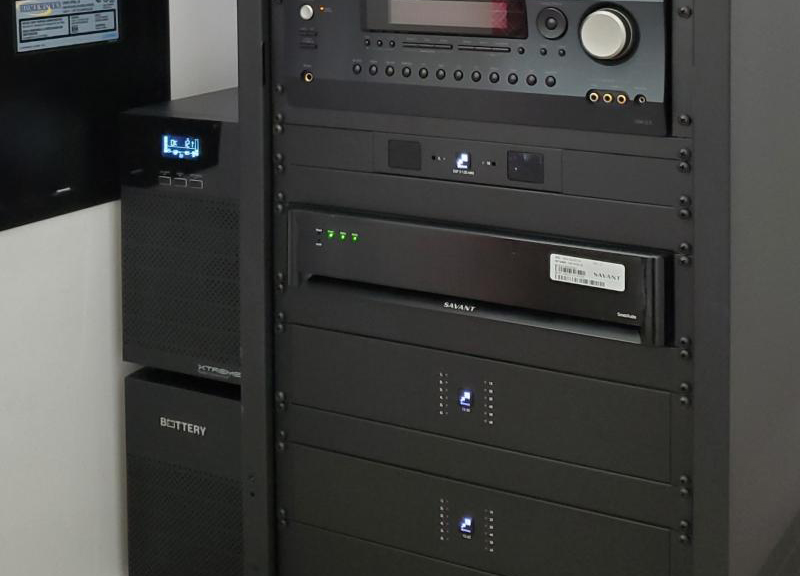
What happens when smart home power fails
Control4, Crestron, Savant, and Lutron processors can take 2–5 minutes to reboot and re-establish device communication. A UPS keeps these systems running through brief power events, preventing the reboot from happening at all.
A UPS for the automation processor means nothing if the router, PoE switch, or gateway loses power at the same time. The UPS strategy needs to cover the entire network stack — router, switch, WAPs — not just the AV rack.
CEDIA integrators managing smart homes under service contracts need to recover stuck devices remotely. SPDU Smart PDUs and J90 switchable outlets allow remote power cycling — eliminating a service visit for what’s often a simple device lockup.
UPS solutions for smart homes and residential AV
The J60 fits inside structured wiring enclosures on a DIN rail or mounts directly on the enclosure wall. Completely fanless — no noise in bedrooms, living rooms, or closets. LiFePO₄ battery eliminates mid-contract replacement visits. The J60C adds short-depth 1U rack form factor for shallow AV credenzas and wall-mount network cabinets.
View J60 / J60C → Compare →Short-depth 1U and 2U line-interactive UPS platforms for residential deployments where lithium isn’t specified and cost is a primary constraint. Wall-mount brackets included. Arriving September 2026 — check the product page for availability and dealer pricing.
Check availability → Compare →Online double-conversion with individual outlet switching — the J90’s per-outlet control allows remote power cycling of specific devices without affecting the rest of the rack. Critical for CEDIA integrators managing smart homes remotely. LiFePO₄ battery and 50°C operation — no replacement needed for the life of the installation.
View J90 → Compare →Online double-conversion in a convertible rack/tower form factor. External battery packs for extended runtime — useful in homes without generator backup where longer ride-through is needed. SNMP/web monitoring for remote visibility. LiFePO₄ battery chemistry — no replacement across the service contract.
View P91Li → Compare →Modular single-phase UPS for whole-home and estate-level installations — covering multi-rack AV systems, whole-home lighting control infrastructure, comprehensive network distribution, and centralized security systems from a single scalable UPS architecture. N+1 redundancy available.
View M90S → Compare →Three-phase online lithium UPS for large estate deployments — whole-home AV infrastructure, lighting control systems, comprehensive networking, and security across a large residential footprint. Hot-swappable battery modules — maintenance without downtime. The same platform deployed in stadiums and broadcast facilities.
View Li90 → Compare →Choosing the right UPS for your smart home project
| Application | Recommended UPS | Key reason |
|---|---|---|
| Structured wiring enclosure | J60 / J60CView → | DIN rail mount · fanless · silent · fits inside enclosure |
| Router, PoE switch, WAPs | J60 / J90View J90 → | Network uptime during power events maintains smart home connectivity |
| Automation processor — Control4, Crestron, Savant | J90View → | Online protection · outlet-level remote reboot for stuck processors |
| Home theater and media room | P91LiView → | Extended runtime · lithium · monitoring for standalone room systems |
| Whole-home or multi-rack AV | M90SView → | Scalable modular · covers full home infrastructure from one system |
| Large estate — mission-critical AV | Li90View → | Three-phase lithium · 10–30kW · hot-swap batteries |
| Remote reboot and managed service | SPDU Smart PDUView → | Outlet-level switching · eliminate service visits for device lockups |
If the theater hums, the problem is usually a ground loop
Backup power and hum are separate problems, and a UPS on its own does not solve the second one. In a residential install the projector, the amplifiers, the head-end rack and the subwoofer are often on different circuits, sometimes on different panels. Those grounds sit at slightly different potentials, and the difference drives current through every interconnect and HDMI run between them. It arrives as noise.
- Hum through the speakersConstant low-frequency hum at any volume, unchanged by source selection.
- Bars drifting through the pictureFaint horizontal bands moving through the projector or display image.
- Noise that appears on connectionEverything is quiet until the subwoofer, projector or a remote zone is cabled in.
- Worse in larger homesSymptoms grow as the system spans more circuits, more floors, or a detached structure.
- Cable or satellite feed humA coax feed entering the house from a different ground reference is a classic offender.
- Buzz that tracks the dimmersLighting dimmers inject noise onto shared circuits, which couples into audio through the ground path.
Why a UPS or a power conditioner does not fix it
Surge suppressors, filters and even double-conversion UPS all work on the waveform. A ground loop is not a waveform problem, it is a connection problem: two grounds joined through your signal cabling. Nothing that cleans the voltage will break that path. This is common mode noise, measured between ground and either neutral or line, and it is the one entry on the list of ten common power problems that online double-conversion alone does not address.
Do not lift the ground pin
A ground-lift adapter will usually silence the hum, and it does it by defeating the safety ground on that component. That is a code violation and a shock hazard, and the underlying condition is still there. Treat it as a diagnostic only: if lifting the ground stops the noise, you have confirmed a ground loop and you know an isolation transformer will fix it properly. Then put the ground back.
What actually fixes it
A galvanic isolation transformer. Primary and secondary share no copper, so power crosses as magnetic flux and the load gets its own derived neutral-to-ground reference. There is no longer a potential difference for current to flow through, so the loop is broken at the source rather than masked at the symptom. It also blocks DC riding on the incoming supply, which can saturate the transformers inside amplifiers and produce mechanical hum from the chassis itself. Two rules decide whether it works: put the transformer downstream of the UPS, and put it close to the equipment, in the same rack or enclosure, because everything past the transformer secondary is unprotected cable again.
Which isolation product fits
- XPD-IT15LV / XPD-IT20LV, 1.5–2 kW — the usual answer for a head-end rack or a theater rack. A 2U isolation transformer PDU with sixteen outlets, 120 V in and out. Pairs with a P91 where the rack also needs battery backup.
- JX-200, 200 W — for a single automation processor, a network switch or a signage player in a structured wiring enclosure. Ultra-slim at 1.25″, and built to the same footprint as the J60-350 so the two stack.
- XPD-IT60A, 6 kVA — for estate-scale racks fed at 208 V that need 120 V equipment power, converting and isolating in one chassis.
Sizing, wiring order and the full pairing detail are on the UPS with isolation transformer page.

Common questions from CEDIA integrators
Why does the home theater hum, and will a UPS fix it?
A UPS alone will not. Hum through the speakers and bars drifting through the picture almost always trace to a ground loop: the projector, amplifiers and head-end rack sit on different circuits at slightly different ground potentials, and the difference drives current through the interconnects between them. That is a connection problem rather than a waveform problem, so surge suppression and filtering do not reach it. A galvanic isolation transformer does, because primary and secondary share no copper and the rack gets its own derived ground reference.
Should I use a ground-lift adapter or a cheater plug?
No. It silences the hum by defeating the safety ground on that component, which is a code violation and a shock hazard in a home. Use it only as a diagnostic: if lifting the ground stops the noise you have confirmed a ground loop, and an isolation transformer will fix it properly. Then put the ground back.
What size isolation transformer does a theater or head-end rack need?
Size it to the load in watts, not to the UPS rating. The 1.5 kW and 2 kW rack models cover most theater and head-end racks. A JX-200 at 200 W suits a single automation processor or switch in a structured wiring enclosure. Mount the transformer in the same rack as the equipment, because everything past its output is unprotected cable again.
Why do smart homes need a UPS?
Power interruptions cause automation processors, networking gear, and AV systems to reboot — losing state, dropping device communication, and requiring manual recovery. A UPS bridges brief utility events so the smart home keeps running without intervention. For CEDIA integrators, it also prevents the service call that follows every power event at an unprotected installation.
Why choose a lithium UPS for residential AV?
LiFePO₄ lithium UPS systems are rated for up to 15 years service life and 3,000–5,000 discharge cycles. In a residential installation, that means no battery replacement for the life of most service agreements — unlike lead acid batteries which typically need replacement every 3–5 years. Lithium systems are also quieter, smaller, and operate at a wider temperature range than lead acid equivalents.
Can I reboot devices remotely without visiting the client site?
Yes. The J90’s individual switchable outlets allow per-device power cycling remotely via SNMP or web interface. The SPDU Smart PDU provides outlet-level switching and metering for any rack — pair it with any UPS for complete remote control. For CEDIA integrators managing multiple client homes under service agreements, this eliminates truck rolls for the majority of device lockup events.
Which UPS is best for my smart home or AV installation?
For small loads and structured wiring enclosures, the J60 or J60C covers control hubs, routers, and WAPs with a fanless silent design. For AV racks and PoE switches with remote reboot requirements, the J90 is the recommended platform. For media rooms and larger AV racks, the P91Li covers 1–3kVA with extended runtime options. For whole-home or estate-level backup, the M90S scales from 6kVA to 48kVA from a single modular system.
What warranty is included?
Lithium platforms — J60, J60C, J90, P91Li, Li90 — carry a 5 or 6-year warranty including electronics and battery. LiFePO₄ batteries are rated for up to 15 years service life under ideal conditions. For CEDIA integrators, a 5 or 6-year warranty covering the battery eliminates the mid-contract replacement conversation with the client.
Talk to us about your smart home project
Load calculations, runtime planning, enclosure compatibility, remote reboot configuration, and product selection for CEDIA and residential AV integrators.