
How to choose a lithium UPS
A practical guide to choosing a lithium UPS: battery chemistry, standby versus online topology, sizing and runtime, operating temperature and lifecycle cost. For the full product range, see lithium UPS systems.

What is a lithium UPS?
A lithium UPS is an uninterruptible power supply that uses lithium battery technology instead of conventional VRLA lead-acid. The electrical architecture — standby, line-interactive, or online double-conversion — works the same regardless of chemistry. What changes is how the battery performs over time, across temperature, and across maintenance cycles.
Xtreme Power lithium UPS systems all use LiFePO₄ (lithium iron phosphate) chemistry — the chemistry specified for stationary power for its thermal stability, long cycle life, and predictable degradation, rather than NMC, which prioritizes energy density over safety and longevity.
The core practical difference: LiFePO₄ batteries are rated for up to 15 years in ideal conditions, where VRLA typically needs replacement every 3–5 years. For one site that’s a cost consideration; across 50 distributed sites it’s a significant operational program.
LiFePO₄ vs NMC — why chemistry matters
Not all lithium UPS systems use the same chemistry. LiFePO₄ and NMC are the two most common in UPS applications, with meaningfully different performance profiles — worth understanding when comparing lithium platforms across vendors.
LiFePO₄ trades some energy density for far better thermal stability, longer cycle life, and more predictable degradation — the characteristics that matter in a UPS, which sits ready for years and must work when called upon.
- Most thermally stable common lithium chemistry; far lower thermal runaway risk than NMC
- 3,000–5,000 discharge cycles at standard depth
- Up to 15-year service life in ideal conditions
- Flat discharge curve — consistent voltage output
- Well-established safety profile in infrastructure
- Chemistry used in all Xtreme Power lithium UPS systems (Li90 fire safety documentation)
NMC offers higher energy density — more energy per kilogram — which suits applications where weight and volume dominate, such as EVs and portable electronics. For stationary UPS use, the tradeoffs are less favorable.
- Higher energy density — smaller and lighter at equal capacity
- Greater thermal sensitivity than LiFePO₄
- Shorter cycle life in most UPS operating profiles
- Used by some UPS vendors as a LiFePO₄ alternative
- More appropriate for portable and mobile applications
Choosing the right lithium UPS topology
LiFePO₄ batteries are available across all three major UPS topologies. The chemistry advantages (longer life, high-temperature tolerance, far fewer battery replacements) apply regardless of topology. The topology choice is driven by load sensitivity and protection requirements.
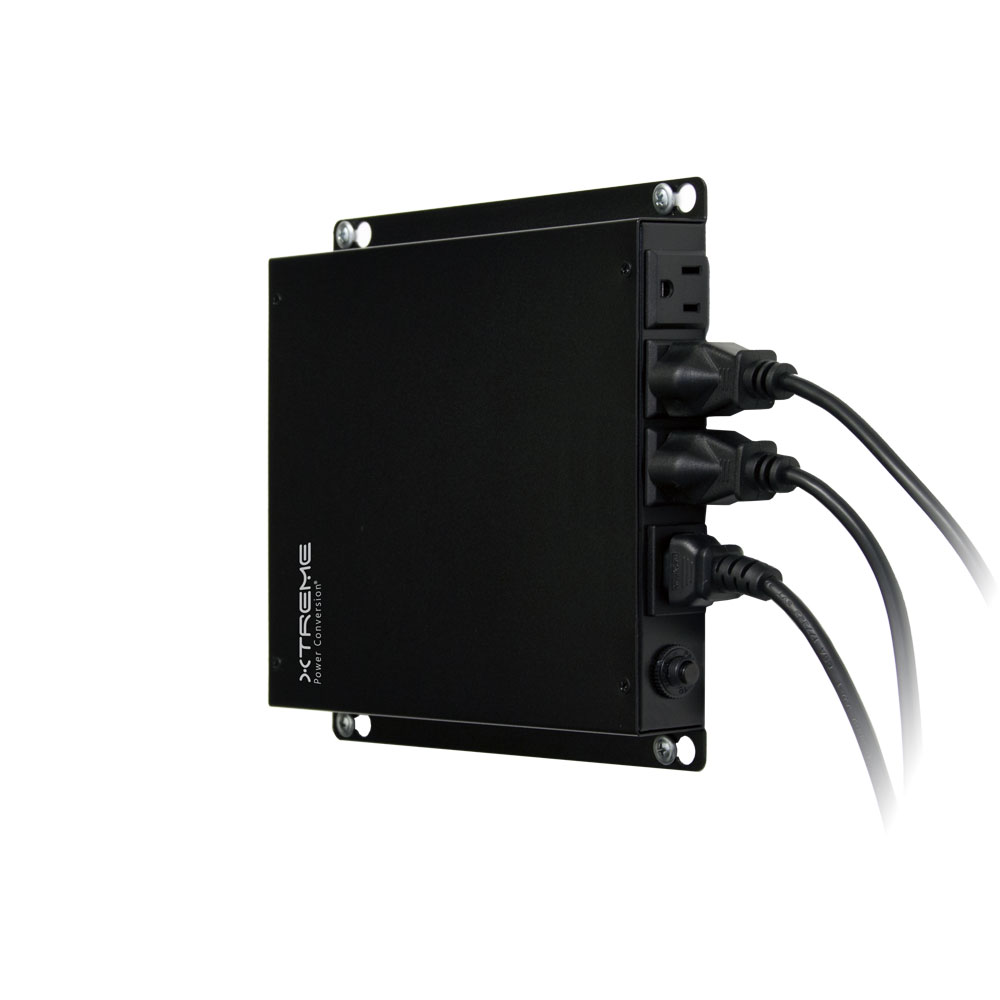
Passes utility power straight to the load, switching to battery on outage with a brief transfer (typically under 10 ms). The right choice where a brief transfer is acceptable and compact form factor is essential — the J60 fits behind kiosk displays and on DIN rails inside control panels, places a conventional UPS cannot reach.

Continuously converts power through the inverter — zero transfer time, continuous conditioning. The load always runs on clean power regardless of utility conditions. Required for sensitive IT, servers, medical devices, and automation that tolerate no transfer delay.
Online double-conversion three-phase protection for large-scale infrastructure. The Li90 integrates LiFePO₄ batteries internally — no external battery cabinets — with hot-swappable modules in a 12.6″ slim cabinet, replacing legacy three-phase VRLA plus external-battery systems with a single unit.
Key factors in lithium UPS specification
The factors that most frequently drive lithium UPS specification — each links to the guide that covers it in depth.
Lead-acid is rated at 25°C; above that, service life roughly halves per 10°C rise. LiFePO₄ operates reliably to 50°C. If your location regularly exceeds 30°C, lithium is the practical choice; at or below 25°C, both perform as specified.
UPS for harsh environments →Lithium has a higher upfront and a lower lifecycle cost. The crossover depends on site count, replacement frequency, and technician cost. For many-site deployments the math favors lithium clearly; for a single easy-access site, lead-acid may win.
Full cost comparison →Lithium energy density enables form factors lead-acid cannot — UPS that fit behind kiosk displays, on DIN rails inside control panels, or in shallow cabinets. For standard rack and tower, both chemistries are comparable.
Lithium UPS range →Where replacement access is hard — sealed panels, remote sites, limited windows — a LiFePO₄ battery rated for up to 15 years largely removes a recurring burden. Where access is easy and replacement is an established program, lead-acid is manageable.
Lithium vs lead-acid guide →Lithium UPS by deployment environment
Each environment has specific requirements that shape UPS selection — not just chemistry, but topology, form factor, and monitoring. The guides below cover each in depth.
J60 · J60C · Li90
Read the guide →J60 · J60C · J90 · P91Li · Li90
Read the guide →J60 · J60C · J90 · JX Series
Read the guide →TX91 isolation UPS · 3.8–10 kVA (lead acid)
Read the guide →J90 · P91Li · Li90 (lithium) · M90S · M90U (lead acid)
Read the guide →Sizing a lithium UPS
Most sizing mistakes come from sizing in VA, ignoring heat, or assuming runtime from a full-load figure. Six steps get it right.
2. Leave headroom. Plan for the load to sit at about 75 to 80% of the UPS watt rating, so growth and inrush do not trip it to bypass.
3. Read runtime at your load. Runtime rises steeply as load falls: a unit that runs 8 minutes at full load may run 20 or more at half load. Use the published runtime table, not the full-load figure.
4. Account for heat. LiFePO₄ runs to 50 °C, but some compact models derate output above 40 °C, and warranty terms shorten for continuous operation between 40 and 50 °C.
5. Check recharge. If outages come in clusters, recharge time matters as much as runtime. Lithium models recharge in roughly 1.5 to 4 hours, depending on model.
6. Plan for more runtime. If the runtime you need is beyond the internal battery, choose a model that accepts external packs (for example the J90 2 and 3 kVA) or step up a size.
Not sure? Use the UPS selector or call (800) 582-4524 for a sizing check.
The Xtreme Power lithium range at a glance
All Xtreme Power lithium UPS systems use LiFePO₄ chemistry. The range covers 350 VA to 30 kW across single-phase and three-phase architectures.
Compare all lithium models side by side on the lithium UPS systems page →
Lithium UPS vs Lead-Acid UPS
Full comparison — lifecycle, temperature, cost, and a decision framework for choosing between chemistries.
Above 30 kW: lithium battery cabinets for three-phase UPS
The product line above covers 350 VA to 30 kW. For 50–700 kW three-phase systems, the X90 Series pairs with Vision REVO TP Series LFP battery cabinets — 20.5 to 51.2 kWh per cabinet, up to 410 kWh per system.
Choosing a lithium UPS: frequently asked questions
Do I need an online or a standby lithium UPS?
How do I size a lithium UPS?
What is the difference between LiFePO4 and NMC?
How long do lithium UPS batteries last?
Are lithium UPS batteries safe?
When is lead acid still the better choice?
Is a lithium UPS worth the higher upfront cost?
Talk to an Xtreme Power engineer about lithium UPS selection
Product selection, runtime sizing, lifecycle modeling, and deployment planning across single-phase and three-phase lithium UPS platforms.
Related guides & platforms
Technology & products
Deployment guides