
Li90 lithium UPS fire safety
The Li90 guards against battery fire with three independent layers of protection, each backing up the one before it, sized for a UPS that holds no more than 8.64 kWh.
Scaled to a UPS, not a storage plant
The Li90 is built for short ride-through and orderly shutdown. Each battery module holds 2.88 kWh, and a fully populated cabinet holds 8.64 kWh.
The cells are lithium iron phosphate (LFP). LFP starts thermal runaway at a higher temperature and releases less energy in runaway than the nickel-based chemistries used in consumer and EV batteries.
The UPS is listed to UL 1778, the battery modules to UL 1973, and the modules are UN 38.3 transport tested.
Three layers of protection
-
Battery management system
The BMS monitors cell voltage, current and temperature. On overtemperature it stops charge and discharge, removing the main source of internal heating while the cells are still far below runaway.
-
Per-module DC-DC converter
Each 57.6 Vdc module feeds the 240 Vdc bus through its own isolated DC-DC converter. The converter has its own heat sensors and shuts down on overtemperature, even if the BMS does not act. Fuses on its input and output clear a short. A faulted module disconnects itself, and the other modules keep carrying the load.
-
Heat-activated suppression in every module
If both active layers fail, five sealed suppression capsules mounted inside the top of the module release a clean extinguishing agent directly at the source. They are triggered by heat alone: no power, sensor, wiring or controller is involved, so they work even if every electronic system has failed.
The suppression capsules
The capsules are thin polymer sheets holding a clean agent that is electrically non-conductive and leaves no residue on electronics.
| Parameter | Value |
|---|---|
| Activation temperature | 140 °C ± 10 °C |
| Trigger | Passive, heat-activated |
| Response time | 50 ms or less |
| Capsules per module | 5 |
| Protected volume per capsule | 10 L |
| Mounting | Top interior of each battery module |
Why 140 °C
LFP cells pass through a slow self-heating stage before thermal runaway, which begins at about 170 °C. Releasing agent at 140 °C cools the cells during self-heating, before runaway can start.
Enough agent to spare
The agent’s design extinguishing concentration is 4.5 to 6%. One capsule reaches about 5% in its rated 10 L. With all five capsules released into the module’s 23 L interior, concentration reaches about 11%, roughly twice the design value.
Test results
In factory testing, a battery module was heated with an external source until it was forced into thermal runaway.
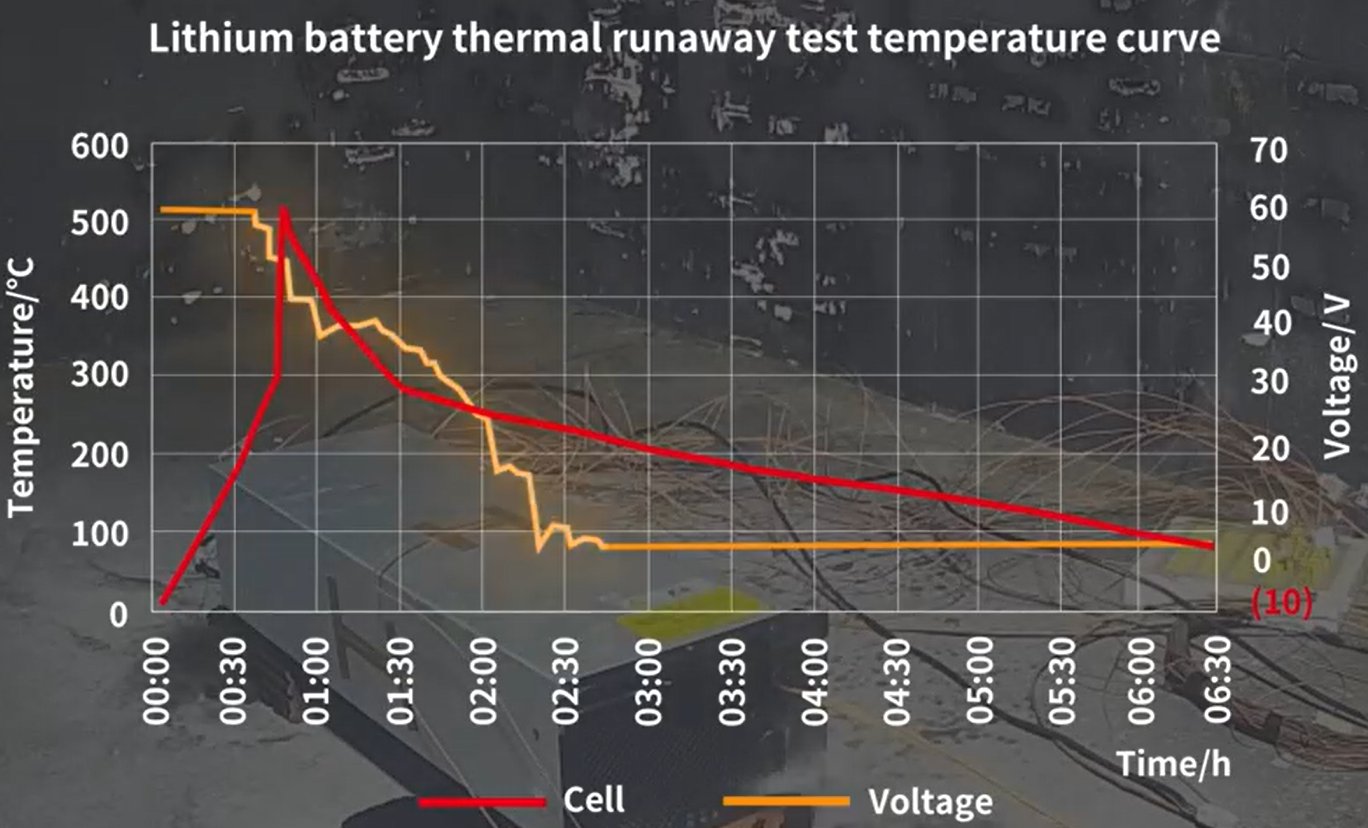
In a multi-module system test, adjacent modules did not go into thermal runaway. The fault stayed in the module where it started.
Integrating with building systems
The Li90 does not include off-gas detection, smoke detection or a ventilation purge system. These are typically specified for large stationary energy storage installations rather than UPS battery cabinets of this size. Where a project requires them, they can be added externally:
- Off-gas detection. Third-party electrolyte vapor sensors can be mounted at the cabinet fan outlets.
- Smoke and heat detection. Provided by the building fire alarm system.
- Signaling the UPS. The Li90’s input dry contact can be assigned to several functions, including charge disabled (the factory default), discharge disabled and remote on/off. Wired to charge disabled, an external alarm stops battery charging while the UPS keeps supporting the load.
Operation and service
The fire protection needs no user action or routine maintenance.
- Keep the room within the rated 0 °C to 50 °C and keep fan inlets and outlets clear.
- The capsules are sealed inside the module and are not user-serviceable. Do not open a module.
- If a module has overheated or shows smoke or odor, do not reinstall it. Remove it from service and contact XPC Technical Support at 800.582.4524 ext 2 or support@xpcc.com.
Full procedures are in the Li90 and Li90-BM user manuals on the Li90 product page.
Frequently asked questions
Does the Li90 have built-in fire suppression?
Yes. Every battery module contains five sealed, heat-activated suppression capsules that release a clean extinguishing agent at 140 °C.
Do the suppression capsules need power or maintenance?
No. They are triggered by heat alone and need no power, wiring or controller. They are sealed inside the module and are not user-serviceable.
What happens if one battery module fails?
The faulted module disconnects itself through its own DC-DC converter. The remaining modules keep supporting the load at reduced runtime, and the failed module can be hot-swapped.
What battery chemistry does the Li90 use?
Lithium iron phosphate (LFP), which has a higher thermal runaway onset and lower energy release than nickel-based lithium chemistries.
Does the Li90 include off-gas or smoke detection?
No. Off-gas and smoke detection can be added externally and connected to the Li90’s input dry contact, which can be set to disable battery charging on alarm.
Questions for your project
For certificates, data sheets, or help coordinating the Li90 with your engineer and local fire official, contact our applications team at 800.582.4524 or sales@xpcc.com.
Related: Li90 product page · Lithium UPS guide · Lithium vs lead-acid UPS