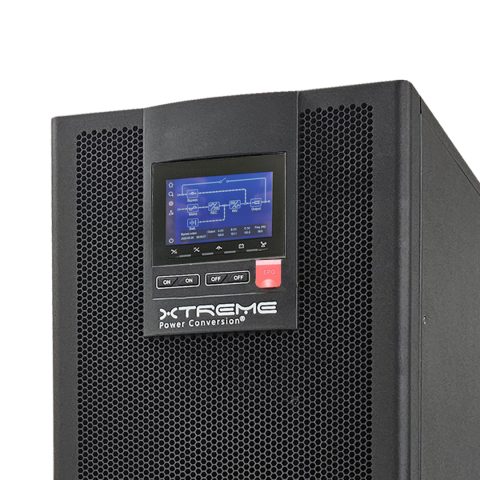


Li90 Integrated 3-Phase Lithium UPS (10–30 kVA)
10–30 kVA | 208/120V Three-Phase | Online Double Conversion
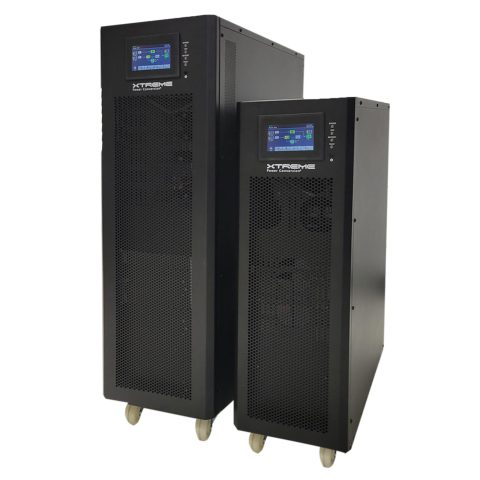
Integrated lithium UPS platform engineered to modernize electrical room infrastructure by eliminating external batteries, reducing maintenance, and improving long-term performance predictability.
Lithium inside the cabinet — no external battery cabinet
Lithium energy storage, built into the cabinet
The Li90 puts the batteries inside the UPS cabinet. Traditional three-phase systems depend on external VRLA cabinets that add footprint, wiring, and a recurring replacement cycle. Consolidating both into one enclosure shrinks the installation, improves service access, and takes battery replacement out of the operating budget.
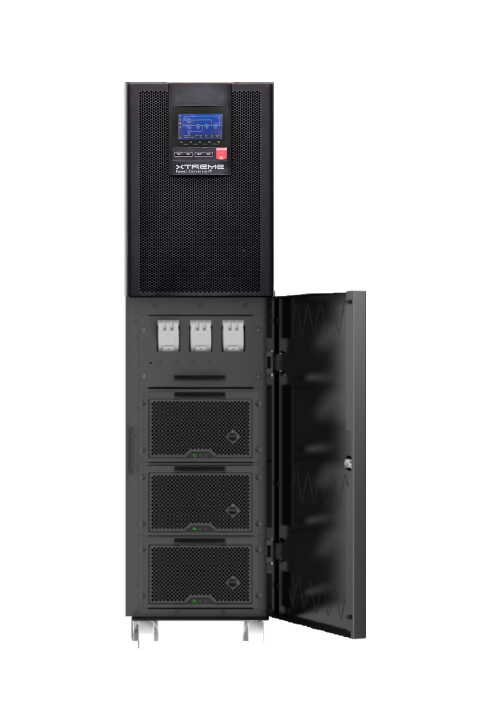
Each 57.6 Vdc LFP module carries its own DC-DC converter to the 240 Vdc bus, so modules run in parallel rather than as one high-voltage series string. Battery quantity becomes a configuration choice, a removed module does not open the string, and the low module voltage keeps hot-swap service within safer working limits.
Unity power factor delivers full usable capacity — kVA = kW — at every rating. A three-level IGBT rectifier holds input power factor at 0.99 or better with under 3% THDi at full load, presenting a clean load to upstream gear and generators.
Engineered for demanding environments
Up to 15 years of service life and 3,000–5,000 discharge cycles — about three times the life of VRLA.
Battery modules replace fast, with no system downtime — service the battery while the load stays protected.
Each 57.6 Vdc module carries its own DC-DC converter to the 240 Vdc bus, so modules run in parallel rather than in one long series string — no cell-count matching, and one, two, or three modules all feed the same bus.
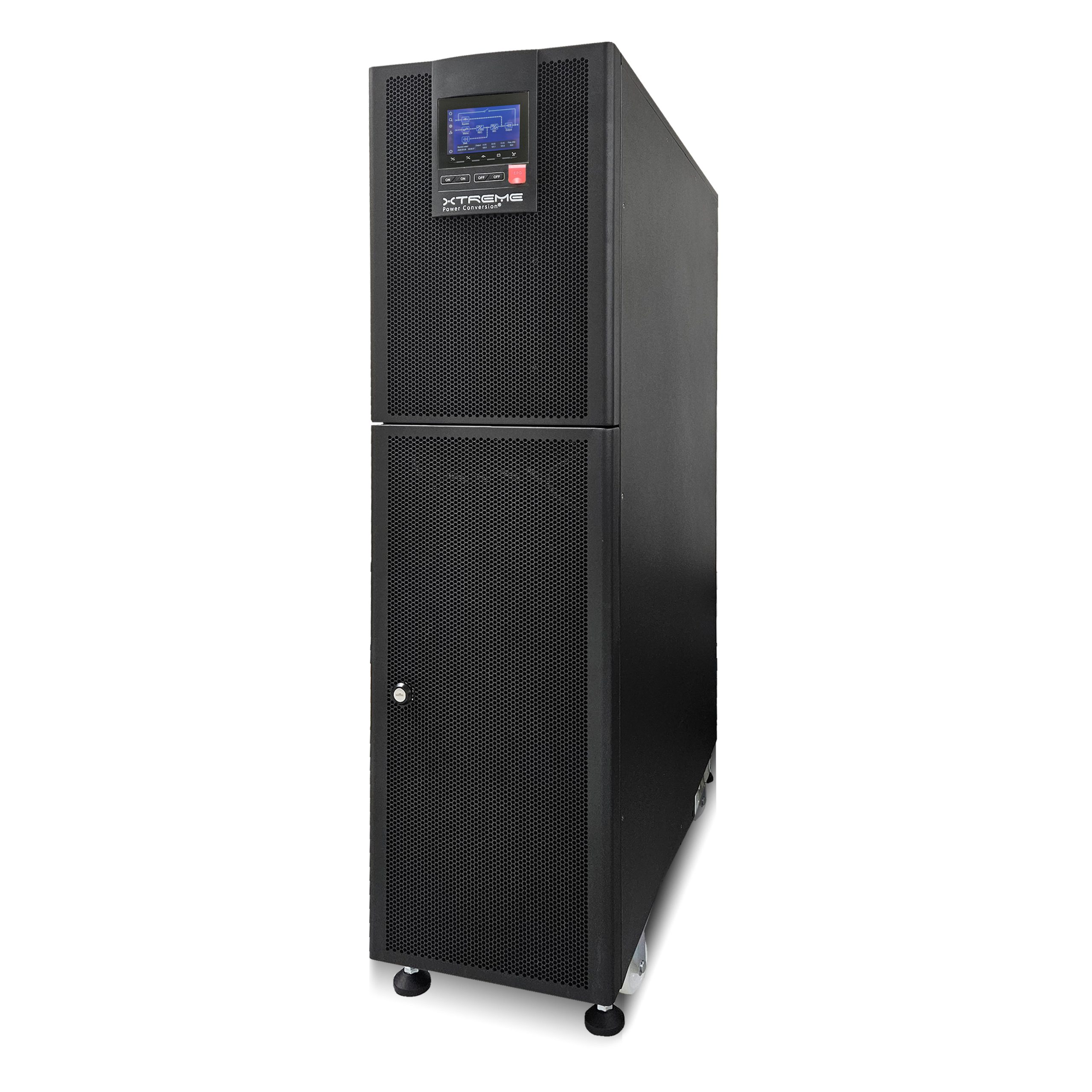
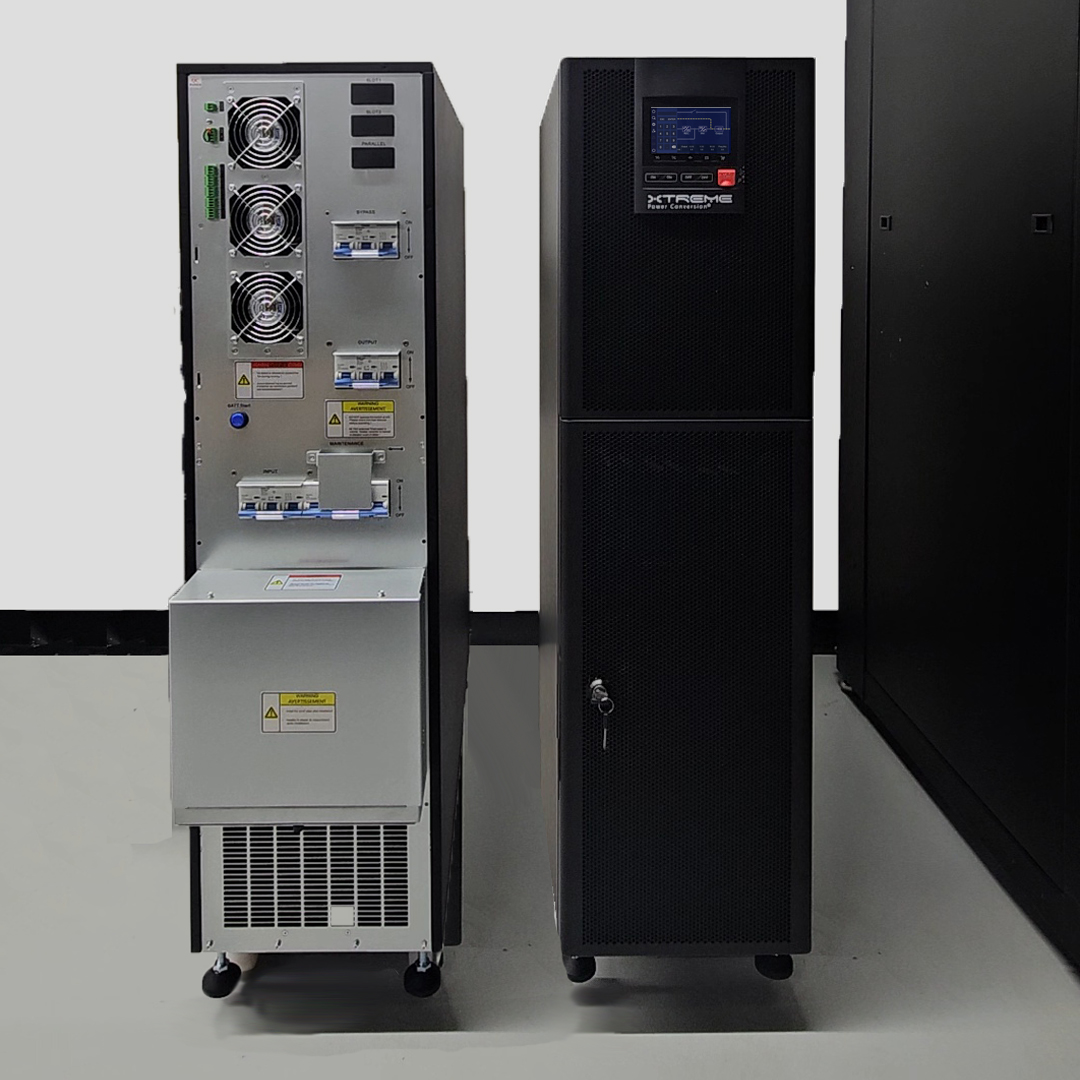
Just 12.6 inches wide — a single cabinet holding 30 kW and its batteries, ideal for edge, automation, and retrofit installations where electrical-room space is tight. Casters allow positioning and later relocation without rigging.
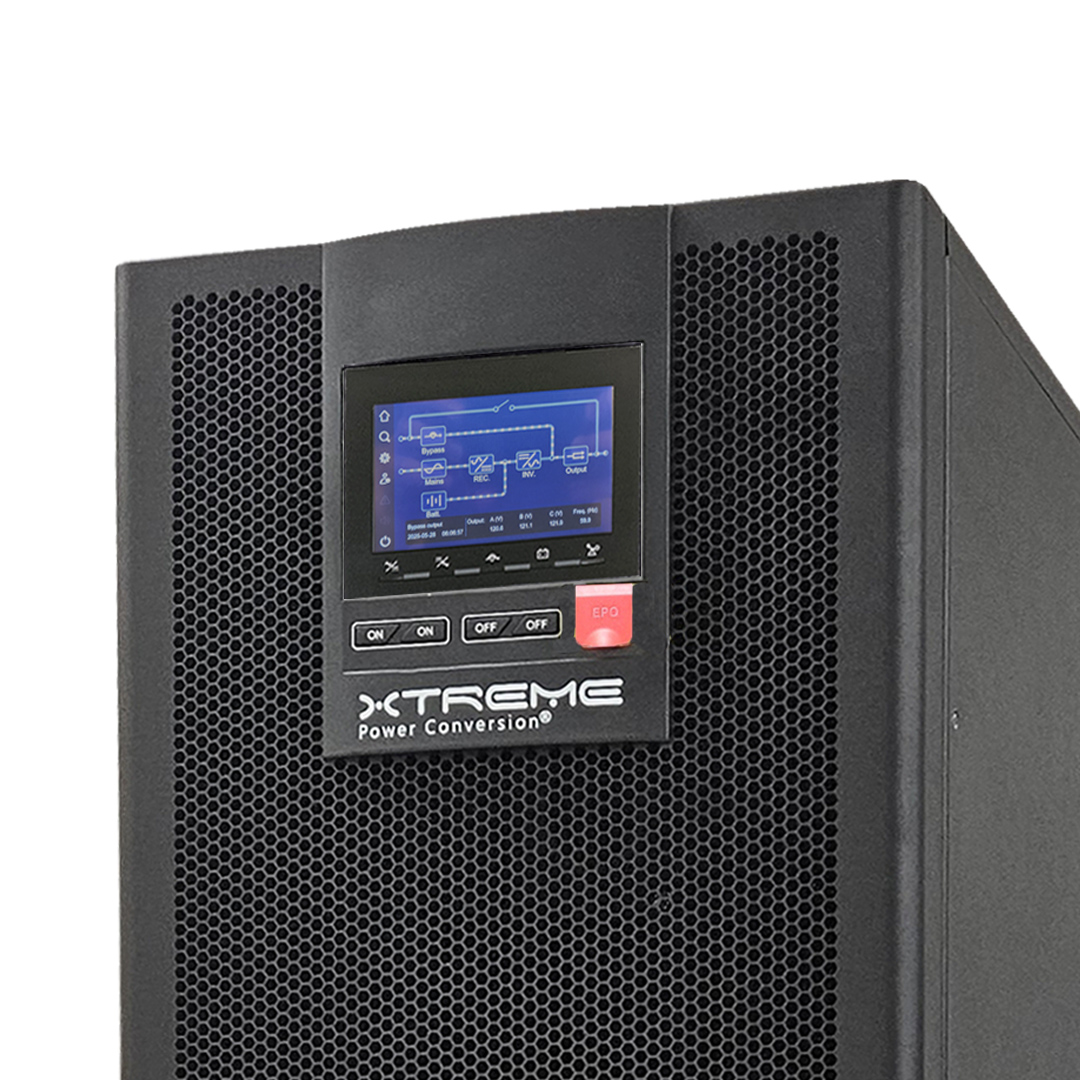
Full-color touchscreen LCD with single-line mimic diagram and event logging for clear local status and diagnostics.
110% for 60 minutes, 130% for 10 minutes, and 155% for 1 minute — built for inrush, surges, and motor/startup loads.
Safe, on-site service without shutting the system down. External maintenance bypass available as an option.
Self-cleaning fans help keep the cabinet clear in dusty environments and extend service life.
Coated boards add protection in industrial and high-humidity environments.
Dual mains input for separate rectifier and bypass feeds, shipped with a jumper installed for single-input operation. RS485 with Modbus, EPO, 1 input + 5 output programmable dry contacts, 2 card slots, optional SNMP.
The UPS verifies itself under load before the real load is connected — no rented load bank, no temporary cabling and breakers, and no wasted energy at startup.
The UPS tracks wear items such as bus capacitors and fans and flags them ahead of failure, turning an emergency call into a scheduled visit.
Runs as a fixed 50 Hz to 60 Hz or 60 Hz to 50 Hz converter for imported equipment and mixed-frequency plant loads.
Three ratings, one slim platform
| Battery modules | 1 module (1–3 selectable) |
| Enclosure weight | 207 lb |
| As configured | 298 lb |
| Audible noise | <63 dB |
| Battery modules | 2 modules (2–3 selectable) |
| Enclosure weight | 227 lb |
| As configured | 390 lb |
| Audible noise | <63 dB |
| Battery modules | 3 modules |
| Enclosure weight | 242 lb |
| As configured | 485 lb |
| Audible noise | <68 dB |
Shared across all models: 12.6″ W × 35.2″ D × 49.2″ H (add 3.9″ depth for the terminal-block cover). LFP module = 57.6 Vdc / 50 Ah / 2,880 Wh, 81 lb each, with an integrated DC-DC converter to the 240 Vdc bus. Charge current 2–40 A selectable (20 A default). Full system weight = enclosure weight + 81 lb per installed module.
Internal-battery runtime by configuration
Approximate runtimes in minutes, by installed battery-module count (rows) and load in kW (columns). Every runtime shown is delivered from internal modules. No external battery cabinet required.
| Battery modules ↓ / Load kW → | 2.5 | 5 | 7.5 | 10 | 12.5 | 15 | 17.5 | 20 | 22.5 | 25 | 27.5 | 30 |
|---|---|---|---|---|---|---|---|---|---|---|---|---|
| 1 module | 58 | 29 | 22 | 15 | — | — | — | — | — | — | — | — |
| 2 modules | 116 | 58 | 44 | 30 | 25 | 20 | 18 | 15 | — | — | — | — |
| 3 modules | 174 | 87 | 66 | 45 | 38 | 30 | 26 | 22 | 20 | 18 | 16 | 15 |
Runtimes in approximate minutes. Actual runtime varies with battery age, temperature, and load profile. Talk to our applications team →
Verify the system before the load is connected
The Li90 includes a built-in load test. The UPS drives itself under load before the facility load is connected, which removes the rented load bank, the temporary cabling and breakers, and the energy those consume — a meaningful reduction in commissioning cost and schedule on a three-phase installation. Casters on the cabinet allow positioning during installation and relocation later without rigging.
Discuss a configuration →
Dual mains input supports separate rectifier and bypass feeds, and ships with a jumper installed for conventional single-input service.
Local visibility and building-system integration
A 4.3-inch color touchscreen with LED status indicators shows a single-line mimic of the power path, with separate password levels for operators, technicians, and service engineers, and a 10,000-event log that can be exported for post-event analysis. A double physical ON/OFF button prevents accidental shutdown.
RS485, Modbus, SNMP
Two card slots take an optional SNMP card for network monitoring and graceful shutdown. RS485 with Modbus drops the UPS straight into an existing building management system.
One assignable input
Selectable from six functions: charge inhibit, external maintenance-bypass breaker status, external battery breaker status, remote on/off, battery ground fault, and discharge inhibit.
Five from thirteen conditions
Mains, bypass, battery, output, and overload abnormal, plus normal operation, battery operation, bypass operation, UPS on/off status, battery low, ECO mode, and fan fault.
A self-dedusting cycle can also be scheduled to clear the cabinet between service visits.
Configurable to the site
SNMP card
Network monitoring and graceful shutdown, available in internal or external form factor. Installs in either of the two communication slots.
External maintenance bypass
Isolates the UPS entirely for service or replacement while the load stays fed from utility. Specified when a site cannot drop the load for any window.
Remove battery replacement from the operating model
The Li90 reduces long-term operational burden by eliminating the periodic battery-replacement cycles associated with VRLA systems. LiFePO₄ batteries provide a much longer service life — up to 15 years under ideal operating conditions — improving predictability, reducing service interventions, and aligning UPS infrastructure with long-term facility-planning cycles. By removing external battery systems and extending battery life, the Li90 minimizes both planned and unplanned maintenance events. Replacing a VRLA three-phase UPS? The Li90 eliminates external battery cabinets, the 3–5-year replacement cycle, and the floor space they consume.
A modernization alternative to legacy three-phase UPS
The Li90 is commonly evaluated against platforms such as the Eaton 93PM, APC Galaxy VS, and Vertiv Liebert EXS when modernizing facility UPS infrastructure. The key distinction is architectural: most competing platforms rely on external or modular battery systems, increasing footprint and lifecycle maintenance, while the Li90 integrates lithium batteries within a single cabinet for a more compact deployment with reduced maintenance exposure. It is frequently deployed in replacement scenarios — Eaton 9355 systems nearing end-of-life battery cycles, 93PM installations with rising service complexity, APC Galaxy VS systems using external battery cabinets, and Vertiv Liebert EXS platforms in space-constrained rooms.
View Li90 comparisons →
Where the Li90 fits in the Xtreme Power lineup
The Li90 is the facility-level UPS in a coordinated architecture, selected when a centralized topology is preferred but legacy battery-cabinet requirements are no longer acceptable. It sits at the top of the 208/120V lithium range; where a site moves to 480V distribution or beyond 30 kVA, the X90 continues the same lithium architecture at facility scale. For modular capacity expansion and N+X redundancy at 208/120V, consider the M90U; for rack-level distributed protection, the J90; and within the three-phase portfolio, the E91 covers traditional VRLA-based systems.
Where the Li90 is deployed
The Li90 is specified in facilities modernizing electrical infrastructure, where floor space, maintenance exposure, and lifecycle cost carry as much weight as capacity. Because the batteries live inside the cabinet, it fits rooms that cannot accommodate a UPS plus a separate battery enclosure, and it removes the three-to-five-year battery replacement cycle from the operating budget.
A conventional three-phase UPS plus its battery cabinets can occupy several times the floor area. Consolidating both into one 12.6-inch cabinet frees the room without reducing protected load, which is often what makes an upgrade approvable at all.
For a single row, a support cabinet, or an edge site standing on its own, 10 to 30 kVA at unity power factor covers the load without committing to a modular frame. Casters allow the cabinet to be positioned and later relocated without rigging.
Hospital electrical rooms are congested and access windows are short. Hot-swappable modules mean battery service happens while the load stays protected, and a 15-year design life takes replacement work off a schedule that is difficult to plan around.
Distributed network sites are often unstaffed and infrequently visited. Key-component pre-alarm flags wear items such as bus capacitors and fans ahead of failure, turning an emergency dispatch into a scheduled one.
Plant electrical rooms run hot and see motor starting and other inrush. Operation to 50 °C and 155% overload for one minute suit that environment, and frequency-converter mode handles imported equipment on a different supply frequency.
The built-in load test verifies the system under load before the facility load is connected, removing the rented load bank, the temporary cabling and breakers, and the energy they consume. On a remote or tightly scheduled site that can decide the install date.
| 10 kVA | Smaller distributed loads and industrial control environments |
| 20 kVA | Mixed-use infrastructure such as healthcare and telecommunications |
| 30 kVA | Centralized facility loads where higher-capacity consolidation is required |
Runtime should be evaluated based on outage duration, generator coordination, and overall continuity strategy. Request sizing help →
Li90 specifications
| Specification | Detail |
|---|---|
| Topology | Online double-conversion, three-level IGBT |
| Capacity | 10 / 20 / 30 kVA — unity power factor (kVA = kW) |
| Input voltage | 208/220V three-phase (3W+N+G) |
| Input range | 120–156V linear derating, 156–268V at full load; 40–70 Hz |
| Input power factor | ≥0.99 |
| Input THDi | <3% at full load |
| Mains input | Dual mains input (separate rectifier and bypass feeds); supplied with a jumper installed for single-input operation |
| Output voltage | 190 / 200 / 208 / 220V ±1% L-L (208V default) |
| Output frequency | 50 / 60 Hz ±0.1 Hz in battery mode; 50↔60 Hz frequency-converter mode |
| Output THDv | <1% linear load · <4% nonlinear load |
| Overload (online) | <105% continuous · 105–110% 60 min · 110–130% 10 min · 130–155% 1 min · 155–200% 200 ms · >200% transfers to bypass immediately |
| Efficiency | Up to 94.5% online · 99% ECO mode |
| Battery | Integrated hot-swap LFP modules — 57.6 Vdc / 50 Ah / 2,880 Wh each, 81 lb per module |
| Installed energy | 2.88 kWh (1 module) · 5.76 kWh (2) · 8.64 kWh (3); all models accept up to three modules |
| Battery quantity | Li90-10K: 1 (1–3 selectable) · 20K: 2 (2–3) · 30K: 3 |
| DC bus | 240 Vdc nominal, fed by a dedicated DC-DC converter in each battery module |
| Charge current | 2–40 A selectable (20 A default) |
| Interface | 4.3-inch full-color touchscreen with single-line mimic, three password levels, and a 10,000-event log |
| Load test | Built-in self-load test for commissioning without an external load bank |
| Bypass | Integrated maintenance bypass (external maintenance bypass optional) |
| Communications | RS485 with Modbus, EPO, programmable dry contacts (1 in / 5 out), 2 card slots, optional SNMP |
| Dimensions (W×D×H) | 12.6 × 35.2 × 49.2 in (add 3.9 in depth for the terminal-block cover) |
| Enclosure weight | 207 / 227 / 242 lb (10 / 20 / 30K) + 81 lb per battery module |
| Weight as configured | 298 / 390 / 485 lb (10 / 20 / 30K with standard module count) |
| Operating temp | −5 °C to 50 °C (23–122 °F); derated above 40 °C (104 °F) |
| Audible noise | <63 dB (10/20K) · <68 dB (30K) |
| Humidity / altitude | 0–95% non-condensing; up to 6,500 ft |
| Certifications | UL 1778, UL 1973, UN 38.3 |
| Warranty | Startup + 2-year on-site UPS; 5-year battery (USA) — 5-yr term up to 40 °C ambient, 2-yr for 40–50 °C |
Listings and documents
UL 1973
UN 38.3
Modernize your UPS infrastructure
Xtreme Power Conversion supports facility engineers, electrical consultants, and infrastructure planners with improved density, reduced maintenance, and predictable lifecycle performance.
Related guides and comparisons