
UPS for Parking Guidance Systems
Parking guidance is the load most often sized wrong, because it does not sit in one place. The sensors, PoE switches, zone controllers, and directional signs are distributed across every level of the structure. Only the head-end server is central. That makes guidance a per-floor backup problem, not a single head-end problem: a four-level garage needs five UPS units, not one.
Xtreme’s J90 and J90i 1U online lithium UPS platforms are built for exactly this shape of deployment: one rack unit per floor IDF, LiFePO₄ batteries rated up to 15 years so nobody is walking every level on a battery route, 50 °C operation for unconditioned equipment closets, and individually switchable outlets for remote reboot of a hung switch or sign controller.
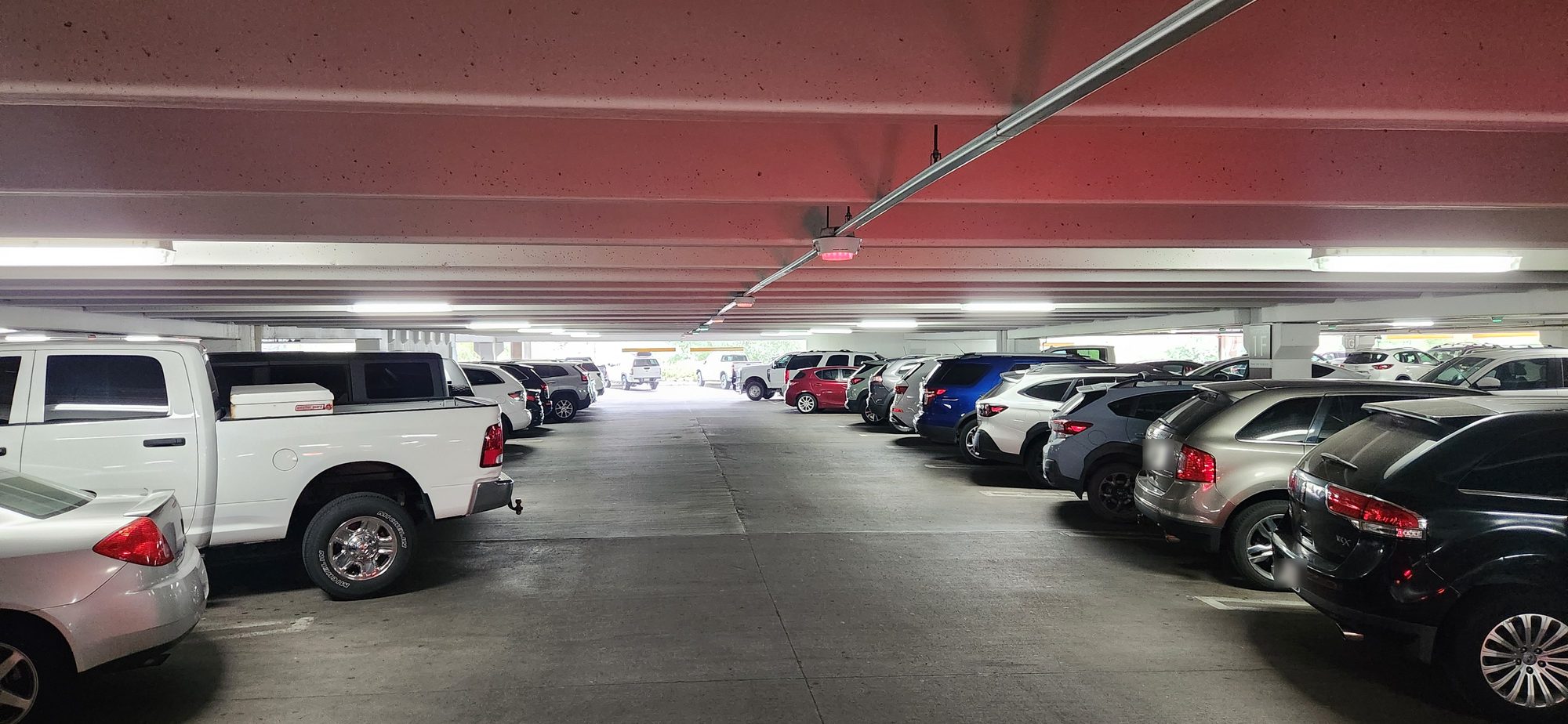
Why guidance backup is a per-floor problem
This is the point most sizing exercises get wrong, and it changes both the model and the unit count.
- The load is distributed by design. Sensors sit above every stall. PoE switches, zone controllers, and directional signs sit in the floor IDF. Only the head-end server is central. There is no single point where the guidance load appears.
- So a four-level garage is five UPS units. One per floor, plus one at the server. Centralizing instead means running long low-voltage feeds back to a single large UPS, which normally loses on both cost and voltage drop.
- Distribution is also a resilience argument. One failed UPS takes out one level, not the whole system. The garage keeps guiding on the other three floors while a tech swaps a 1U unit.
- It scales linearly with the structure. A six-level deck is seven units. This is the number worth putting in front of a manufacturer sizing an installed base, because it is not one UPS per garage: it is one per floor plus one.
What happens when a parking guidance system loses power
Guidance is the one system in the garage whose failure is immediately visible to every driver on the deck.
- Bay indicators go dark. The green-and-red overhead lights are the entire user-facing value of the system. When they drop, drivers revert to circling, and the aisle congestion that guidance was installed to eliminate comes straight back.
- Floor-count and wayfinding signs freeze. Entrance signs stop reflecting real availability. A sign reading FULL on a half-empty deck turns cars away at the gate.
- Occupancy data drifts. Vehicles enter and leave while the system is down. When power returns, the database no longer matches the deck and usually needs a re-scan or a manual reconciliation.
- The cost outlasts the outage. A ninety-second utility sag can mean an afternoon of bad occupancy data, which is the part most often underestimated when backup power is scoped. Because the load is per floor, an unprotected level fails independently: the system reports partial data rather than going cleanly offline, which is harder to reconcile than a full outage.
How much power does a parking guidance system use?
Work it out per floor, then add the server once. A worked example for a 1,000-stall structure over four levels, averaging 250 spaces per floor:
| Per floor | Ultrasonic | Camera-based | What is in the number |
|---|---|---|---|
| Sensors | ~250 W | ~360 W | Ultrasonic: one sensor per stall. Camera: roughly 60 multi-stall camera units covering 250 spaces. |
| Switches, signs, controller | 50–100 W | 100–150 W | Floor-level directional signs and the zone controller. Camera systems add PoE network switches, which carry the sensor load. |
| Floor total | 300–350 W | 460–510 W | Repeated on every level of the structure. |
| Central server | 200–500 W: once per facility | Normally in a central IT room rather than repeated per level. | |
| 1,000 stalls, 4 levels | 1,400–1,900 W | 2,040–2,540 W | Facility aggregate, but it is never backed up as one load. See below. |
These are planning estimates drawn from published example installations, not measurements of a specific system. Confirm against your as-built schedule and the sensor manufacturer’s published draw before specifying. Camera count, level count, sign density, and PoE budget all move the number.
The largest line item per floor, and the one that scales with stall count. Camera systems run higher than ultrasonic because the PoE switches feeding them carry the load.
Directional signs and the floor controller. Individually modest, but they are per-level and they are the part drivers actually see.
Occupancy database, counting logic, sign controllers. One instance for the whole garage, and the component least tolerant of an unclean transfer.
What size UPS do I need per floor?
| Position | Est. load | Model | Loading & notes |
|---|---|---|---|
| Floor: ultrasonic | 300–350 W | J90-1kLiD / J90i-1kLiD | About 33–39% loaded. The J60C-600 (360 W) would technically fit at the bottom of this range but runs at 83–97% loading with no expansion headroom, not a specification worth making. |
| Floor: camera-based | 460–510 W | J90-1kLiD / J90i-1kLiD | About 51–57% loaded. The J60C-600 does not cover this load. Step to the 1.5k where a floor carries an unusually dense camera count or shares the UPS with security equipment. |
| Central server | 200–500 W | J90-1kLiD / J90i-1kLiD | One per facility. Step to the 1.5k or 2k where the head-end shares a rack with adjacent network or security gear, or where external battery packs are wanted for extended runtime. |
| 1,000 stalls, 4 levels | n/a | 5 × J90-1kLiD | Four floor units plus one at the server. Same platform throughout, so one spare covers every position in the building. |
J90 covers 120V facilities; J90i covers 208–240V. Both are TAA compliant, which matters on airport, municipal, university, and federal parking contracts, and it is a reason a manufacturer’s own customers push them toward a compliant UPS. Runtime depends on exact draw and on whether external packs are fitted.
Why guidance equipment needs online double-conversion
The gates can live on a standby UPS. The head-end should not.
- No transfer delay. The J90 regenerates output continuously through the inverter, so the load never runs on raw utility power and there is no transfer gap during an event. A standby UPS transfers on detection, which is fine for a gate operator and poor for a server mid-write.
- Continuous conditioning. Parking structures sit on the same service as elevators, ventilation fans, and EV chargers. That is a switching-heavy environment, and the head-end sees clean regulated power regardless of what else on the deck just started.
- Per-outlet remote reboot. Every J90 outlet is individually switchable. A hung server, sign controller, or PoE switch gets power-cycled from the office instead of from the top level of the deck.
- One UPS protects a whole floor. Camera nodes are PoE-fed, so the floor unit protecting the PoE switch protects every sensor behind it. That is what keeps the count at one per level instead of one per device.
- Batteries that outlast the guidance contract. LiFePO₄ rated up to 15 years and 50 °C operation. With a unit on every level, a three-year VRLA replacement cycle means a recurring battery route through the whole structure, which is the maintenance cost that actually accumulates.
Products and adjacent applications
Parking guidance power questions
How much power does a parking guidance system use?
Do I need one UPS per floor or one for the whole garage?
What size UPS do I need per floor for a parking guidance system?
Why online double-conversion instead of a standby UPS?
What happens to a parking garage when the guidance system loses power?
Size the UPS for your guidance deployment
Send us the level count, the sensor technology, and the per-floor schedule, and our engineers will come back with a sized configuration per position: floor units, server unit, and whether external battery packs are worth it at your load.