
ORv3 and 50 VDC rack power for AI
In an Open Rack v3 environment the rack already has a DC busbar, so the shortest path to the GPUs is to convert once, at the rack, and feed that busbar directly. This page covers how that is built with the AX5-33 power shelf: one conversion stage, 33 kW in 1 OU, and 132 kW per rack from four shelves in parallel.
One conversion stage, straight to the busbar
Open Rack v3 puts a shared DC busbar in the rack and measures height in open rack units across a 21 inch equipment width. That changes where conversion belongs. Instead of every tray converting its own AC, a power shelf converts once and feeds the busbar, and the trays take DC directly.
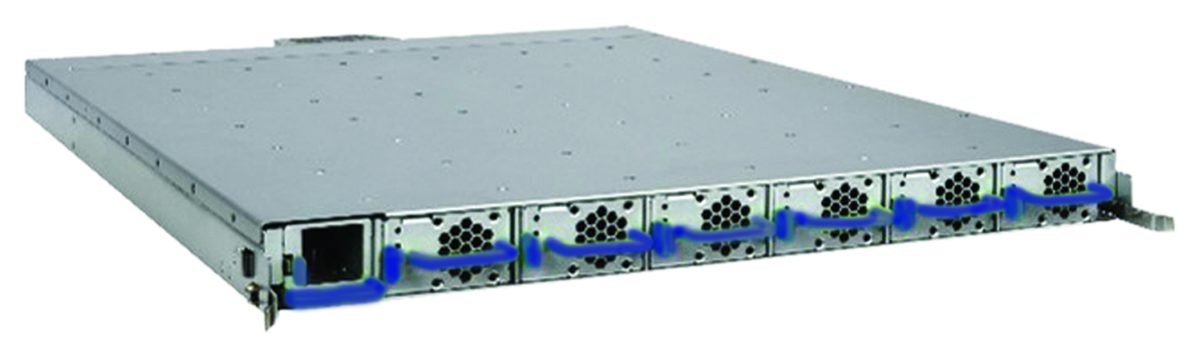
The AX5-33 is that shelf. Six PSU5-55 modules at 5.5 kW each give 33 kW of regulated 50 VDC from a 1 OU shelf, at up to 97.5% efficiency, with 113 A per module and up to 678 A per shelf. Four shelves run in parallel for 132 kW in a rack, coordinated by the PMC controllers.
AC or DC in, 50 VDC on the busbar. The optional 2 OU battery shelf sits in the same rack and is monitored by the same controllers.
AC or DC on the same shelf
The AX5-33 accepts 346 to 480 VAC three-phase wye (4W + G), or 200 to 277 V single-phase, or 180 to 400 VDC at 240 VDC nominal, at full rating on either AC or DC. A site already distributing DC can use the same shelf as one distributing AC, and a site moving between the two does not need different hardware at the rack.
Two AC inputs feed three PSU positions each, at 30 A NEC or 32 A IEC per input. A single-input variant is also available.
| Building block | Quantity | Rating |
|---|---|---|
| PSU5-55 | 6 per shelf | 5.5 kW, 113 A at 50 VDC, 120 J integrated capacitance, hot-swappable |
| AX5-33 shelf | Up to 4 in parallel | 33 kW in 1 OU; 33 / 27.5 / 16.5 kW at N+0 / N+1 / N+N |
| PMC controller | 1 per shelf | RS485 Modbus at rack level, CAN between shelves, automatic addressing |
| Battery shelf | Optional, 2 OU | Up to 33 kW; 5.5 kW for 90 s or more, 4 kW for 240 s or more |
Capacitance first, battery second
AI data center racks swing from near idle to peak and back in milliseconds, thousands of times an hour. Each PSU5-55 carries 120 J of integrated bulk capacitance, which absorbs those load steps within regulation and provides roughly 20 ms of hold-up to bridge to the battery shelf on loss of input. Ride-through is therefore spent on genuine loss of supply rather than on routine compute transients.
From 5.5 kW increments to 132 kW racks
Capacity grows two ways: modules inside a shelf, and shelves inside a rack. A shelf rates 33 kW at N+0, 27.5 kW at N+1 and 16.5 kW at N+N, and modules are hot-swappable so capacity can be added or a module serviced without interrupting the load. Up to four shelves run in parallel for 132 kW, with active and droop current sharing and coordinated operation across shelves.
On the roadmap
Higher-density ORv3 modules at 8 kW and 12 kW, which take the same 1 OU shelf to 48 kW and 72 kW. The 8 kW PSU5-80 is on display now.
When to use 800 VDC instead
Direct 50 VDC conversion suits racks fed from nearby AC at moderate density. As density rises, the feed into the rack becomes the constraint: 90 kW at 50 VDC is 1,800 A on the run, while the same power at 800 VDC is 112 A, with the high-current path confined to a short busbar inside the rack. Compare both routes on the DC power architecture page →, or read how the 800 VDC chain is built on the 800 VDC architecture page →.

ORv3 and 50 VDC: common questions
What is ORv3?
Open Rack v3, the Open Compute Project rack standard built around a 21 inch equipment width and a shared DC busbar, with height measured in open rack units (OU) rather than the 1.75 inch U of a 19 inch rack. Power shelves sit in the rack and feed the busbar, so the IT trays take DC directly instead of each tray converting its own AC.
Why 50 VDC at the rack instead of AC to every tray?
It removes a conversion stage. With AC distribution each tray converts AC to DC itself, which multiplies power supplies, losses and failure points across the rack. A shelf converting once at the rack and feeding a 50 VDC busbar takes those stages out, and the AX5-33 does it at up to 97.5% efficiency.
How much power does one shelf deliver?
33 kW from a 1 OU shelf, from six 5.5 kW PSU5-55 modules, with 113 A per module and up to 678 A per shelf at 50 VDC. Redundancy arrangements give 33 kW at N+0, 27.5 kW at N+1 and 16.5 kW at N+N.
How does it scale?
Up to four AX5-33 shelves operate in parallel for 132 kW per rack, coordinated by the PMC controllers over Modbus and CAN with automatic address allocation. Capacity inside a shelf grows in 5.5 kW increments as modules are added.
Can it run from DC input?
Yes. The same shelf accepts 346 to 480 VAC three-phase wye (4W + G) or 180 to 400 VDC at 240 VDC nominal, at full rating on either. That matters where a facility already distributes DC, or where a site is moving between the two.
What provides ride-through?
An optional 2 OU battery shelf, hot-swappable and monitored by the same PMC architecture, supporting up to 33 kW, with 5.5 kW for 90 seconds or more and 4 kW for 240 seconds or more. Each PSU module also carries 120 J of integrated capacitance, which absorbs AI load steps and provides 20 ms of hold-up to bridge to the battery shelf.
When is 800 VDC distribution the better choice instead?
At higher density and facility scale, where the feed into the rack becomes the constraint. Delivering 90 kW at 50 VDC puts 1,800 A on the run into the rack; the same power at 800 VDC is 112 A, with the high-current path confined to a busbar inside the cabinet. The architecture comparison page walks through both routes.
Size a 50 VDC rack
Xtreme Power engineers can work through shelf count, redundancy, ride-through and input arrangement for your rack density.
PRELIMINARY. Products described are not yet in production and specifications are subject to change. Agency listings are pending. Figures are from AX5-33 preliminary specifications, flyer rev AX533.11U.