
Maximum UPS Capacity by Electrical Circuit Rating
In many deployments, the limiting factor for UPS selection isn’t the load — it’s the circuit. A 15A wall receptacle, a 20A dedicated circuit, a 30A 208V outlet — each one sets a firm ceiling on how large a UPS can be. This guide covers the maximum practical UPS size for common North American single-phase and three-phase circuits.
Why circuit rating determines maximum UPS size
UPS systems must operate within the continuous load limits of the branch circuit and breaker feeding them. Under NEC 210.20, continuous loads — those operating for 3 hours or more — must not exceed 80% of the breaker rating. UPS systems are continuous loads.
This 80% rule is the ceiling. Exceeding it causes nuisance breaker trips during normal operation, not just during fault conditions. It also represents a code violation in many jurisdictions.
Maximum UPS size by circuit
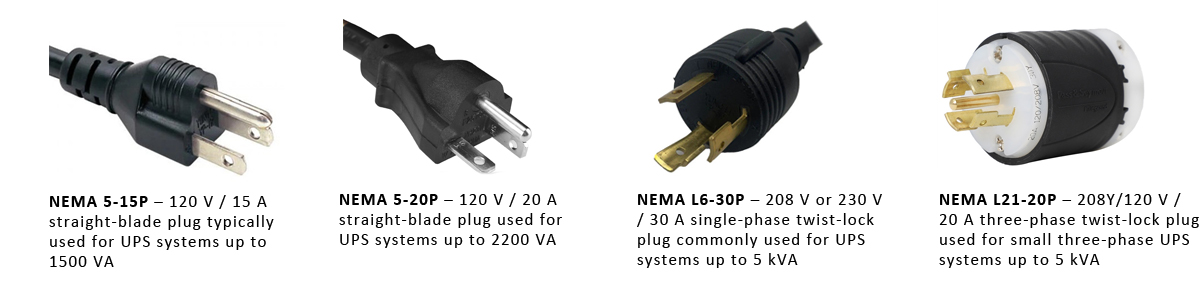
A standard 120V 15A receptacle — the most common circuit in commercial and office environments. The practical ceiling is a 1500VA UPS. Larger units will exceed continuous load limits during normal operation.
Maximum practical UPS for a standard 15A receptacle. Operates within the 12A continuous limit without requiring a dedicated or upgraded circuit.
Common applications- Small network closets
- POS systems
- Security equipment
- AV racks
A dedicated 20A circuit is common in IDF closets, server rooms, and commercial AV installations. A 2000VA UPS maximizes the capacity of this circuit without requiring a breaker upgrade.
Maximum practical UPS for a dedicated 120V 20A circuit. Fully utilizes the available capacity within continuous load limits.
Common applications- IDF and MDF closets
- Network switches and routers
- Firewall and telecom equipment
- Retail infrastructure
A 208V 30A circuit with L6-30P plug is common in server rooms, data closets, and light industrial environments. A 5kVA 208V UPS is the practical maximum — larger units would require hardwired installation or a higher-rated circuit.
Maximum practical UPS for a 208V 30A L6-30P circuit. Maximizes usable capacity without requiring a larger breaker or hardwired connection.
Common applications- Larger AV systems
- Light industrial equipment
- Small server rooms
- Distributed edge infrastructure
Three-phase circuits use the √3 (1.732) multiplier. A 208V 20A three-phase circuit supports up to approximately 5.76 kW continuous — making a 5kVA three-phase UPS the right fit. Larger three-phase UPS systems typically require hardwired installation.
Fits within the continuous capacity of a 20A L21-20P three-phase circuit without requiring panel upgrades or hardwired installation.
Common applications- Small server rooms with 3-phase power
- Branch offices and edge data rooms
- Retail and commercial infrastructure
- Industrial panels with 3-phase service
Circuit capacity is only one part of UPS sizing
Knowing the maximum UPS for your circuit tells you the ceiling — not necessarily the right size. Load profile, runtime requirements, and battery technology must also be evaluated. A 2000VA UPS on a 20A circuit may be the maximum the circuit allows, but the right UPS for a 400W load with a 30-minute runtime target is a different calculation.
When operating near the maximum capacity of a branch circuit, lithium UPS systems offer stable runtime over the battery lifetime — LiFePO₄ maintains more consistent capacity across its service life than VRLA lead-acid, which degrades progressively. This matters when the circuit ceiling leaves no room for a larger UPS to compensate for battery aging. Lithium vs lead-acid comparison →
Maximum UPS by circuit — frequently asked questions
How does circuit rating determine maximum UPS size?
What size UPS can I put on a 20-amp circuit?
Can I install a larger UPS than my circuit allows?
Does circuit rating alone determine the UPS I need?
What circuit do I need for a larger UPS?
Need help determining maximum UPS size for your circuit?
Circuit capacity verification, breaker and plug compatibility, derating calculations, runtime optimization, and lithium vs lead-acid selection.