
Lithium UPS · Mobile & Cart Applications

Lithium UPS Systems for Mobile Cart Applications

Mobile carts in healthcare, dental imaging, telemedicine, AV, retail, and industrial environments often need continuous power while moving between rooms and work areas. Xtreme Power lithium UPS systems provide compact, lightweight backup designed for these mobile applications, and for the repeated daily discharge-and-recharge cycling that comes with them.
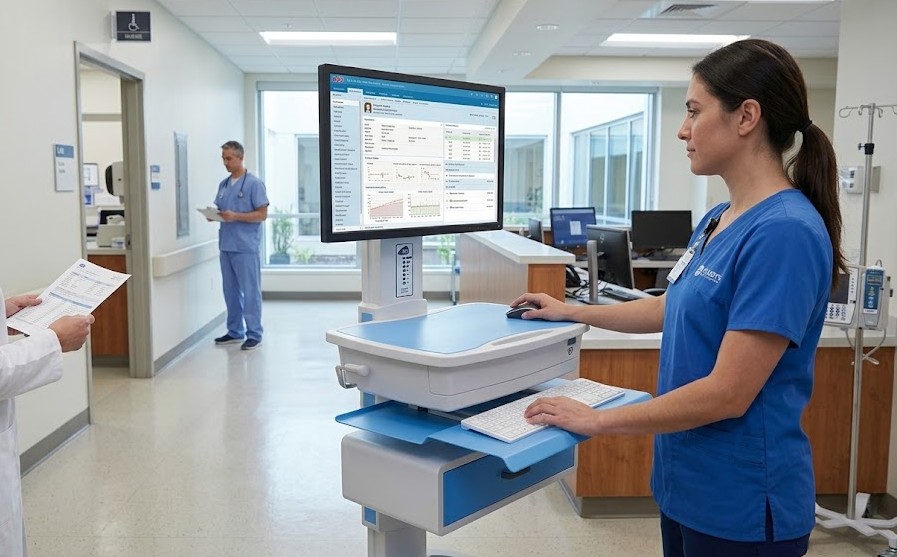
Mobile medical workstation cart, height-adjustable column with monitor, keyboard tray, storage drawer, and a powered base on casters, representative of carts that run on a compact lithium UPS
Mobile workstation carts run on battery power between rooms: a compact lithium UPS rides through unplug-and-move transitions. (Representative image.)
Built for cart duty cycles. Carts may discharge and recharge multiple times a day: a profile that wears lead-acid quickly.
LiFePO₄ chemistry. Lithium iron phosphate is far better suited to repetitive shallow-discharge use than VRLA.
Compact and light. Less size and weight to add to a cart, with quiet, maintenance-free operation.
UL 1778
Safety listed
FCC
Compliant
TAA
Compliant
LiFePO₄
Battery chemistry
3–5k
Discharge cycles
50°C
Operating temp

XPC J60, J60C, and J90 lithium UPS systems are UL 1778 listed, FCC compliant, and TAA compliant. They are not certified to IEC 60601-1 / ANSI AAMI ES60601-1 and are supplied as non-medical equipment. In a medical cart they are normally treated as non-ME equipment within an ME system under Clause 16, where the UPS carries its own product-safety listing and the assembled cart is evaluated for touch current and leakage at the system level. Bring us in early: we can provide measured leakage data to support that evaluation.

Common applications

Where mobile-cart UPS protection is deployed

Dental imaging
Dental scanning carts

Intraoral scanners, displays, computing, and network gear that must stay powered while moving between operatories.

Telehealth
Telemedicine carts

Displays, cameras, microphones, and computing for remote consultations as carts move between patient rooms.

WOW / EMR
Mobile clinician workstations

Workstation-on-wheels stations relying on continuous operation for EMR, barcode scanning, and care workflows.

Diagnostics
Mobile imaging systems

Portable imaging carts and diagnostic workstations supporting sensitive electronics during transport and interruptions.

AV / education
AV & presentation carts

Mobile AV for classrooms, conference rooms, training, and events needing backup during movement and disruptions.

Industrial / retail
Industrial & retail workstations

Mobile workstations in warehouses, manufacturing, and retail that require uninterrupted operation on the move.

Why lithium

Why lithium works better for mobile carts

Traditional lead-acid UPS systems are designed for standby operation with infrequent discharge. Mobile carts create a much more demanding duty cycle: repeated discharge and recharge throughout the day as carts are unplugged, moved, and reconnected. Lithium iron phosphate (LiFePO₄) is built for exactly that pattern.

Weight
Lighter on the cart

Less mass to push and steer than an equivalent lead-acid pack.

Recharge
Faster recovery

Quicker recharge between uses for carts that dock briefly.

Lifecycle
Longer service life

Far more usable cycles before meaningful capacity loss.

Footprint
Compact size

A small, integrated package that fits cart enclosures.

Service
Maintenance-free

No routine battery service in normal cart operation.

Cycling
Tolerates repetition

Handles repeated shallow discharge that wears VRLA quickly.

Selection guide

Recommended UPS by cart type

Cart applicationRecommended UPS
Dental scanning cartsJ60 Series
Telemedicine cartsJ60 Series / J90 Series
Mobile clinician workstationsJ60 Series
AV & presentation cartsJ60C Series
Mobile imaging cartsJ90 Series
Mobile IT & network cartsJ60C Series
Recommended systems

Lithium UPS systems for mobile carts

J60 / J60i
Ultra-compact · embedded

Ultra-compact lithium UPS for embedded and mobile use where space and weight are critical: the typical fit for dental carts, telemedicine carts, and workstation-on-wheels. Quiet, light, with flexible mounting for integration directly into a cart.

View the J60 →
J60C / J60Ci
Short-depth · 1U rack

Lithium battery technology in an ultra-short-depth 1U rackmount: ideal for mobile AV systems, shallow enclosures, and portable racks. Best for carts or mobile cabinets that already use rackmount equipment.

View the J60C →
J90
Online double-conversion

Higher-capacity online double-conversion lithium UPS for larger or more critical carts: the typical choice for higher-power imaging carts, multi-display telemedicine, and environments where online protection is preferred.

View the J90 →
Battery life

Battery life in mobile-cart duty cycles

In many cart environments the UPS may discharge and recharge multiple times per day. That cycling is where the chemistries diverge most: lead-acid is designed for occasional backup events, while LiFePO₄ is built to cycle.

300–500
VRLA lead-acid
Approximate partial-discharge cycles before significant capacity degradation.
3,000–5,000
LiFePO₄ (XPC lithium)
Approximate partial-discharge cycles under ideal operating conditions.

Actual service life depends on the number of daily discharge cycles, load level, depth of discharge, ambient temperature, and recharge opportunity between uses.

Field tip: for best long-term battery performance, keep carts connected to utility power whenever they are stationary: this maximizes recharge opportunity and reduces unnecessary cycling.

Mobile-cart UPS: frequently asked questions

Why is lithium better than lead-acid for mobile carts?
Carts discharge and recharge many times a day as they are unplugged, moved and docked. VRLA lead acid is built for occasional backup and wears out in roughly 300 to 500 cycles of that duty; LiFePO₄ is rated for 3,000 to 5,000. Lithium is also lighter and smaller for the same capacity.
What size UPS does a mobile cart need?
Add up the cart’s load in watts: display, PC, scanner or medical device. The J60-350 (200W) and J60-600 (360W) cover most workstation, dental and telehealth carts. For higher-power imaging carts or multi-display telemedicine, the J90 (1 to 3 kVA, online) is the usual choice.
How long will a lithium cart UPS run on battery?
It depends on the load. A J60-600 runs about 86 minutes at 30W, 35 minutes at 80W, 23 minutes at 120W and 14 minutes at 200W. That covers moves between rooms and short unplugged periods; keep the cart docked whenever it is stationary so the battery stays charged.
How should the UPS be mounted on a cart?
Securely. The J60 weighs 3.4 to 4.7 lbs, has no fan, and comes with wall-mount brackets that fasten it to the cart frame or base; the J60C and J90 mount in a cart rack or with their wall brackets. Fasten it so it cannot shift as the cart moves.
How long before the battery needs replacing?
LiFePO₄ is rated for 3,000 to 5,000 partial-discharge cycles and up to 15 years in ideal conditions, 3 to 4 times the life of VRLA. Actual life depends on daily cycles, load, depth of discharge and temperature.
What warranty and load protection come with these units?
In the USA and Canada: 5 years on the J60 and J60C and 6 years on the J90, reduced to 2 years for continuous operation between 40 and 50 °C, and 2 years depot repair elsewhere. The J60 and J60C carry a $25,000 connected-equipment load protection policy and the J90 $50,000, with registration within 10 days.
Can these UPS systems be certified to UL 60601 for a medical cart?
No. The J60, J60C, and J90 are listed to UL 1778, the UPS product-safety standard, and are not certified to ANSI/AAMI ES60601-1, the current US adoption of IEC 60601-1, which replaced the withdrawn UL 60601-1. In most cart programs they do not need to be. Under Clause 16 of the standard, a UPS is non-ME equipment within an ME system: it carries its own product-safety listing, and the assembled cart is evaluated at the system level against the 60601 touch-current limits. Because everything on a cart sits inside the patient environment, that system evaluation is what determines whether a medical separation transformer is needed upstream. We can supply measured earth leakage and touch current figures to support your evaluation.
Can I connect an external battery pack for longer runtime?
Not on a standard J60. It is listed with its internal lithium pack as a closed configuration, so adding an external pack in the field would place the unit outside its evaluated configuration and void the UL 1778 listing. The J90-1.5kLiX and the J90 2 kVA and 3 kVA models accept J90-EBP48 external lithium packs as standard. For other programs that need an external pack, we develop OEM variants: send us the load, required runtime, pack voltage and capacity, and expected volume.

Discuss your mobile-cart application

Xtreme Power can help match the right UPS to your cart deployment: runtime requirements, mounting, recharge expectations, and battery lifecycle planning.