
UPS Systems for MRI Machines
MRI systems operate superconducting magnets maintained at near absolute zero in liquid helium. A power loss during operation can trigger a quench — a sudden loss of superconductivity that releases helium rapidly, requires 24–72 hours of system recovery, and can cost tens of thousands of dollars in helium refill. The right UPS prevents that from happening.
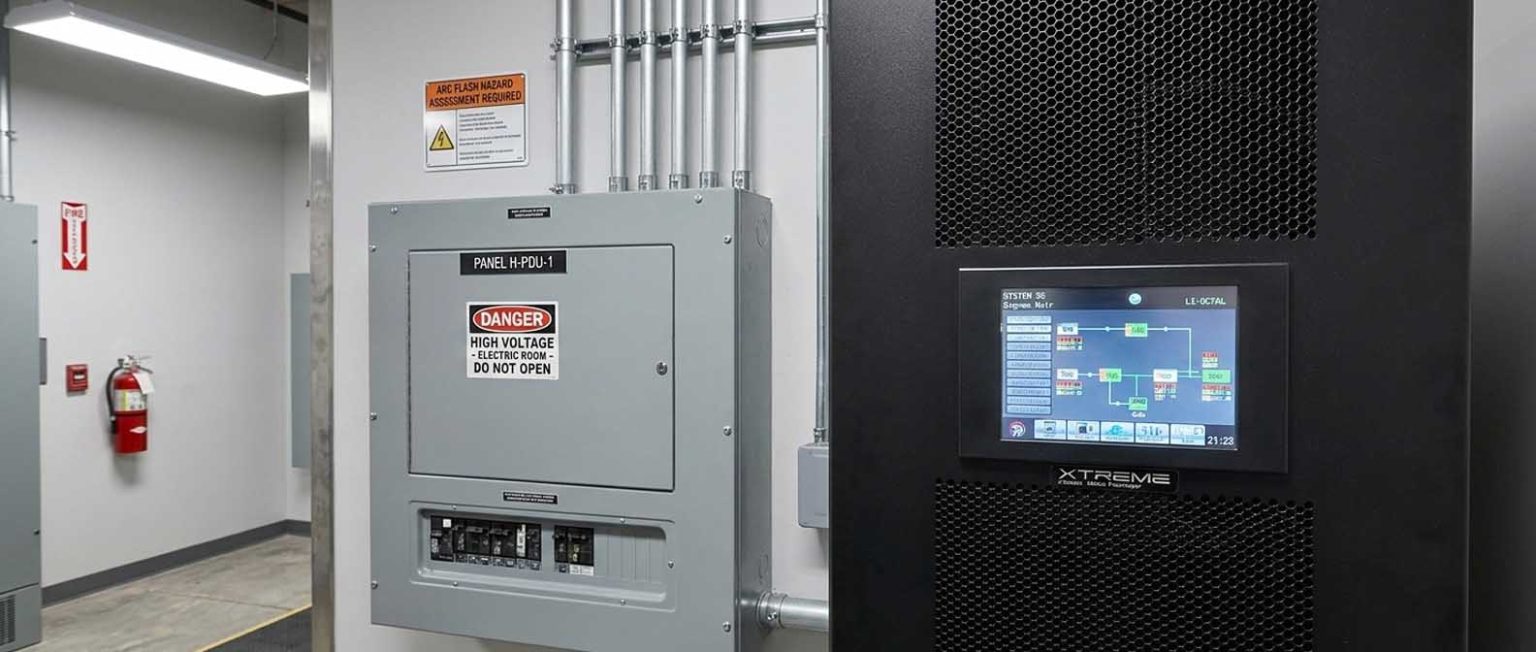
The consequences of power failure in an MRI suite
MRI systems are among the most power-sensitive equipment in a hospital. Unlike most clinical equipment where a power failure causes inconvenience or data loss, an MRI power failure during operation can trigger events that take the system offline for days and require significant service intervention.
Superconducting MRI magnets are maintained at near absolute zero in liquid helium. A power interruption can trigger a quench — sudden loss of superconductivity, rapid helium release, 24–72 hours of system downtime, and tens of thousands of dollars in helium refill and service costs.
An active scan interrupted by a power event means a repeat scan — additional patient time, potential rescheduling, and in some cases clinically unacceptable image artifacts. In emergency and trauma imaging, the impact is immediate.
MRI cooling systems — cryocoolers, gradient coil cooling, and RF amplifier thermal management — must remain operational during any power event. Loss of cooling during a high-duty-cycle scan sequence can damage gradient coils and RF systems.
Unique electrical challenges of MRI installations
MRI systems present electrical challenges that go beyond the requirements of most hospital equipment. UPS selection must account for these characteristics during both specification and installation planning.
MRI gradient amplifiers draw significant inrush current during initialization — often 3–5× the steady-state load. UPS systems must tolerate this inrush without nuisance tripping or output voltage sag that could affect the startup sequence.
Most MRI systems operate on 480V three-phase power — the X90 platform’s native voltage. This eliminates step-down transformers between the UPS and the MRI system, simplifying installation and reducing potential points of failure.
MRI systems have extended restart sequences after a power event — gradient calibration, shimming verification, and cooling system stabilization can take 30–60 minutes even without a quench. Runtime strategy must account for generator transfer plus this restart window.
MRI RF systems and gradient electronics are sensitive to harmonic distortion on the input power supply. Online double-conversion UPS architecture regenerates a clean sine wave output independent of utility power quality.
X90 Series — 480V modular UPS for MRI applications
The X90 Series provides online double-conversion power protection at 480V — the native voltage of most MRI installations. Modular architecture supports N+1 redundancy and scalable capacity across single-suite and multi-suite imaging departments.
The X90-1S provides modular online UPS protection for single MRI suite installations. Compact modular architecture supports N+1 redundancy within a single cabinet footprint. Scalable from 50kW with modular power module expansion to 70kW — accommodating future MRI upgrades without UPS replacement.
- Online double-conversion — zero transfer time
- Unity power factor (PF = 1.0)
- 480V input and output
- N+1 redundancy capable
- VRLA or Vision Lithium battery options
- TAA compliant
The X90-2S doubles the capacity ceiling to 140kW — appropriate for hospital imaging departments with multiple MRI suites, facilities with MRI plus CT infrastructure on a shared UPS architecture, or installations requiring higher N+1 redundancy margins. The same modular platform as the X90-1S with expanded module capacity.
- Online double-conversion — zero transfer time
- Unity power factor (PF = 1.0)
- 480V input and output
- 50–140 kW modular scaling
- VRLA or Vision Lithium battery options
- TAA compliant
VRLA or Vision Lithium — battery options for MRI UPS
X90 UPS systems support two battery configurations. Selection depends on runtime requirements, available floor space, and lifecycle cost strategy.
- Extended runtime configurations available
- Proven technology in medical facility deployments
- Multiple cabinet configurations for runtime scalability
- Lower upfront cost
- 3–5 year battery replacement cycle
- Reduced cabinet footprint for constrained electrical rooms
- Lower weight — important for floor loading in hospital construction
- Longer service life — reduced replacement frequency
- Lower maintenance requirements over system lifecycle
- Higher upfront cost offset by lifecycle savings
Runtime strategy for MRI UPS installations
- Generator startup and transfer time — typically 10–30 seconds
- Active scan completion — most sequences run 2–8 minutes
- Controlled system state preservation during transfer
- Cooling system continuity through the transfer window
- Facility generator transfer time specification
- Critical load segmentation strategy
- Available electrical room floor space
- Lifecycle cost and battery replacement access
MRI UPS integration with facility electrical infrastructure
MRI UPS systems do not operate in isolation — they must be coordinated with the facility’s electrical distribution, generator system, isolation transformer, and HVAC infrastructure. Xtreme Power engineering teams assist with all phases of this coordination.
- Isolation transformer sizing and placement
- Facility 480V distribution panel coordination
- Generator transfer switch integration
- HVAC and cooling system load segmentation
- One-line diagram review and documentation
- Load analysis and UPS sizing confirmation
- Inrush tolerance evaluation for gradient amplifiers
- Redundancy planning and N+1 configuration
- Battery runtime modeling for generator strategy
- Submittal documentation for construction projects
Common questions about UPS for MRI systems
Most MRI installations operate on 480V three-phase power. The X90 Series operates natively at 480V — no step-down transformer is required between the UPS and the MRI system. This simplifies the installation, reduces potential failure points, and is consistent with standard hospital electrical infrastructure for large medical equipment.
Most MRI UPS systems are sized for 2–15 minutes of runtime — enough to bridge generator startup (typically 10–30 seconds), complete an active scan sequence, and maintain system stability during the utility-to-generator transfer. Runtime beyond 15 minutes is generally handled by the facility generator, not the UPS battery system. Exact runtime depends on facility generator strategy and critical load segmentation.
A quench is a sudden loss of superconductivity in the MRI magnet — typically triggered by a disruption to the magnet’s operating conditions, which can include power loss to the cryocooler system that maintains the helium temperature. A quench results in rapid helium boil-off, a loud event, and 24–72 hours of system downtime while the magnet is re-cooled and re-energized. An online double-conversion UPS with zero transfer time maintains continuous power to the cryocooler and magnet systems through any utility disturbance, eliminating the power-related quench trigger.
Yes. All X90 Series UPS systems are TAA compliant, supporting procurement through VA, DoD, and other federal healthcare facility channels. Xtreme Power has active deployments across VA Medical Centers in support of healthcare infrastructure modernization projects.
Yes. The X90’s modular architecture supports N+1 redundancy configurations within a single cabinet. For hospital imaging departments where MRI uptime is critical, N+1 redundancy ensures that a single module failure does not interrupt UPS output. Redundancy configuration is determined during load analysis and one-line diagram review.
Speak with a medical imaging power specialist
Load analysis, inrush tolerance evaluation, redundancy planning, runtime modeling, one-line diagram review, and submittal documentation for MRI UPS projects.