
Lithium UPS vs Lead-Acid UPS — Battery Comparison
Both lithium and lead-acid UPS batteries serve legitimate roles in modern infrastructure. This guide covers how they compare across lifecycle, temperature performance, footprint, and cost — with an honest framework for deciding which is right for your deployment.
LiFePO₄ vs VRLA lead-acid — the key differences
The two chemistries have different strengths. LiFePO₄ outperforms VRLA across most long-term and environmental factors. VRLA lead-acid has a meaningful upfront cost advantage and remains well-suited for specific deployment contexts. The table below presents both without favoring either.
| Factor | LiFePO₄ Lithium UPS | VRLA Lead-Acid UPS |
|---|---|---|
| Battery service life | Up to 15 years — ideal conditions | 3–5 years typical |
| Discharge cycles | 3,000–5,000 at standard depth | 200–500 before significant degradation |
| Rated operating temperature | Up to 50°C | 25°C — degrades above this |
| Routine battery replacement | None in most deployments | Every 3–5 years — parts, labor, downtime |
| Thermal stability | Inherently stable — no thermal runaway | Sulfation and stratification with heat and age |
| Recharge speed | Up to 4× faster than lead acid | Slower — longer exposure window between events |
| Energy density | Higher — up to 70% smaller at equiv. capacity | Lower — larger and heavier |
| External battery cabinets | Often not required | Typically required for larger systems |
| Upfront cost | Higher initial purchase price | Lower initial purchase price |
| Total cost of ownership | Lower over full lifecycle | Lower upfront; higher over full lifecycle |
| Best for | Distributed, high-temp, long-lifecycle deployments | Cost-sensitive, single-site, controlled environments |
Understanding each chemistry
LiFePO₄ and VRLA lead-acid are fundamentally different battery chemistries with different performance profiles. Understanding where each excels — and where each has limitations — is the basis for a sound specification decision. Xtreme Power uses LiFePO₄ in its lithium UPS product line; lead-acid in its standard UPS product line.
- Thermally stable — no thermal runaway under normal operating conditions
- 3,000–5,000 discharge cycles at standard depth of discharge
- Flat discharge curve — consistent voltage through most of the discharge range
- Maintains capacity better at elevated temperatures than other lithium chemistries
- Long calendar life — designed for stationary applications, not consumer electronics
- Well-established safety profile in mission-critical infrastructure
- Lower upfront cost — the established standard for UPS battery technology
- 200–500 cycles at standard depth before significant capacity degradation
- Well understood — decades of field data, broad industry support
- Performance specified at 25°C — well-suited for climate-controlled installations
- Battery replacement every 3–5 years — straightforward maintenance cycle
- Heavier than lithium at equivalent capacity — standard rack form factors accommodate this
Some UPS vendors use NMC (nickel manganese cobalt) lithium chemistry, which offers higher energy density but carries greater thermal sensitivity and less favorable cycle life than LiFePO₄. For stationary power applications where thermal stability and long service life are priorities — rather than maximum energy density in minimum volume — LiFePO₄ is the better-suited chemistry.
Temperature — the key deployment constraint
Lead-acid battery specifications are written at 25°C. In climate-controlled data centers, server rooms, and office environments — that’s a reasonable assumption. In back-of-house retail spaces, plant floors, telecom shelters, and outdoor enclosures, it often isn’t. Temperature is the single factor that most clearly separates the two chemistries in real-world deployments.
The Arrhenius rate law — a well-established principle in battery chemistry — predicts that lead acid battery service life is roughly halved for every 10°C increase above 25°C. A battery specified for 5 years at 25°C may last 2–3 years at 35°C and under 18 months at 45°C. This is not a theoretical risk — it’s the dominant failure mode in distributed retail, industrial, and edge deployments.
Lifecycle cost — the real comparison
Upfront cost favors lead acid. Lifecycle cost — when battery replacement cycles, labor, and downtime are included — often favors lithium, particularly in distributed multi-site deployments. The crossover point depends on the number of sites, replacement cycle frequency, and technician cost. The model below illustrates the factors involved.
Footprint — where energy density matters most
Higher energy density means lithium UPS systems are significantly smaller and lighter than lead acid at equivalent capacity. For most standard rack and tower deployments, both chemistries fit without difficulty. The size difference becomes decisive when space is genuinely constrained — kiosk installations, DIN rail mounting, shallow cabinets, or sealed control panels.
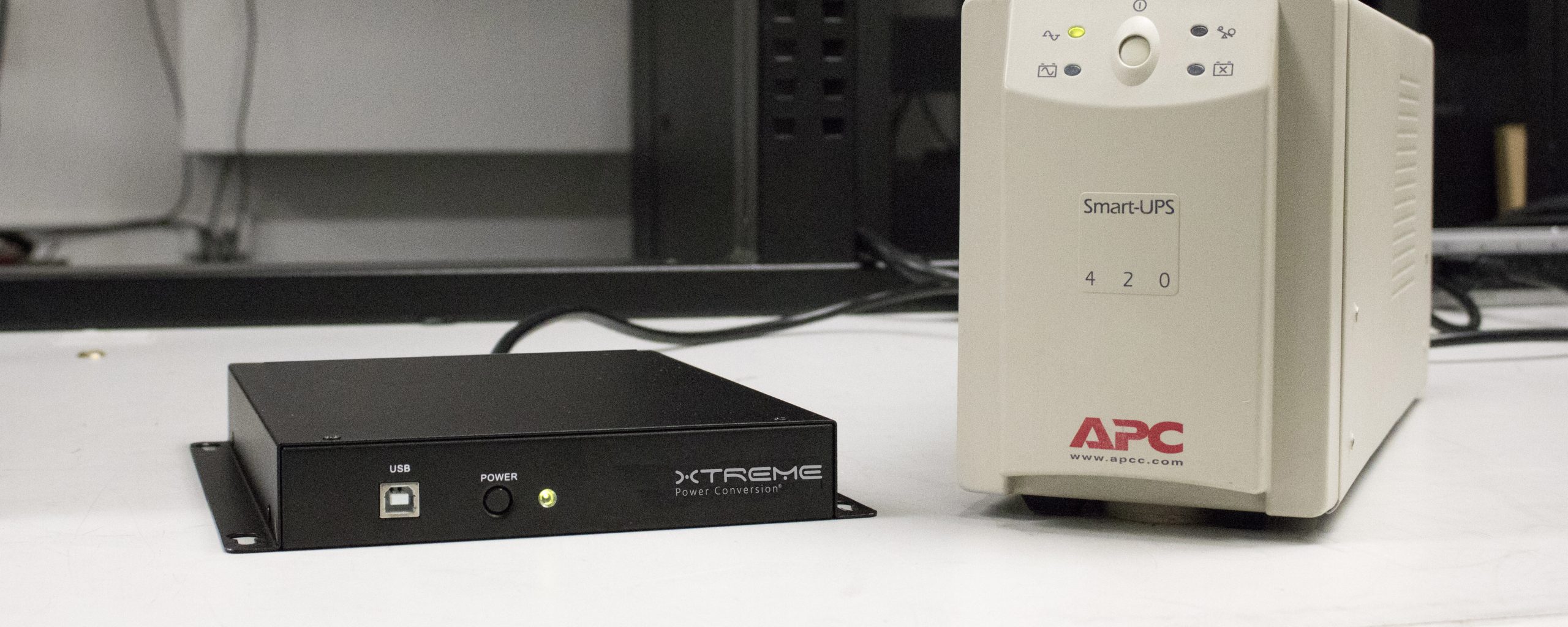
The size difference opens up form factors that don’t exist in lead acid — UPS systems that mount behind kiosk displays, clip to DIN rails inside control panels, or fit in shallow cabinets where standard UPS depth won’t work. For standard rack and tower deployments, both chemistries are available in the same form factors and the size difference is less of a deciding factor.
When to choose each technology
Both chemistries are appropriate for specific deployment contexts. The decision framework below is honest about where each performs best. If your deployment conditions fit the lead acid column, it’s a reasonable choice — Xtreme Power makes both.
- Ambient temperature regularly exceeds 25°C at the installation location
- Deployment spans multiple distributed sites — battery replacement logistics compound
- Battery replacement access is difficult — sealed panels, remote sites, limited technician availability
- Long deployment lifecycle is planned — 10+ years without infrastructure refresh
- Form factor is constrained — kiosk, DIN rail, shallow cabinet, behind-display installation
- Minimizing maintenance intervention is an operational priority
- Total cost of ownership is evaluated over the full deployment lifecycle
- Upfront capital cost is the primary constraint
- Deployment is single-site with reliable technician access for routine replacement
- Environment is climate-controlled and maintains 25°C or below consistently
- Deployment lifecycle is short — 3–5 years before planned infrastructure refresh
- Standard rack or tower form factor is acceptable
- A lithium model is not yet available for the required capacity or topology
- Organization has established lead acid replacement processes already in place
UPS systems from Xtreme Power — lithium and lead acid
Xtreme Power makes both lithium and lead-acid UPS systems. The right choice depends on your deployment — not a preference for one chemistry over the other. All lithium systems use LiFePO₄ chemistry.
Wall mount, DIN rail, or flat mount. The J60 fits behind displays and inside control panels where no conventional UPS can go. Fanless. LiFePO₄ battery. No battery replacement for the life of the deployment.
View J60 →Online double-conversion with LiFePO₄ batteries. 1U rack (J90) or rack/tower convertible (P91Li). Eliminates battery replacement in distributed deployments where access is difficult or maintenance costs are high.
View lithium single-phase →Internal LiFePO₄ battery modules — no external battery cabinets. Hot-swappable modules. 50°C operating temperature. Direct replacement for legacy three-phase VRLA UPS systems with external battery cabinet combinations.
View Li90 →Online double-conversion protection for IT infrastructure and network equipment. Lower upfront cost than the lithium equivalent. Appropriate for climate-controlled environments where a 3–5 year battery replacement cycle is an acceptable operational model.
View P91 →Detailed comparisons vs other UPS platforms
Evaluating lithium UPS against specific competitive platforms? These comparisons cover the Li90 three-phase lithium UPS against the major alternatives from Eaton, Vertiv, and Schneider Electric.
Common questions about lithium vs lead acid UPS
It depends on the deployment. Lithium UPS systems provide longer battery service life, fewer replacement cycles, better performance in elevated temperatures, and lower total cost of ownership over a 10–15 year deployment — making them the stronger choice for distributed, high-temperature, or long-lifecycle environments. Lead-acid UPS systems have a lower upfront cost and remain the right choice for cost-sensitive single-site deployments in climate-controlled environments, or where a 3–5 year replacement cycle is acceptable. Xtreme Power makes both — the goal is matching the technology to the deployment, not defaulting to either.
LiFePO₄ UPS batteries can last up to 15 years in ideal operating conditions (at or below 25°C, moderate depth of discharge). They are rated for 3,000–5,000 discharge cycles. In elevated temperature environments — above 40°C continuous — service life is reduced. Standard 5-year battery warranty applies up to 40°C ambient; a 2-year warranty applies above 40°C. Compare this to VRLA lead acid, which requires replacement every 3–5 years under similar conditions.
Lead-acid was the dominant UPS battery chemistry for decades because it was mature, widely available, and relatively inexpensive. Lithium iron phosphate technology for stationary power applications has only become cost-competitive in the last 10 years. Systems specified in the 2000s and 2010s used lead acid because lithium at scale wasn’t yet a viable option — not because it was the better technology.
The upfront purchase price is higher. The total cost of ownership over a 10–15 year deployment is typically lower — sometimes significantly lower — when battery replacement cycles, labor, downtime, and disposal costs are included. For distributed deployments with many sites, the cost advantage of lithium is amplified by the elimination of truck rolls for battery replacement.
LiFePO₄ is the most thermally stable of the common lithium battery chemistries. It does not exhibit thermal runaway under normal operating conditions — the failure mode sometimes associated with other lithium-ion chemistries. All Xtreme Power lithium UPS systems include integrated battery management systems that monitor cell voltage, temperature, and charge state continuously. The safety profile of LiFePO₄ is a primary reason it’s the chemistry of choice for stationary power applications.
Generally no — UPS systems are designed around specific battery chemistry and voltage profiles. A lead acid UPS cannot be field-retrofitted with lithium batteries. Transitioning to lithium requires replacing the UPS system itself. The good news is that lithium UPS platforms from Xtreme Power are designed to be drop-in replacements for common legacy systems in most rack and tower form factors.
Talk to an Xtreme Power engineer about battery technology selection
Lifecycle analysis, architecture evaluation, runtime modeling, and product selection guidance — for both lithium and lead-acid deployments.