
Modular UPS Systems
Modular UPS systems provide scalable, serviceable continuity architecture for evolving electrical infrastructure — across distributed facilities, technology-dense environments, and lifecycle-driven modernization initiatives.
Unlike fixed-capacity monolithic platforms, modular architectures enable incremental capacity expansion, simplified service workflows, and long-term continuity planning aligned with real-world deployment. As technology density rises across commercial, industrial, healthcare, and distributed IT environments, modular strategies let planners align continuity architecture with facility evolution rather than static electrical assumptions.

Modular vs monolithic UPS architecture
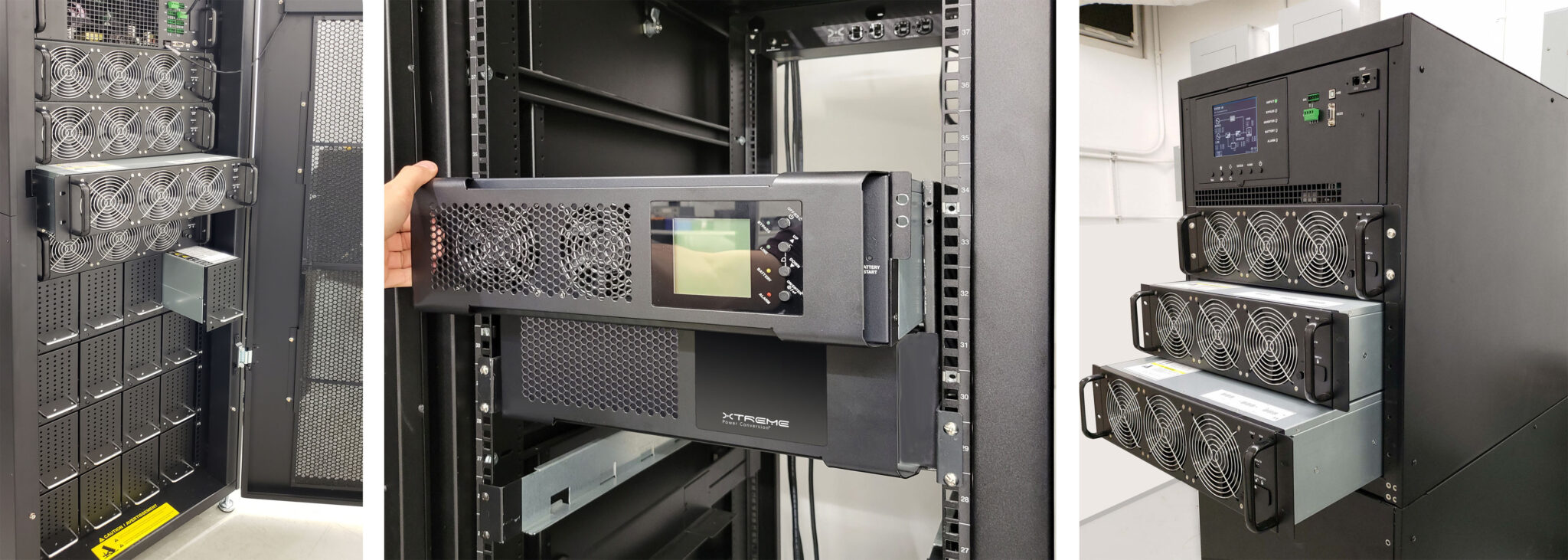
Traditional monolithic UPS systems are deployed at fixed capacity, requiring full system replacement when load outgrows the original design. Modular platforms address this through hot-swappable power and battery modules that support:
- Incremental capacity scaling
- Reduced service disruption during maintenance
- Standardized deployment across multiple facilities
- Extended infrastructure lifecycle planning
- Improved operational flexibility in constrained electrical environments
This philosophy enables continuity planning aligned with phased technology deployment rather than fixed electrical infrastructure assumptions.
Modular UPS architecture tier framework
Xtreme Power modular platforms are engineered across distinct architectural tiers to match different infrastructure deployment realities.
Distributed centralized continuity
Centralized scalability where three-phase service is unavailable or operationally unnecessary.
Rack-integrated centralized continuity
Scalable centralized continuity within space-constrained electrical environments.
Electrical room centralized continuity
Large infrastructure environments requiring high-capacity scalability and redundancy capability.
Enterprise & data-hall centralized continuity
High-capacity platforms for enterprise data centers, large-scale facilities, and high-density compute — from floor-standing modular frames (X90) to rack-integrated modular systems (Ai90), with modular power and battery modules.
Modular UPS architecture decision matrix
| Infrastructure Condition | Tier | Platform | Capacity | Electrical Service | Typical Environment | Strategic Rationale |
|---|---|---|---|---|---|---|
| No three-phase service, but centralized scalability required | Single-Phase Modular | M90S | 6–48 kW | 208/120V or 240/120V 1-ph | Telecom, distributed compute, commercial distributed | Centralized lifecycle continuity without an electrical upgrade |
| Three-phase available, footprint constrained (North America) | Compact Three-Phase Modular | M90C | 5–24 kVA | 208/120V 3-ph | Edge IT, healthcare, industrial automation, hospitality | Centralized scalability in constrained LV infrastructure |
| Three-phase available, footprint constrained (International / IEC) | Compact Three-Phase Modular | M90Ci | 10–60 kVA | 400/230V 3-ph | Global commercial, telecom hubs, industrial | Higher centralized density aligned with IEC standards |
| Facility-level centralized continuity required | Facility-Scale Modular | M90U | 15–140 kW N+1 | 208/120V 3-ph | Data centers, large industrial & commercial | High-capacity lifecycle scaling with redundancy capability |
| Enterprise / data-hall scale on 400/480V service | 400/480V High-Capacity Modular | X90 | 50–700 kW | 480V / 400V class | Enterprise & colocation data centers, large industrial | Highest-capacity modular scaling with VRLA or lithium batteries |
| High-density / rack-level compute on 400/480V service | 400/480V High-Capacity Modular | Ai90Coming Nov 2026 | 50–70 kW | 480/277V · 480V 3W · 400/230V | High-density compute, AI/GPU, rack-level | Rack-integrated UPS, battery, bypass & distribution in 13U |
Compact modular capacity ranges vary by electrical standard — North American LV environments prioritize distributed scalability, while IEC regions support higher centralized density. Ai90 capacity also depends on voltage: 50/70 kW at 480V, 50/60 kW at 400/230V. X90 is currently available in 480V only.
Modular infrastructure lifecycle strategy
Modular deployment models align power continuity architecture with evolving infrastructure growth rather than fixed-capacity planning assumptions, enabling organizations to:
- Extend usable infrastructure lifecycle
- Reduce long-term capital replacement risk
- Standardize deployment across facility types
- Improve serviceability in mission-critical environments
- Support phased modernization without disruptive system replacement
Modular UPS evaluation resources
Select the right modular architecture tier
Choosing the right tier means weighing electrical infrastructure constraints, lifecycle objectives, redundancy requirements, and deployment conditions. Our engineers help map all four to the right platform.