
Remote Switching UPS and Smart PDU
The J90 UPS with remote outlet control and the SPDU Smart PDU solve two related but distinct problems. The J90 provides backup power plus per-outlet switching. The SPDU provides per-outlet monitoring, control, and power sequencing without a battery. In most racks, both are deployed together — UPS runtime upstream, intelligent distribution downstream.
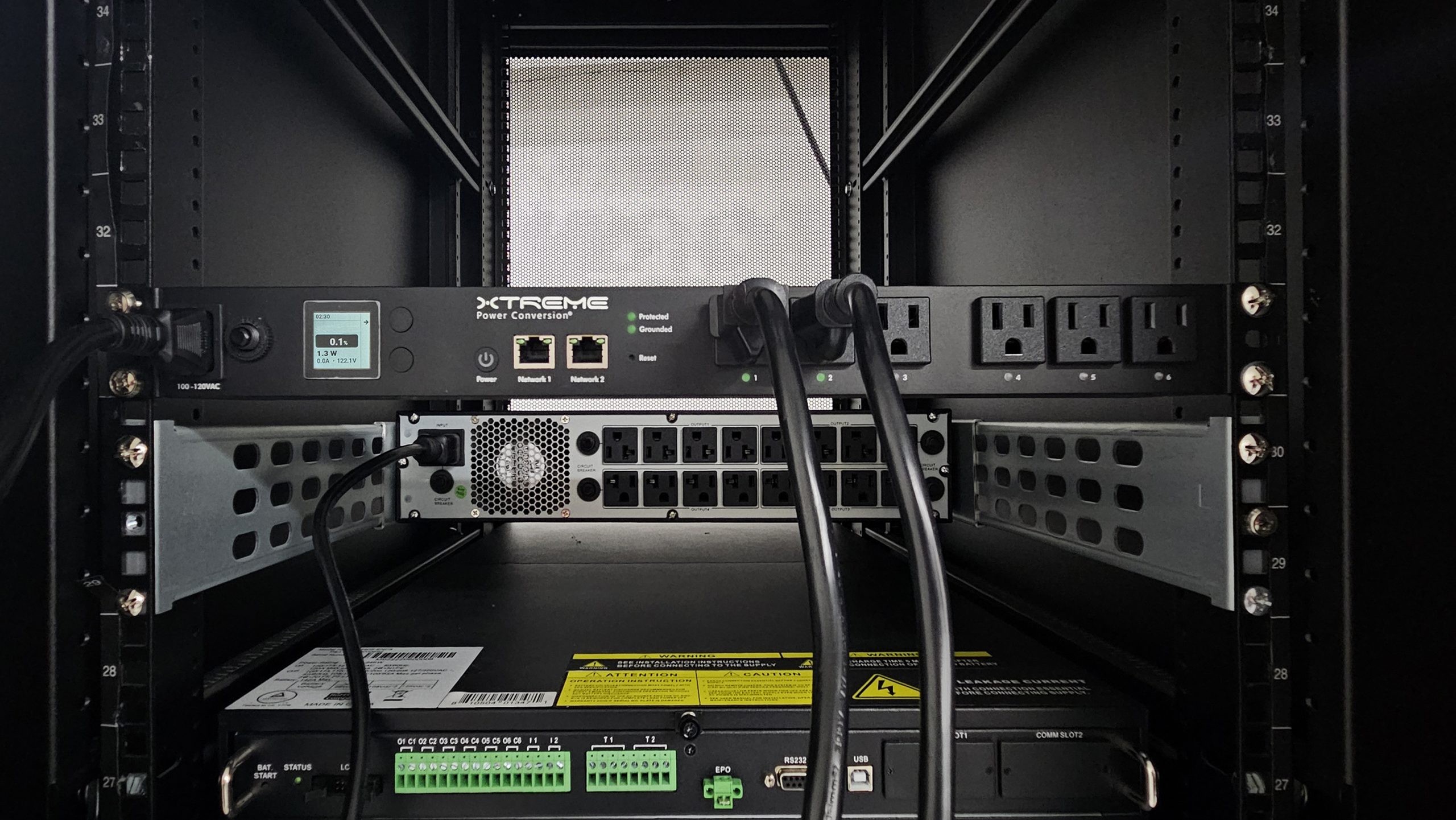
A 1U online double-conversion lithium UPS with individual switchable outlets — backup power and remote reboot capability in a single compact unit. When a device locks up at a remote site, you power-cycle it from anywhere without dispatching a technician.
- Online double-conversion — zero transfer time
- Individual outlet switching — per device
- LiFePO₄ — up to 15-year battery life
- 1–3kVA · 120V · 1U rack or wall-mount
- 50°C operation — IDF closets and edge sites
- 6-year warranty · TAA compliant
A metered-by-outlet smart rack PDU providing outlet-level energy measurement, remote switching, and sequenced startup — for racks that already have a UPS and need intelligent distribution. Measures wattage per outlet, controls power remotely, and staggers startup to protect sensitive electronics.
- Metered-by-outlet — wattage and energy per device
- Remote outlet switching and power sequencing
- SNMP/web interface for remote management
- 1U (6-outlet) or 2U (14-outlet) configurations
- 50°C operation — high-temperature environments
- 5-year warranty · TAA compliant
Remote power control across distributed infrastructure
A frozen switch, hung firewall, or locked-up controller can be power-cycled remotely via SNMP or web interface. For organizations managing 10, 20, or 50 distributed sites, eliminating a truck roll for what amounts to a power cycle changes the economics of distributed IT management significantly.
The SPDU’s metered-by-outlet monitoring shows exact wattage and energy consumption per connected device. Capacity planning becomes data-driven — you know which outlets are underloaded, which are approaching limits, and where to add capacity before it becomes a problem.
The SPDU staggers equipment startup after a power event — bringing devices online in sequence rather than simultaneously. This eliminates the inrush current spike that can trip breakers or stress UPS inverters when a full rack restores at once after an outage.
Restrict which users and systems can switch outlets on or off across the network. For security-sensitive environments, locking outlet control behind SNMP credentials or web authentication prevents unauthorized power cycling of critical devices.
The J90 supports an optional temperature and humidity sensor. The SPDU supports environmental probes via SNMP/web. Both enable early warning of thermal conditions in IDF closets, edge cabinets, and equipment rooms before they become failure events.
Both the J90 and SPDU are manufactured in Taiwan — a TAA designated country — and are eligible for U.S. federal, state, and municipal procurement. Remote power management capability for government IT infrastructure without compliance exceptions.
J90 UPS vs SPDU Smart PDU — feature comparison
| Feature | J90 UPS with Remote Outlet Control | SPDU Smart PDU |
|---|---|---|
| Primary function | Backup power + remote outlet control | Rack PDU + outlet monitoring and control |
| Form factor | 1U rackmount UPS | 1U (6-outlet) · 2U (14-outlet) |
| Battery backup | Yes — 1–3kVA · LiFePO₄ | No — distribution only |
| Remote outlet switching | Yes — per outlet | Yes — per outlet |
| Metered-by-outlet monitoring | No | Yes — wattage and energy per outlet |
| Power sequencing | No | Yes — staged startup |
| Environmental monitoring | Optional temp/humidity sensor | Probes via SNMP/web |
| Battery chemistry | LiFePO₄ — 15-year design life | N/A |
| Operating temperature | Up to 50°C | Up to 50°C |
| TAA compliance | Yes — Taiwan | Yes — Taiwan |
| Warranty | 6 years (2 years above 40°C) | 5 years |
| Best for | Backup power + remote reboot in one unit | Per-outlet monitoring where UPS already exists |
J90 or SPDU — or both
- You need UPS protection plus remote reboot without adding a separate PDU
- Your rack or cabinet has limited space — the J90 covers both functions in 1U
- You want LiFePO₄ long-life batteries and 50°C operation for edge and IDF deployments
- You need TAA-compliant UPS with remote switching for government procurement
- You want a 6-year warranty covering both electronics and battery
- A UPS is already in the rack and you need intelligent distribution downstream
- You need metered-by-outlet wattage and energy data per connected device
- Sequenced startup after a power event is required to protect sensitive equipment
- You need 14 switched and monitored outlets — the 2U model covers a full rack
- You need TAA-compliant smart PDU for federal or public-sector rack infrastructure
The J90 provides upstream battery backup and basic outlet switching. The SPDU provides downstream per-outlet energy metering, fine-grained control, and sequenced startup across all connected devices. Together they create a complete intelligent rack power architecture — runtime and protection from the UPS, visibility and control from the PDU. This is the recommended configuration for distributed IT, edge deployments, and managed service environments where both uptime and operational efficiency matter.
TAA-compliant remote power management for government infrastructure
Both the J90 and SPDU are manufactured in Taiwan — a Trade Agreements Act designated country — and are eligible for U.S. federal, defense, education, and municipal procurement. Remote power management capability doesn’t require a compliance exception for government IT infrastructure.
Where remote switching UPS and smart PDU are deployed
Remote switching & smart PDU — frequently asked questions
What is a remote switching smart PDU?
What is the difference between a UPS and a remote switching PDU?
Can I reboot a frozen device remotely?
Where is remote switching most useful?
Does the smart PDU also monitor power?
Talk to an engineer about rack power management
J90 and SPDU configuration, distributed deployment planning, TAA procurement support, and managed service rack architecture.