
Reliable Backup Power for Critical Network Infrastructure
Network switches are a fundamental component of modern IT infrastructure, connecting servers, wireless access points, security systems, and end-user devices across enterprise networks.
If power is interrupted, network switches immediately shut down, disrupting communication between systems and causing network-wide outages.

Network switches and routers powering critical communications and data traffic
A UPS (Uninterruptible Power Supply) provides battery backup power that allows network switches to remain operational during power disturbances or outages. Installing a UPS for network switches helps ensure network availability and prevents disruptions to critical services.
UPS protection is commonly deployed in environments such as:
- data centers
- edge computing deployments
- IDF and MDF network closets
- retail locations and branch offices
- telecommunications rooms
Reliable UPS protection helps maintain network connectivity and reduces downtime across distributed infrastructure.
Why Network Switches Require UPS Protection
Modern networks depend on continuous operation of switching infrastructure to maintain communication between devices and applications.
Typical network equipment requiring UPS protection includes:
- core and aggregation switches
- access switches supporting PoE devices
- edge switches connecting branch infrastructure
- wireless controller infrastructure
- network security appliances
If a network switch loses power, connected devices such as wireless access points, VoIP phones, and security cameras also lose connectivity.
In many environments, switches also power connected devices using Power over Ethernet (PoE), making reliable power protection even more critical.
UPS systems allow switches to remain operational during short power interruptions and provide time for graceful shutdown procedures during longer outages.
Challenges in Protecting Network Switch Infrastructure
Network switches are often installed in locations that present unique power protection challenges.
Common environments include:
- IDF and MDF network closets
- telecom cabinets
- edge computing racks
- distributed infrastructure rooms
These environments may have limited space, elevated temperatures, and limited maintenance access.
Traditional UPS systems designed for desktop computers or office environments are often not optimized for these conditions.
Key considerations when selecting a UPS for network switches include:
- rack space availability
- power capacity and load requirements
- battery lifecycle and maintenance intervals
- thermal performance in network closets
- scalability for future network growth
Selecting the right UPS platform ensures reliable network operation while minimizing maintenance and operational costs.
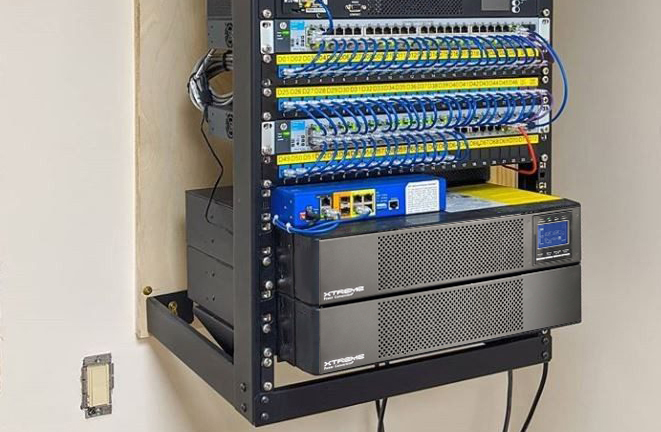
UPS systems integrated with network switches and routers to ensure continuous connectivity
Lithium UPS vs Traditional Lead-Acid UPS Systems
Traditional UPS platforms commonly use valve-regulated lead-acid (VRLA) batteries. While widely used, these batteries require periodic replacement and may have limited lifespan in higher temperature environments.
Lithium UPS systems offer several advantages for network infrastructure deployments.
| Feature | Lead-Acid UPS | Lithium UPS |
| Battery lifespan | 3–5 years | up to 10–15 years |
| Temperature tolerance | moderate | higher temperature operation |
| Maintenance requirements | periodic battery replacement | minimal maintenance |
| Lifecycle cost | higher over time | lower total cost of ownership |
Lithium battery UPS systems using LiFePO₄ chemistry can significantly reduce maintenance requirements and improve long-term reliability for distributed network infrastructure.
Recommended UPS Solutions for Network Switches
Xtreme Power provides multiple UPS platforms designed to protect network switching infrastructure across a wide range of environments.
J60 Compact Lithium UPS
The J60 Series is an ultra-compact lithium UPS designed for small networking devices and distributed edge infrastructure.
Typical applications include:
- small switches
- wireless access points
- edge networking equipment
- telecom cabinets
Learn more:
https://xpcc.com/products/j60/
J90 Rackmount Lithium UPS
The J90 Series is a compact rackmount lithium UPS platform designed for protecting network switches in IT racks and telecom environments.
Typical applications include:
- rack-mounted network switches
- IDF closet infrastructure
- branch office network equipment
Learn more:
https://xpcc.com/products/j90/
J90i 208V Rack UPS
The J90i Series provides lithium UPS protection for higher-voltage rack infrastructure operating at 208V or 230V.
Typical deployments include:
- enterprise network infrastructure
- telecom racks
- edge data center environments
Learn more:
https://xpcc.com/products/j90i/
P91 Rackmount UPS
The P91 Series provides scalable UPS protection for network racks requiring higher capacity or longer runtime.
Typical applications include:
- larger network racks
- telecom infrastructure
- distributed IT environments
Learn more:
https://xpcc.com/products/p91_1-3/
Applications for Network Switch UPS Systems
UPS protection for network switches is commonly deployed across a wide range of industries.
Typical applications include:
- enterprise network infrastructure
- retail store networking environments
- branch office infrastructure
- hospitality and restaurant networks
- healthcare facilities
- educational campuses
These deployments often rely on distributed network closets and edge infrastructure where reliable power protection is essential.
Related application pages:
UPS for IDF & MDF Closets
https://xpcc.com/ups-for-idf-mdf-closets/
UPS for Edge Computing
https://xpcc.com/ups-for-edge-computing/
UPS for Network Closets
https://xpcc.com/ups-for-network-closets/
Related UPS Comparisons
Engineers and IT managers frequently compare UPS platforms before selecting a solution for network infrastructure.
Explore these comparison resources:
J90 UPS Competitive Comparisons
https://xpcc.com/j90-ups-comparisons/
J90i UPS Competitive Comparisons
https://xpcc.com/j90i-ups-comparisons/
P91 UPS Competitive Comparisons
https://xpcc.com/p91-ups-competitive-comparisons/
Best Practices for Protecting Network Switches with UPS
When deploying UPS protection for network switching infrastructure, consider the following guidelines:
- size the UPS to support switch load and PoE power requirements
- ensure adequate ventilation in network closets
- plan for future network expansion and load growth
- periodically test UPS systems to verify proper operation
Properly designed UPS protection helps maintain reliable network connectivity and reduces downtime across distributed infrastructure.
Frequently Asked Questions About UPS for Network Switches
Do network switches need a UPS?
Yes. Network switches are critical infrastructure devices that connect servers, wireless access points, and endpoint devices. Installing a UPS ensures switches remain operational during power disturbances or outages.
How long will a UPS power a network switch?
Runtime depends on the UPS capacity and the power consumption of the switch. Smaller switches may require less than 100 watts, while larger PoE switches can require significantly more power.
What size UPS is required for a network switch?
The appropriate UPS size depends on the switch power consumption and the number of connected devices. Network administrators typically select a UPS with sufficient capacity to support both the switch load and any PoE devices connected to it.
Can one UPS power multiple switches?
Yes. In rack environments, a UPS system often protects multiple network switches as well as routers, firewalls, and other networking equipment.
Need Help Selecting a UPS for Network Infrastructure?
Xtreme Power engineers can help you select the right UPS solution for network switches, routers, and distributed IT infrastructure.
Contact our team for technical guidance or a quotation.
sales@xpcc.com
1-800-582-4524