
Edge data centers require compact, scalable, and reliable power protection to support distributed IT infrastructure closer to users and devices.
Unlike centralized hyperscale facilities, edge environments often operate in constrained spaces, with limited cooling, limited service access, and variable utility quality. UPS systems must deliver high reliability in smaller footprints while supporting future capacity growth.
Xtreme Power provides modular and lithium UPS platforms optimized for edge deployments ranging from single wall-mount racks to regional aggregation hubs.

Compact edge data center supporting distributed IT workloads and localized computing.
Edge Deployments Range from 1 Rack to Regional Hubs
Edge infrastructure spans a wide range of deployment sizes. Xtreme Power supports applications from micro-edge network closets to multi-hundred-kilowatt regional facilities.
Micro Edge & Wall-Mount Rack Deployments (1–3 kVA)
Many edge environments consist of:
- Single wall-mounted network racks
- Retail or branch IT closets
- Telecom cabinets
- Remote monitoring sites
- Industrial enclosures
These deployments typically require compact 1–3 kVA UPS systems with minimal maintenance requirements.
Recommended Platform
J90 / J90i 1U Lithium UPS (1–3 kVA)
Short-depth, lithium-based UPS ideal for shallow racks and high-temperature network closets.
Explore 1U Lithium UPS →
https://www.xpcc.com/1u-lithium-ups/
Lithium battery integration provides:
- Up to 15-year design life
- Reduced maintenance requirements
- Stable runtime over lifecycle
- Operation up to 50°C (122°F), depending on configuration
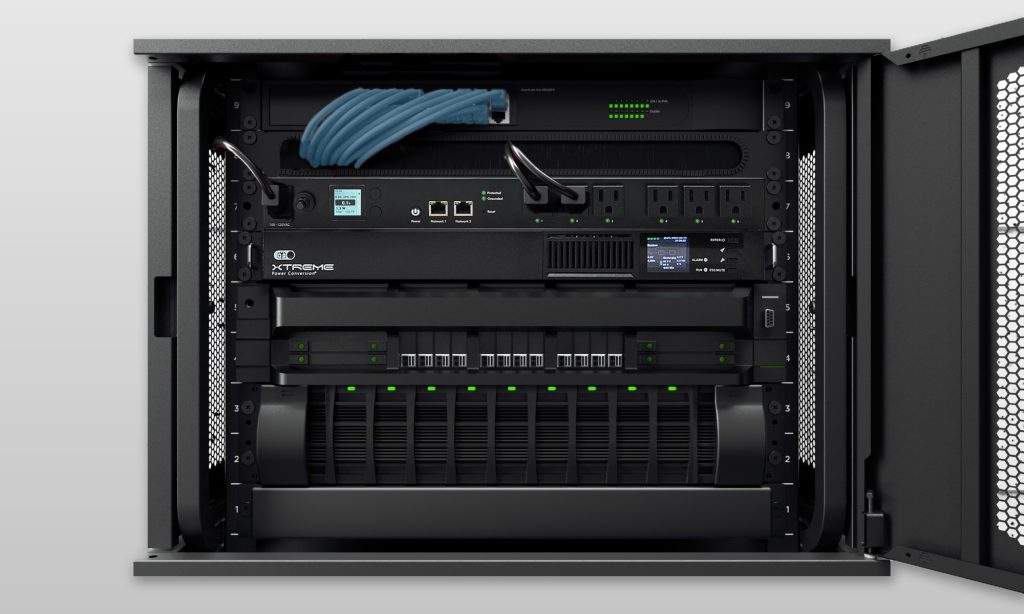
1–3 kVA lithium UPS deployed in a wall-mount edge network cabinet.
Single-Phase Edge & Telecom Sites
Many distributed edge environments do not have access to 3-phase power. These locations typically operate on 120V or 208/240V single-phase circuits and include:
- Cell tower base stations
- Telecom shelters
- Rural aggregation sites
- Outdoor equipment cabinets
- Utility and pipeline monitoring stations
- Transportation infrastructure sites
These environments often require higher capacity than micro-edge deployments but are limited by single-phase electrical service.
Recommended Platform
M90S-12S Modular Single-Phase UPS (6–36 kW)
Scalable modular architecture designed for high-capacity single-phase edge and telecom applications.
https://xpcc.com/products/m90s-12s/
The M90S-12S provides:
- 6–36 kW scalable capacity
- N+1 modular redundancy
- Integrated maintenance bypass
- Flexible battery configuration
- Reliable operation in distributed infrastructure environments
This platform is ideal for telecom and tower deployments where 3-phase power is unavailable but higher load capacity is required.

Single-phase modular UPS supporting remote telecom and tower infrastructure.
Small 3-Phase Edge Data Rooms (5–30 kW)
Where 3-phase power is available, compact modular systems provide scalable protection with higher efficiency.
Recommended Platforms
M90C Modular UPS (5–24 kW)
https://www.xpcc.com/xtreme-power-m90c-modular-ups-systems/
Li90 Three-Phase Lithium UPS (10–30 kW)
https://xpcc.com/3-phase-lithium-ups-li90/
Lithium integration reduces footprint and maintenance in distributed environments and supports high-temperature operation.
Regional Edge Hubs (15–700 kW)
Regional edge hubs aggregate traffic and computing resources across broader service areas. These deployments often resemble small enterprise data centers.
Recommended Platforms
M90U Modular UPS (15–140 kW)
Enterprise modular architecture for row-based or centralized edge deployments.
https://xpcc.com/xtreme-power-m90u-ups-family/
Ai90 Rack Modular UPS (50–70 kW per rack)
Designed for high-density edge and AI-enabled sites.
https://www.xpcc.com/ai90-modular-ups-systems/
X90 Series Modular UPS (50–700 kW)
Scalable modular platform for centralized regional hubs.
https://www.xpcc.com/x90-modular-ups-series/
Power Challenges in Edge Environments
Edge data centers often face:
- Limited floor space
- Higher ambient temperatures
- No on-site generator
- Variable grid stability
- Rapid load growth
- Limited on-site service personnel
UPS systems must be compact, efficient, and scalable to support these constraints.
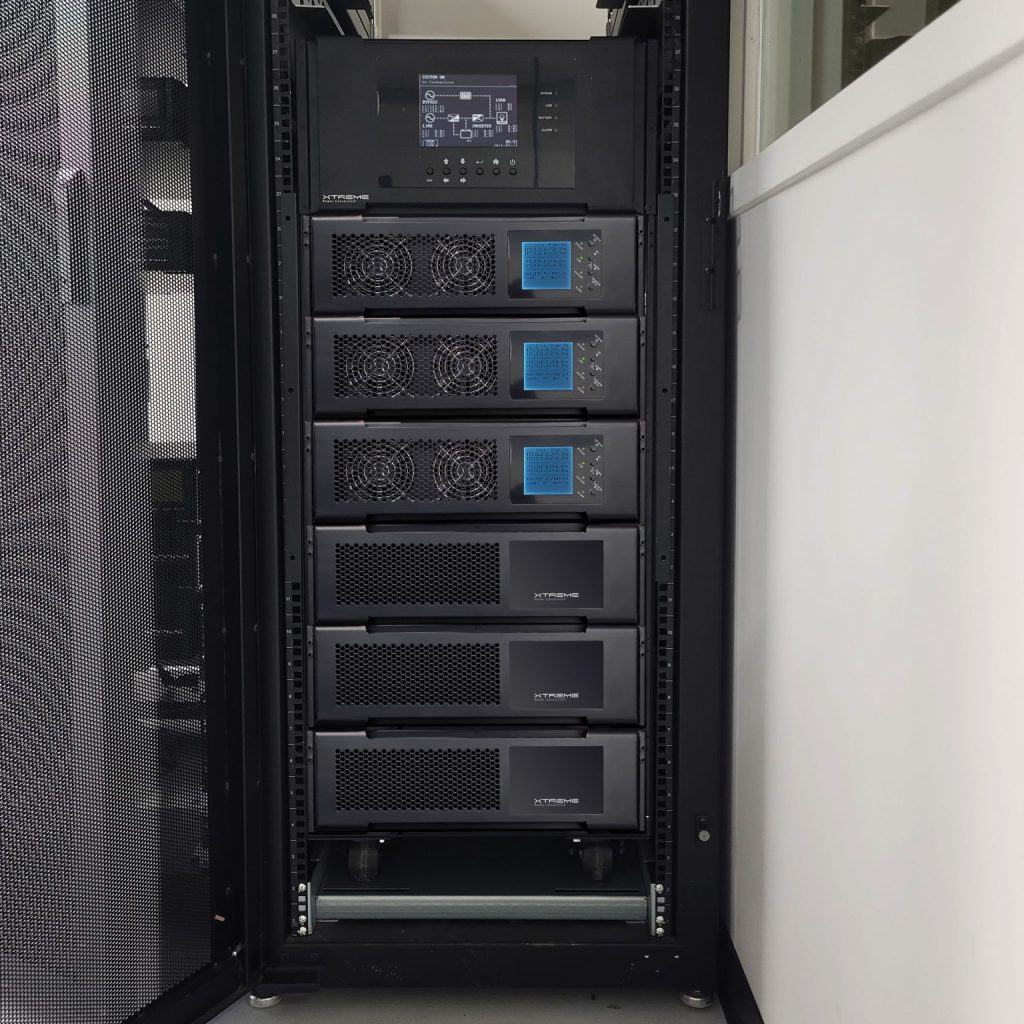
Compact modular UPS protecting distributed edge computing environments.
Why Lithium UPS Is Ideal for Edge Deployments
Lithium battery technology provides significant advantages in distributed environments:
- Extended service life (up to 15 years, depending on model)
- Reduced maintenance
- Smaller footprint
- Lower weight
- Stable runtime over lifecycle
- Operation up to 50°C (122°F), depending on configuration
Explore Lithium UPS Solutions →
https://www.xpcc.com/lithium-ups/
Runtime Strategy for Edge Sites
Most edge data centers design for:
- 2–10 minutes of runtime
- Generator ride-through (if available)
- Controlled shutdown capability
Runtime strategy depends on site criticality, service level agreements, and maintenance access.
Use the Xtreme Power UPS Sizing Tool →
https://xpcc.com/ups-sizing-tool/

Scalable modular UPS architecture supporting regional edge aggregation sites.
Distributed vs Centralized Protection
Edge deployments may use:
- Per-rack UPS systems
- Room-level modular UPS
- Hybrid distributed architectures
Modular UPS systems simplify phased expansion and N+1 redundancy while minimizing downtime risk.
Speak with an Edge Infrastructure Specialist
Contact Xtreme Power at 800.582.4524
https://www.xpcc.com/contact/
Xtreme Power engineers support:
- Load growth forecasting
- Redundancy planning
- Runtime modeling
- Generator coordination
- Site-specific UPS selection