S71 Line-Interactive UPS (700–1500 VA, 120V)
700–1500 VA | 120V | Line-Interactive UPS
Line-interactive UPS designed for network, AV, and distributed IT equipment requiring battery backup and automatic voltage regulation (AVR) for improved power stability.
700–1500 VA · 120VAC · Line-Interactive Tower UPS
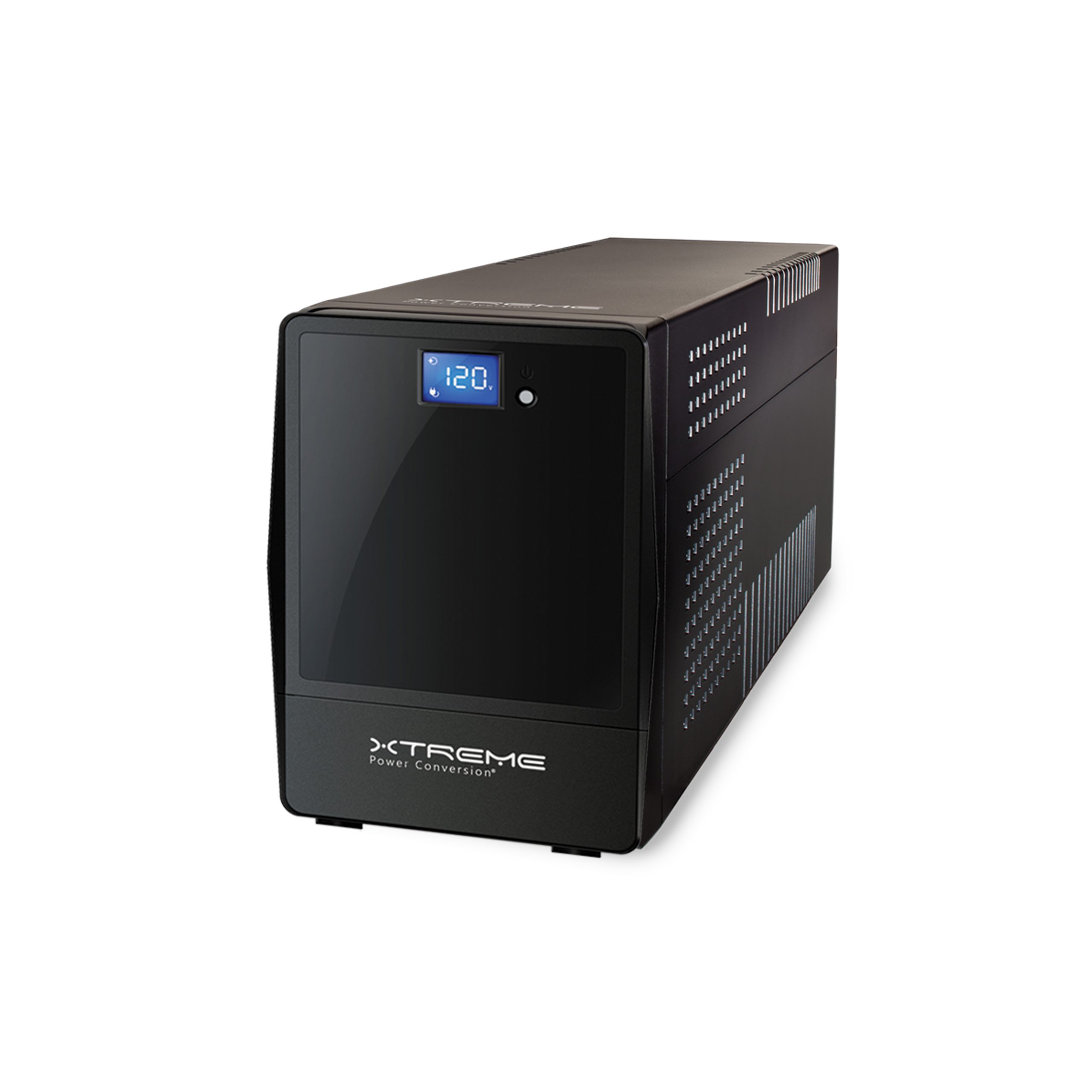
S71 line-interactive tower UPS
The Xtreme Power S71 Series is a line-interactive UPS for home, small office, and distributed environments where voltage instability and short-duration outages affect reliability. It provides battery backup during outages and automatic voltage regulation (AVR) to stabilize incoming power without transferring to battery — reducing battery wear while maintaining consistent output. In a compact tower with a touch LCD, sine-wave output on utility and simulated sine on battery, and standard TAA compliance under the Trade Agreements Act, it protects desktops, routers and switches, POS, AV, and small network systems.
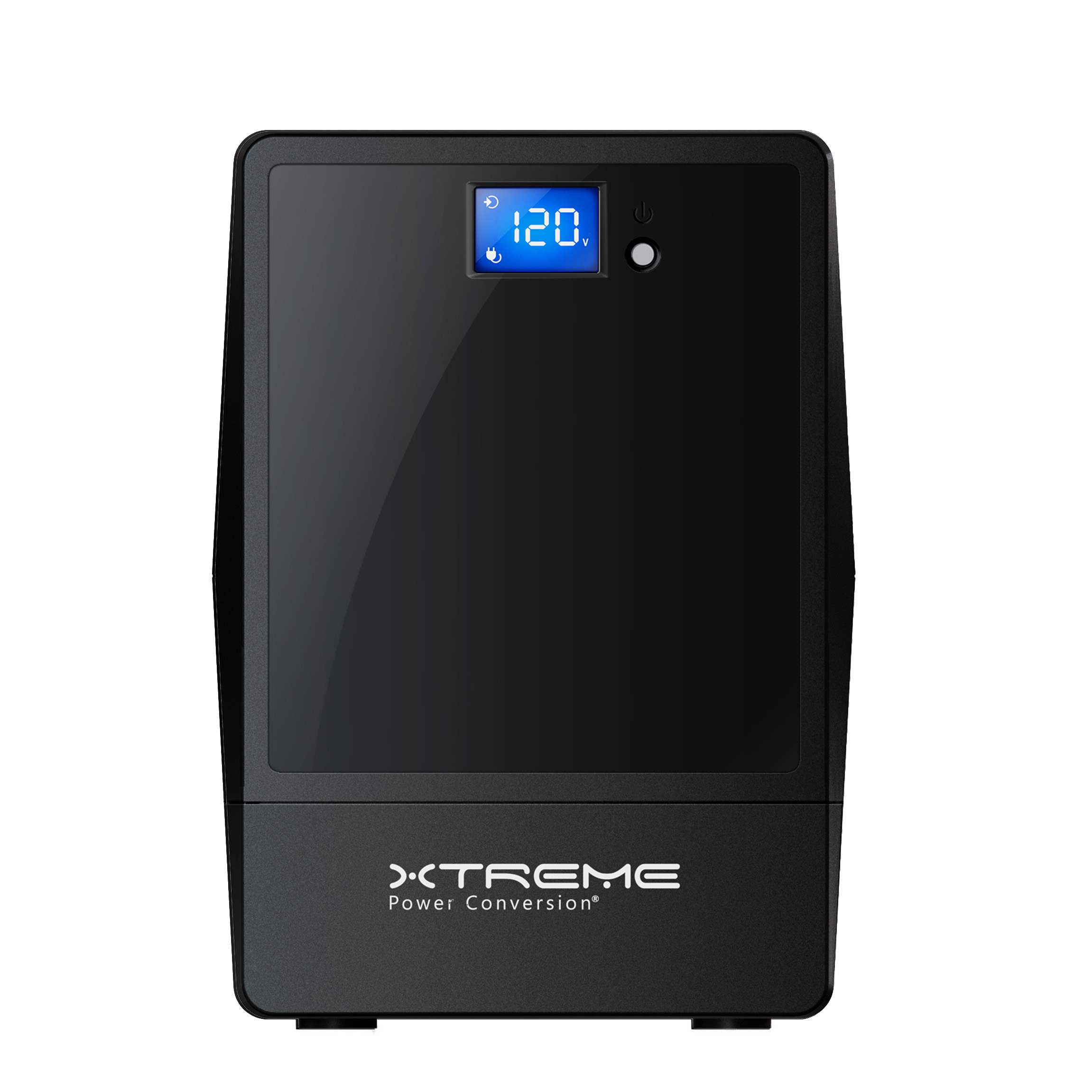
S71 line-interactive tower UPS — front-panel touch LCD showing live output voltage, shown in two capacities.
Voltage stability without online complexity
Power quality disturbances — voltage fluctuations, over-voltage, under-voltage, and blackouts — occur unexpectedly. When they do, the S71 activates to protect connected critical loads, from a desktop computer to a business telephone system. AVR corrects sags and swells without switching to battery, preserving battery life and maintaining stable output. That places the S71 in the line-interactive tier, which addresses five of the ten common power problems.
Installation is plug-and-play, providing backup power protection right out of the box. The touch LCD offers real-time monitoring of UPS parameters, while bundled shutdown and monitoring software enables UPS and remote device control over the network. This positions the S71 between standby UPS systems and online or lithium platforms — better power stability, while keeping deployment simple and cost-efficient.
What the S71 includes
Shows AC / battery mode, load and battery level, input and output voltage, overload, and low-battery alarms.
Corrects sags and swells without using battery; a wide input range means less battery use and longer battery life.
USB (HID) with bundled shutdown and monitoring software for plug-and-play setup and network management.
465-joule surge suppression plus RJ45 surge protection for devices connected to data lines.
Automatically restarts after a full battery discharge once utility power returns.
A $25,000 connected-equipment load-protection policy backs your attached devices.
The enhanced entry tier for distributed power
The S71 serves as the enhanced entry tier within the Xtreme Power distributed UPS architecture, bridging the gap between basic backup and higher-performance platforms.
Distributed UPS architecture comparison
The S71 improves voltage stability compared to standby UPS systems, while the P80 introduces rack-based deployment, pure sine wave output, and scalable runtime for structured IT environments.
| Feature | A60 (Standby) | S71 (Line-Interactive) | P80 (Rack UPS) |
|---|---|---|---|
| Topology | Standby | Line-interactive (AVR) | Line-interactive |
| Voltage regulation | None | AVR (buck/boost) | AVR (enhanced) |
| Output on utility | Sine (passthrough) | Sine wave | Pure sine wave |
| Output on battery | Simulated sine | Simulated sine wave | Pure sine wave |
| Battery usage | Frequent switching | Reduced (AVR stabilizes input) | Reduced |
| Runtime capability | Short | Short | Scalable (external battery options) |
| Form factor | Compact / desktop | Tower | Rackmount (2U) |
| Best use case | Basic backup | Distributed stability | Structured IT environments |
Compared to standby platforms, the S71 adds voltage regulation and reduces unnecessary battery transfers. Compared to online UPS systems, it provides a simpler, more efficient, and cost-effective solution where continuous power conditioning is not required.
Replace APC, Eaton, and Vertiv line-interactive UPS
The S71 is commonly deployed as a standardized replacement for line-interactive UPS platforms such as APC Smart-UPS (SMT series), Eaton 5P, and Vertiv Liebert PSI — supporting consistent deployment across distributed environments while adding TAA compliance and stable voltage regulation.
Three models, 700–1500 VA
| Model | Capacity | Outlets | Battery | Dimensions (W×D×H) | Weight | Cooling |
|---|---|---|---|---|---|---|
| S71-700 | 700 VA / 420 W | (4) 5-15R | (1) 12V 9Ah | 3.9 × 11.8 × 5.6 in | 11.2 lb | Convection |
| S71-1000 | 1000 VA / 600 W | (6) 5-15R | (2) 12V 7Ah | 5.1 × 12.6 × 7.1 in | 18 lb | Fan |
| S71-1500 | 1500 VA / 900 W | (6) 5-15R | (2) 12V 9Ah | 5.1 × 12.6 × 7.1 in | 23 lb | Fan |
Capacity guidance: 700 VA for small network devices and desktop equipment; 1000 VA for POS, AV, and distributed IT loads; 1500 VA for higher-load or multi-device environments. The S71-700 uses a removable 6 ft C13-to-5-15P cord (C14 inlet); the 1000 and 1500 use a 6 ft 5-15P cord.
Estimated runtime by load
| Model | 250 VA | 350 VA | 500 VA | 700 VA | 1000 VA | 1500 VA |
|---|---|---|---|---|---|---|
| S71-700 | 15 | 6 | 2 | <1 | — | — |
| S71-1000 | 22 | 12 | 6 | 3 | 1 | — |
| S71-1500 | 30 | 21 | 11 | 6 | 3 | 1.5 |
Runtimes in approximate minutes at the listed VA load. Actual runtime varies with battery age, temperature, and load. A dash indicates a load beyond that model’s rating. Size it with the UPS selector →
Built for home, office, and distributed environments
The tower form factor installs flexibly alongside equipment — on a desk, at a POS station, within an AV setup, or in a small network environment — without requiring rack infrastructure, suiting both new deployments and retrofits.
Reliable backup and protection for home-office and small-office setups.
Ride-through and AVR for desktop computers and edge equipment.
Protection for routers, switches, and small network closets.
Backup and voltage regulation for point-of-sale systems.
Stable power for AV systems, displays, and digital signage.
TAA-compliant protection for federal, state, and regulated installations.
S71 specifications
| Specification | Detail |
|---|---|
| Topology | Line-interactive with automatic voltage regulation (AVR) |
| Capacity | 700 / 1000 / 1500 VA (420 / 600 / 900 W) |
| Input | 120 VAC, 50/60 Hz (auto-sensing) |
| Output | 120 VAC, 60 Hz ± 1 Hz |
| Output waveform | Sine wave (utility / normal); simulated sine wave (on battery) |
| Transfer time | 4 ms (typical) |
| Battery | Sealed, maintenance-free lead-acid (VRLA); 4–6 h recharge to 90% |
| Battery configuration | S71-700: (1) 12V 9Ah · S71-1000: (2) 12V 7Ah · S71-1500: (2) 12V 9Ah |
| Receptacles | S71-700: (4) 5-15R · S71-1000 / S71-1500: (6) 5-15R |
| Surge protection | 465 joules; RJ45 data-line surge suppression |
| Communications | USB (HID); bundled shutdown & monitoring software |
| Display | Touch LCD (mode, load & battery level, input/output voltage, overload, low battery) |
| Cooling | Convection (S71-700); fan-cooled (S71-1000 / S71-1500) |
| Form factor | Tower |
| Operating temperature | 32–104°F (0–40°C) |
| Humidity / altitude | 0–90% RH; up to 11,500 ft |
| Approvals | UL, cUL, RoHS, TAA |
| Load protection policy | $25,000 connected-equipment protection |
| Warranty | 3-year electronics / 3-year battery (USA & Canada) |
| Included in box | Shutdown & monitoring software, USB cable, user manual |
When to consider lithium UPS platforms
For applications requiring longer lifecycle, reduced maintenance, or improved performance in high-temperature or space-constrained environments, lithium-based platforms may be considered. At the device level the most direct alternative is the J60 Series — longer battery lifespan, faster recharge, compact form factors, and operation at higher ambient temperatures. For rack-based or higher-power needs, lithium platforms such as P91 Li and J90 extend these benefits into structured IT environments.
S71 line-interactive UPS — frequently asked questions
Is the S71 a line-interactive or a standby UPS?
Line interactive. It adds automatic voltage regulation to the standby design, so it corrects sustained high and low line voltage using transformer taps instead of transferring to battery. On an unstable circuit that is the difference between a UPS that cycles its battery all day and one that does not, and it is why a line-interactive unit covers five of the ten common power problems rather than three.
What size S71 do I need?
Three models cover 700, 1000, and 1500 VA, at 420, 600, and 900 W. Add up the nameplate wattage of everything you intend to protect, then leave headroom. The watt rating is the binding constraint on this class, not the VA rating, because most modern loads have a power factor well below unity.
How much runtime does the S71 provide?
See the runtime table above for estimated minutes by load and model. The S71 is designed for ride-through and orderly shutdown of a workstation, POS terminal, or small network device, not extended backup. If runtime rather than voltage stability is the requirement, a lithium platform holds up better over the life of the installation.
What is the difference between the S71 and the V70?
Form factor, mainly. The S71 is a tower for desktops, counters, and back-of-house locations. The V70 is a short-depth rackmount unit for shallow wall-mount racks and equipment closets. Both are line interactive at 120 V and address the same five power problems.
Can the S71 run from a generator?
Not well, and this is the main limit of the topology. Engine generators vary output frequency as load changes, and a line-interactive UPS will often reject that as out of tolerance and run from battery until it is exhausted. If the site is generator-backed, specify an online double-conversion unit instead.
Does the S71 replace an APC, Eaton, or Vertiv line-interactive UPS?
Yes, in the same capacity band and the same applications. The comparison page linked on this page puts the S71 against the equivalent models from each of those lines on capacity, runtime, outlets, and warranty.
When should I look at a lithium UPS instead?
When the unit sits somewhere hot, somewhere hard to reach, or somewhere you do not want to be replacing batteries every three to four years. Lithium platforms hold up at elevated temperature and last far longer between service events, which usually matters more than purchase price across a distributed deployment.
Is the S71 TAA compliant?
Yes. The S71 is compliant with the Trade Agreements Act, alongside UL, cUL, and RoHS. That matters because TAA compliance is what makes a UPS eligible for federal, state, and many institutional procurement schedules, and it is not standard at this capacity and price point. If you are supplying government, education, or healthcare accounts, it is often the difference between being on the bid and being off it.
Documents and related links
Plan with confidence
The S71 Series provides a practical, architecture-aligned solution for environments where power quality issues are common but simplicity and cost efficiency remain priorities. Xtreme Power supports contractors, integrators, and infrastructure planners with standardized UPS platforms designed for real-world deployment.