
When selecting a UPS, it’s important to understand the difference between apparent power (kVA) and real power (kW). The Power Factor (PF) is the ratio between these two values, and it directly impacts how much usable capacity your UPS can deliver.
- Watts (kW): The real, usable power consumed by your equipment.
- Volt-Amperes (kVA): The total power drawn, including reactive power.
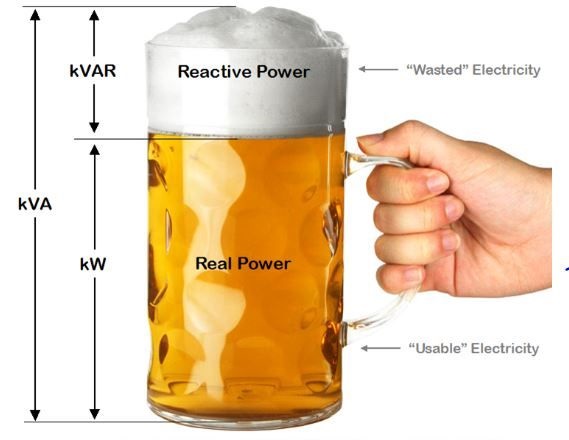
Visualizing power factor: kW is usable power, while kVA includes both usable power and overhead
A UPS must be sized to meet both kVA and kW ratings. If either value is exceeded, the UPS will overload. A simple way to visualize this is the “beer mug” analogy: kW represents the beer you drink, while kVA includes the beer plus the foam. The more real power (kW) you get, the better the efficiency and value.
Why Unity Power Factor Matters
Older UPS designs typically operated at a 0.8 PF. For example, a 20 kVA UPS with a 0.8 PF only provided 16 kW of usable power. This meant IT managers often had far less real capacity than expected.
Today’s power factor corrected IT equipment operates much closer to unity PF. To support these loads, modern UPS systems must deliver full kVA = kW output.
A 1.0 PF UPS ensures you get the maximum usable kW capacity from your UPS investment — improving efficiency by up to 25% compared to older 0.8 PF systems. This makes unity PF systems ideal for data centers, edge computing, enterprise IT, and high-density server rooms where every kilowatt counts.
Power Factor Comparison
| UPS Rating | Power Factor (PF) | Real Power Output (kW) | Example Models | Usable Capacity vs. 20 kVA |
| 20 kVA | 0.8 PF | 16 kW | Legacy UPS (older APC / Eaton / Vertiv) | 80% of capacity |
| 20 kVA | 1.0 PF (Unity) | 20 kW | XPC M90S-12S, Li90, M90C, M90U, X90-2S | 100% of capacity |
Key takeaway: A unity power factor UPS delivers full kVA as usable kW — giving you more IT load support, higher efficiency, and better ROI.

X90-2S 100 kW unity power factor UPS installed in an electrical room supporting high-capacity critical power infrastructure
XPC Unity Power Factor UPS Solutions
Xtreme Power Conversion provides a complete range of unity PF UPS systems designed for modern data centers, enterprise IT rooms, and edge computing environments:
- M90S-12S UPS – Compact, scalable design with unity PF output, ideal for server rooms and distributed IT.
- Li90 Lithium UPS – High efficiency lithium-ion UPS with extended battery life and compact footprint.
- M90C / M90U Modular UPS – Scalable, modular architecture for high-density data center UPS applications.
- X90-2S UPS – Next-generation UPS with 1.0 PF, advanced redundancy, and maximum availability.
- T91 UPS – Online, high efficiency 1.0 PF UPS designed for network, retail, and office applications.
- E91 UPS – Compact 3 phase UPS for critical applications
Each system is engineered to support power factor corrected IT loads, ensuring your UPS delivers the full performance you paid for.
Related UPS Applications
Unity PF UPS systems are ideal for:
- Data Center UPS – Optimize efficiency and maximize rack-level load support.
- Lithium-ion UPS for Schools – Long-life UPS solutions eligible for E-Rate funding.
- High Temperature UPS – Reliable backup in environments up to 50°C.
- Modular UPS Systems – Scalable power to grow with your business.
Ready to Maximize Your Power?
Don’t settle for outdated 0.8 PF UPS systems. With Xtreme Power’s unity power factor UPS lineup, you get the full kVA as usable kW, ensuring higher efficiency, more runtime per cabinet, and a better return on investment.
Talk to an Expert Today – Our team will help you size the right 1.0 PF UPS for your application.
Contact Us | View All Products
(800) 582-4524